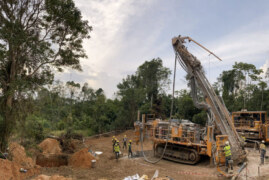
In the competitive world of aggregate production, flexibility is key. Projects vary in location, material type, capacity requirements, and final product specifications. Contractors and operators across Latin America increasingly rely on the mobile stone crusher not just for its mobility but for its adaptability to different working conditions. Whether crushing hard granite, recycled concrete, or river gravel, a mobile crusher must adjust quickly to maintain productivity and meet demand.
This article explores how to switch the working conditions of a stone crusher plant to suit various aggregate applications—without sacrificing efficiency, output quality, or uptime.
Understanding the Core Flexibility of Mobile Stone Crushers
Modular Configurations Enable Fast Adjustments
Modern mobile stone crusher units are designed with modularity in mind. Each functional component—feeder, crusher, screen, and conveyor—can be adjusted or replaced based on the material to be processed. For instance, when shifting from limestone to basalt, operators can swap out wear parts like jaw plates or install a more powerful secondary crusher to handle harder rock.
Because these modules are built to fit within the same frame or skid, modifications can be completed in hours rather than days. This kind of flexibility allows producers to use a single crusher plant across multiple sites or for various types of aggregates throughout the year.
Mobility Simplifies Access to New Worksites
Changing aggregate demand often means moving between different worksites. A mobile crusher’s design allows it to be relocated with ease, whether via flatbed trailer or track-mounted mobility. Relocation is streamlined when the plant includes hydraulic support legs, foldable conveyors, and plug-and-play wiring.
This ability to relocate and resume operation with minimal reinstallation work is crucial for contractors working on infrastructure or urban renewal projects across diverse geographic regions.

Adjusting Settings for Material Differences
Crusher Type and Speed Control
One of the easiest ways to adapt a stone crusher plant to different aggregate demands is by adjusting crusher type or rotation speed. For example, impact crushers are better for producing fine, uniform particles from softer rock, while jaw or cone crushers are ideal for primary crushing of harder materials.
Variable speed drives allow operators to optimize crushing efficiency for different feed sizes and material hardness. These settings can be pre-programmed or manually adjusted using on-board control panels or remote systems.
Screening and Output Size Modifications
Different construction applications require different output sizes—from coarse road base to fine concrete aggregate. To switch product types, operators can change the screen mesh or adjust the screen angle and vibration frequency. This ensures precise sorting of crushed materials without having to shut down the plant for major reconfiguration.
Advanced mobile crushers also feature multi-deck screens, enabling multiple product sizes to be produced simultaneously. This minimizes material handling and boosts productivity in diverse working environments.
Operational Strategies for Fast Transition
Material Pre-Testing and Planning
Before arriving on-site, operators can run test batches of the incoming raw material. By analyzing properties such as moisture content, compressive strength, and abrasiveness, the crushing team can make informed decisions about feed rates, crusher settings, and wear part selection.
This proactive approach minimizes downtime and ensures the mobile stone crusher starts operating at optimal efficiency from the moment it’s deployed.
Quick-Change Wear Parts and Maintenance Design
Wear parts—such as hammers, liners, and jaw plates—are among the most commonly replaced components when working conditions change. Crushers with easy-access maintenance panels and hydraulic lifting mechanisms make these part changes fast and safe.
Some advanced mobile units even include tool-free replacement systems or modular cartridge designs, which allow teams to perform swaps in the field without special equipment.
Embracing Automation for Smarter Adjustments
Intelligent Control Systems
Automated control systems enable real-time adjustments during crushing operations. These systems monitor input size, crusher load, and throughput to automatically adjust motor speed, feed rate, or hydraulic pressure. When switching from soft to hard material, for instance, the system can increase crushing force or reduce feed speed to prevent blockages.
This technology not only helps the stone crusher plant adapt to changing material conditions but also reduces wear and improves safety.
Remote Monitoring and Preset Programs
Some mobile stone crusher models offer remote diagnostics and cloud-based performance tracking. Operators can switch between pre-programmed modes for different materials—concrete recycling, natural rock, or sand production—with a single tap.
This capability is especially useful for companies managing multiple crusher units across regions, enabling centralized control and consistent product quality.
Conclusion
In today’s fast-paced construction and mining sectors, aggregate demands change rapidly—and equipment must keep up. The mobile stone crusher has evolved into a highly adaptable tool, capable of switching between working conditions with minimal downtime. Whether through modular configurations, smart controls, or efficient wear part replacement, a flexible stone crusher plant helps operators meet diverse material demands across a wide range of applications.
For Latin American contractors working on highways, urban infrastructure, or remote mining operations, adaptability isn’t optional—it’s a competitive advantage. And mobile crushers are leading the way.