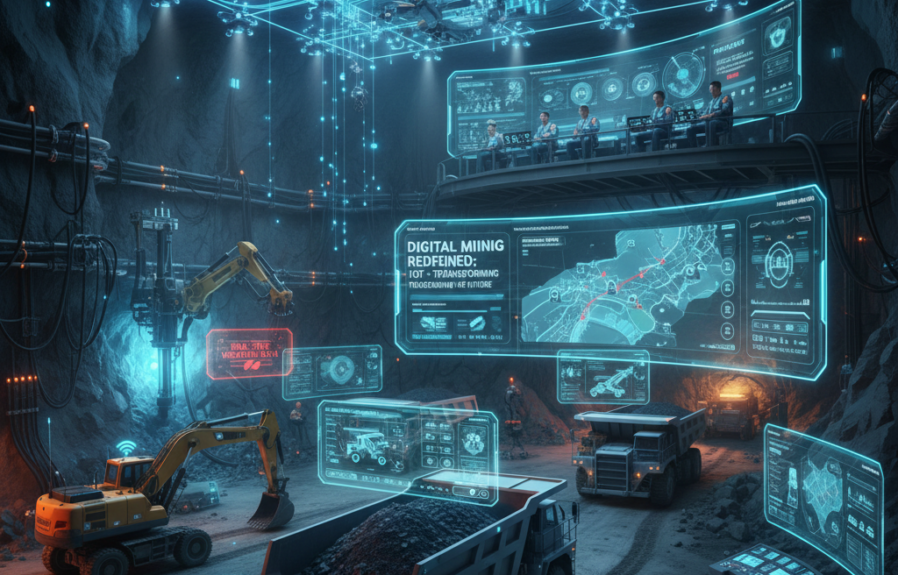
The mining industry is entering a new era—one defined by intelligence, connectivity, and data-driven operations. At the heart of this transformation lies the Internet of Things (IoT). As mining companies embrace digital mining strategies, IoT is redefining how operations are monitored, optimized, and safeguarded.
From the pit to the control room, IoT is turning mines into smart, connected ecosystems.
- Understanding IoT in the Mining Ecosystem
The Internet of Things (IoT) refers to a network of interconnected devices—sensors, machines, and software platforms—that continuously collect and exchange data. In mining, IoT acts as the digital backbone that connects equipment, workforce, and infrastructure in real time.
By integrating IoT into mining operations, organizations gain actionable insights that enable faster decisions, lower operational costs, improved safety, and enhanced sustainability. This convergence of data, automation, and analytics is a foundational pillar of digital transformation in mining.
- Why IoT Is a Game-Changer for Mining Operations
IoT adoption is not just a technological upgrade—it’s a strategic shift toward smarter, safer, and more sustainable mining.
- Safety Intelligence That Protects Lives
Mining environments are inherently risky. IoT-powered safety systems help mitigate these risks through continuous monitoring.
- Real-time tracking of worker location, health, and movement
- Sensors detecting gas leaks, temperature spikes, vibrations, and air quality
- Automated alerts enabling proactive intervention before incidents occur
IoT transforms safety from reactive to predictive—where prevention comes before response.
- Predictive Maintenance for Maximum Asset Reliability
Unplanned equipment failures can disrupt production and inflate costs. IoT-enabled predictive maintenance addresses this challenge head-on.
- Continuous monitoring of temperature, pressure, vibration, and load
- Early detection of wear and performance degradation
- Scheduled maintenance based on actual equipment health
This approach minimizes downtime, extends machinery lifespan, and ensures uninterrupted mining operations.
- Operational Optimization Through Real-Time Data
IoT delivers deep visibility into every layer of mining operations.
- Performance insights across equipment, material flow, and fuel usage
- AI-driven analytics to fine-tune productivity and resource utilization
- Automation of repetitive tasks using autonomous drills, loaders, and haulers
By leveraging real-time data, mining companies can operate leaner, faster, and smarter.
- Centralized Remote Monitoring and Control
IoT-powered mining software enables operators to oversee operations from centralized command centers or remote locations.
- Remote equipment control in hazardous or inaccessible sites
- Live dashboards displaying operational and environmental data
- Faster decision-making during critical events
This capability reduces on-site workforce exposure while ensuring round-the-clock operational continuity.
- Sustainability and Environmental Accountability
Environmental responsibility is no longer optional—it’s essential. IoT supports sustainable mining by monitoring and optimizing resource usage.
- Tracking water consumption, emissions, and energy utilization
- Ensuring compliance with environmental regulations
- Reducing waste through optimized processes and predictive maintenance
Smart mining is sustainable mining—and IoT makes it achievable.
- Key Applications of IoT in the Mining Industry
IoT applications in mining extend across equipment, infrastructure, workforce safety, and logistics.
Advanced Equipment & Process Monitoring
- IoT sensors integrated with Digital Twin technology and 4G connectivity
- Real-time tracking of equipment condition, trip cycles, and mine environment
- SCADA-enabled crushers and conveyors for continuous process health monitoring
Intelligent Fleet and Dispatch Management
- GPS-based tracking of vehicle location, speed, and fuel usage
- Operator Independent Truck Dispatch Systems (OITDS) to manage queuing and routing
- Reduced idle time and optimized haulage efficiency
Smart Load, Payload, and Material Tracking
- Payload sensors on Load Haul Dump (LHD) machines
- Accurate material tonnage data transmitted in real time
- Improved production planning and accountability
Fuel & Refueling Optimization
- IoT-based fuel level monitoring across mobile fleets
- Consumption pattern analysis to reduce wastage
- Optimized refueling schedules for higher productivity
Proximity, Location, and Collision Avoidance Systems
- Real-time tracking of personnel and equipment
- Proximity alerts near hazardous zones or moving machinery
- Automated vehicle stoppage to prevent collisions
Autonomous and Semi-Autonomous Mining Systems
IoT enables the rise of autonomous mining equipment:
- Self-driving trucks and automated drilling systems
- 24/7 operation with minimal human intervention
- Higher productivity, reduced human error, and lower labor risk
Autonomy powered by IoT is shaping the future of large-scale mining.
- Challenges Slowing IoT Adoption in Mining
Despite its advantages, IoT implementation in mining comes with challenges.
Connectivity Constraints in Remote & Underground Sites
Mining operations often occur in harsh, remote, or underground environments where network reliability is limited.
- Wireless communication disruptions impact real-time data flow
- High costs involved in deploying and maintaining network infrastructure
- Technical complexity in ensuring consistent connectivity
Overcoming these challenges requires robust communication strategies and scalable digital infrastructure.
- The Road Ahead: IoT as the Core of Digital Mining
IoT is no longer an emerging trend—it is a strategic necessity for modern mining operations. From enhancing safety and efficiency to driving sustainability and automation, IoT is reshaping the mining industry from the ground up.
Digital mining is not about replacing people—it’s about empowering decisions with intelligence.
As IoT technologies continue to evolve, mining companies that invest today will lead tomorrow’s resource-driven economy.