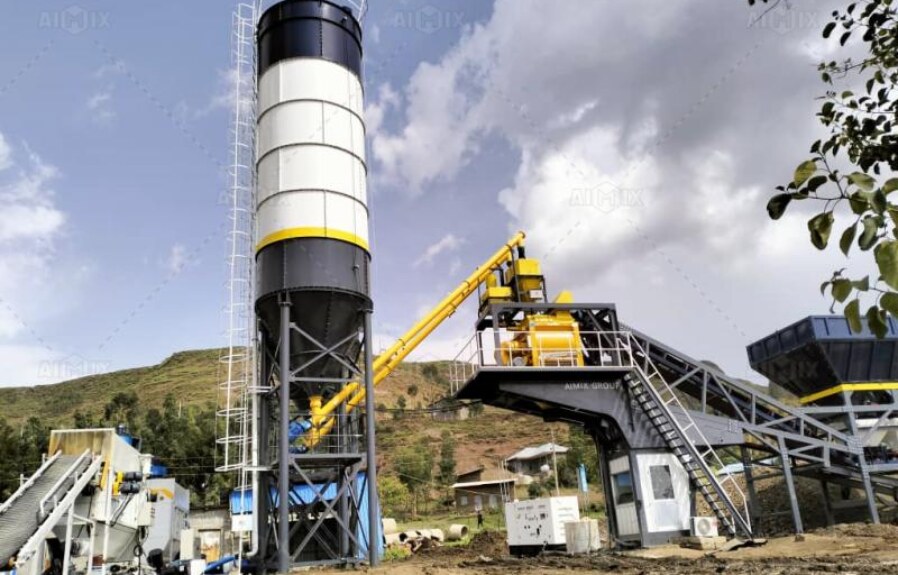
The mining industry relies heavily on durable infrastructure, including roads, processing facilities, and structural foundations, to ensure safe, efficient, and continuous operations. High-quality concrete is critical for these projects, but producing it on-site presents unique challenges due to the remote and often harsh conditions typical of mining environments. Mobile concrete batching plants have emerged as a practical and cost-effective solution, providing flexible, high-capacity concrete production directly at the mine site.
Challenges of Concrete Supply in Mining Projects
Mining projects are frequently located in remote areas, far from urban centers where concrete suppliers are typically based. Transporting concrete from off-site plants can be logistically difficult, time-consuming, and expensive. Long travel distances increase the risk of concrete setting during transit, leading to inconsistent quality and potential waste.
In addition, mine roads and processing facilities require large volumes of high-strength concrete capable of withstanding heavy machinery, vibration, and extreme weather conditions. Standard ready-mix solutions may not meet these specific requirements due to delays in transportation or lack of customized mix designs. Mobile concrete batching plants overcome these challenges by producing concrete on-site, ensuring consistent quality while minimizing delays and transportation costs.
Advantages of Mobile Concrete Batching Plants for Mines
1. On-Site Production: Mobile batching plants bring the plant directly to the construction site. For mine roads or processing facilities, this means concrete can be mixed as needed, reducing the risk of setting during transport and ensuring every batch meets design specifications. This flexibility is especially useful for projects with variable production schedules or multiple construction areas spread across the mine site.
2. Portability and Rapid Deployment: Mobile concrete batching plants are designed for quick setup and relocation. In mining operations, where construction activities may shift based on site expansion or new exploration areas, the ability to move the plant efficiently reduces downtime and avoids the need for multiple stationary plants.
3. Consistent Quality and Mix Control: Modern mobile plants are equipped with advanced control systems, allowing precise measurement of aggregates, cement, water, and admixtures. This ensures uniform mix quality, which is crucial for structures like mine roads that must support heavy haul trucks and processing equipment. Automated controls also minimize human error, maintaining compliance with structural specifications and safety standards.
4. Cost Efficiency: By producing concrete on-site, mobile batching plants reduce transportation costs, minimize material waste, and eliminate reliance on third-party suppliers. In the context of large-scale mining infrastructure, these savings can be substantial, helping companies manage budgets without compromising quality.
Applications in Mine Roads
Mine roads are critical for operational efficiency, allowing trucks, loaders, and other heavy machinery to transport ore and materials safely. These roads require concrete with high compressive strength, resistance to abrasion, and durability under heavy traffic loads.
Mobile concrete batching plants enable the timely production of high-quality concrete, customized for specific road sections. Engineers can adjust mix designs to account for soil conditions, climate variations, or load requirements, ensuring long-lasting pavement that reduces maintenance needs. The modular nature of mobile plants also allows parallel operations, producing multiple batches simultaneously for extensive road networks.
Furthermore, mobile batching plants facilitate the construction of reinforced concrete elements, including culverts, bridge decks, and drainage systems, which are often integral to mine road networks. With on-site production, these elements can be completed faster, supporting overall project timelines.
Applications in Processing Facilities
Processing facilities, including crushing plants, concentrators, and storage areas, demand concrete for foundations, slabs, and structural supports. The quality of these concrete components directly affects equipment stability, operational efficiency, and long-term facility durability.
Using mobile concrete batching plants, mining operators can produce large volumes of consistent, high-strength concrete tailored to facility requirements. Automated mix systems allow precise control of water-cement ratios, admixtures, and aggregate grading, which is critical for foundations subjected to heavy vibrations and high dynamic loads.
Additionally, mobile plants enable phased construction. As processing facilities expand or new production lines are added, the plant can be relocated within the site to provide fresh batches as needed, avoiding delays and ensuring consistent quality throughout the facility.
Sustainability and Environmental Benefits
Mobile concrete batching plants also offer sustainability advantages in mining operations. On-site production reduces the carbon footprint associated with transporting concrete from distant ready mix plants. Advanced dust collection and water recycling systems further minimize environmental impact.
By producing only the required amount of concrete for each project phase, mobile plants help reduce material waste and lower energy consumption, aligning with mining companies’ goals for more sustainable operations.
Conclusion
For mine roads and processing facilities, mobile concrete batching plants provide a flexible, cost-effective, and high-quality solution to meet the challenges of remote and demanding construction environments. By enabling on-site production, precise mix control, and rapid deployment, these plants ensure that mining infrastructure can withstand heavy traffic, vibration, and environmental stresses.
Companies leveraging mobile concrete batching plants benefit from reduced transport costs, minimized waste, and enhanced operational efficiency. Whether constructing mine roads, building foundations for processing facilities, or expanding operations to new areas, mobile batching plants deliver the reliability, scalability, and performance that modern mining projects demand.