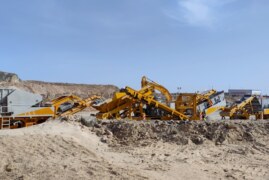
As the mining and construction industries evolve, so too do the machines that power them. Among the most notable equipment making waves across global markets is the mobile jaw crusher. Engineered for portability, flexibility, and performance, mobile jaw crushers are increasingly becoming the go-to solution for crushing needs across mining operations, infrastructure projects, and urban demolition sites. This article explores the emerging trends driving global demand, compares mobile and stationary options, and examines what this means for equipment buyers and suppliers alike.
Rising Demand in a Fast-Paced Industry
The construction and mining sectors continue to grow, especially in emerging economies in Southeast Asia, Africa, and Latin America. As projects expand into remote locations and urban redevelopment intensifies, the need for on-site crushing capabilities becomes paramount. Unlike traditional stationary crushing plants, which require fixed installations and longer setup times, mobile jaw crushers can be transported easily and set up with minimal infrastructure, reducing time and labor costs.
This demand for mobility is mirrored in government investments in infrastructure, especially road building, railway development, and large-scale mining operations. From remote quarries to inner-city construction sites, mobile crushers offer fast deployment and versatility—traits that modern construction and mining businesses value.
Technological Advancements Fueling Growth
One of the core trends in mobile jaw crusher development is integration with digital technology. Many leading models now come equipped with telematics, allowing operators and fleet managers to track fuel consumption, crushing output, wear part status, and machine health in real-time. These smart features not only boost operational efficiency but also support predictive maintenance planning, extending equipment life and reducing unexpected downtimes.
Moreover, advancements in engine design and energy-efficient hydraulic systems are helping reduce carbon footprints—an increasingly critical requirement as sustainability regulations tighten globally.
Mobile vs. Stationary: Making the Right Choice
While stationary crushing plants still dominate large-scale, fixed-location mining operations, mobile jaw crushers are increasingly closing the gap in performance. Thanks to improvements in engine power, crushing force, and feed capacity, modern mobile units now rival their stationary counterparts in output—especially when used in mid-scale or distributed work sites.
The choice between mobile and stationary comes down to project type and site logistics. For instance, large mining operations that extract material from a central location may still opt for stationary crushers. But for short-term construction projects, quarry rehabilitation, or multiple job sites, the mobile jaw crusher offers unmatched flexibility and lower setup costs.
Rental Markets and Cost Considerations
The rise of equipment rental and leasing markets has also boosted mobile crusher adoption. Many companies now prefer renting a mobile unit for specific jobs rather than investing in stationary infrastructure. This trend is especially prevalent among small to medium-sized contractors seeking to reduce upfront capital expenditure.
Moreover, mobile jaw crushers have become more cost-competitive. With the growing number of mining equipment suppliers entering the market, price points are more accessible, and customization options have expanded. Buyers can now choose from basic units to advanced models with remote controls, integrated screens, and hybrid power systems.
Regional Trends and Supply Chain Shifts
In Asia-Pacific, China remains a leading producer and consumer of mobile crushers, with exports reaching Southeast Asia, the Middle East, and Africa. In contrast, Europe and North America are seeing a rise in demand for electric and hybrid models, driven by stricter emissions standards and government green mandates.
Global supply chains are also adapting. Many mobile jaw crusher manufacturers are establishing regional assembly hubs and local service centers to reduce lead times and provide faster technical support—a critical selling point for contractors working on tight deadlines.
Future Outlook
Looking ahead, the mobile jaw crusher market is expected to grow steadily over the next decade, with CAGR projections between 4–6% depending on the region. The biggest growth drivers will continue to be:
-
Infrastructure expansion in developing countries
-
Rising interest in mobile and modular crushing equipment
-
Stricter environmental compliance standards
Innovation will also play a key role. We can expect to see further integration with AI-based systems for automation, improvements in material durability, and enhancements in compact design for urban environments.
Conclusion
The mobile jaw crusher has become more than just a portable alternative to fixed plants—it’s a central player in the evolving landscape of global mining and construction. With advantages in flexibility, technology, and cost-efficiency, it’s no surprise that demand continues to climb. Whether you’re a stationary crushing plant operator looking to diversify or a mining equipment supplier preparing for future trends, keeping an eye on mobile crusher development is essential for staying competitive in today’s dynamic markets.