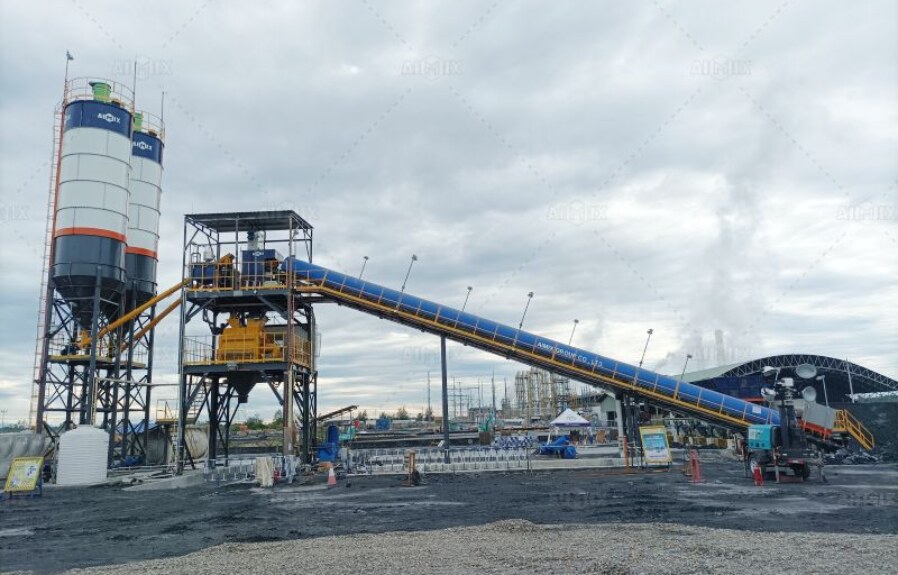
As mining operations expand in scale and complexity, the demand for a stable, high-capacity concrete supply becomes increasingly critical. From haul roads and processing plant foundations to retaining structures and worker facilities, concrete is a core input that directly affects construction schedules and operational continuity. For growing mining businesses, a stationary concrete batching plant is not just a production asset—it is a strategic investment that supports scalability, cost control, and long-term expansion.
Growing Concrete Demand in Expanding Mining Operations
Mining projects rarely remain static. Initial exploration phases often evolve into full-scale extraction, beneficiation, and logistics operations. As output increases, so does the need for durable infrastructure: thicker pavements for heavy trucks, larger crushing and screening platforms, expanded stockyard foundations, and additional processing buildings. Relying on external ready-mix suppliers becomes increasingly inefficient as volumes rise and project timelines tighten. A stationary concrete batching plant provides on-site, continuous concrete production, ensuring that infrastructure expansion keeps pace with mining growth without supply bottlenecks.
High-Capacity Design for Long-Term Growth
One of the key advantages of a stationary concrete batching plant is its ability to support high and consistent production capacity. Unlike mobile plants, which are optimized for flexibility and short-term deployment, stationary systems are designed for sustained output over many years. For mining businesses planning phased expansion, plants can be selected with reserve capacity or modular layouts that allow additional mixers, silos, or aggregate bins to be added later. This scalability enables operators to match concrete output with mining production increases, avoiding premature equipment replacement.
Integration with Crushing and Aggregate Systems
Mining operations often have direct access to raw materials suitable for concrete production. A stationary concrete batching plant can be seamlessly integrated with on-site crushing and screening lines, allowing processed aggregates to flow directly into the batching system. This integration reduces transportation costs, minimizes material handling losses, and improves quality control by keeping aggregate gradation consistent. As mining businesses expand their crushing capacity, the batching plant can be adjusted to accommodate higher aggregate throughput, reinforcing a vertically integrated production model.
Operational Stability and Process Control
As mining sites grow, operational stability becomes more important than short-term flexibility. Stationary concrete batching plants are typically equipped with advanced automation and control systems that ensure precise batching, repeatable mix designs, and consistent quality. For large mining projects with strict engineering standards, this reliability is essential. Stable concrete quality reduces rework, enhances structural durability, and supports long-term operational safety. Over time, these benefits compound, making expansion smoother and more predictable.
Cost Efficiency Through Economies of Scale
Scalability is closely tied to cost efficiency. A stationary concrete batching plant allows mining businesses to benefit from economies of scale as production volumes increase. Fixed assets such as foundations, control rooms, and material storage facilities are amortized over larger output, lowering the unit cost of concrete. In addition, using site-produced aggregates and bulk cement procurement further reduces operating expenses. For expanding mining operations, these savings can be reinvested into additional processing capacity, environmental controls, or workforce development.
Supporting Remote and Long-Life Mining Projects
Many mining operations are located in remote areas where external concrete supply is unreliable or prohibitively expensive. A stationary concrete batching plant provides autonomy and supply security, which is especially valuable for long-life mines with expansion plans spanning decades. As new pits, processing units, or infrastructure zones are developed, the batching plant remains a central production hub. Its permanent installation aligns with the long-term nature of mining investments, offering a stable platform for ongoing expansion.
Environmental and Compliance Advantages During Expansion
Expansion often brings stricter environmental and regulatory scrutiny. Modern stationary concrete batching plants are designed with dust collection systems, enclosed conveyors, and water recycling features that help mining businesses meet environmental requirements. As production scales up, these systems can be upgraded or expanded to maintain compliance. Moreover, the ability to use recycled aggregates or optimized mix designs supports sustainability goals, which are increasingly important for mining companies seeking permits and community acceptance.
Strategic Asset for Future-Proof Growth
For growing mining businesses, scalability is not just about increasing output—it is about building resilient systems that can adapt to future demands. A stationary concrete batching plant supports this objective by offering capacity expansion, integration flexibility, and long-term operational stability. It becomes part of the mine’s core infrastructure, enabling smoother project execution and reducing dependence on external suppliers. As mining operations evolve, the batching plant evolves with them, reinforcing a foundation for sustainable and profitable growth.
In an industry where expansion is both an opportunity and a challenge, investing in a stationary concrete batching plant provides mining businesses with the control, scalability, and efficiency needed to support long-term development.