Mining has never been an easy industry.
Even with modern equipment, experienced workers, and strict safety protocols, accidents still happen. A single missed helmet, an unnoticed gas leak, or one distracted forklift operator can lead to injuries, operational shutdowns, or even fatalities.
Now imagine a mining site where cameras don’t just record footage — they actively detect danger before humans notice it.
That’s exactly what AI-powered computer vision is starting to do.
And honestly, this is one of the few AI trends that feels less like hype and more like something the industry genuinely needs.
The Real Problem With Traditional Mine Safety
Most mining companies already have:
- CCTV cameras
- Safety checklists
- Manual inspections
- Compliance officers
- Worker training programs
But here’s the issue:
Traditional safety systems are mostly reactive.
They help investigate accidents after they happen rather than stopping them in real time.
For example:
- A supervisor may notice missing PPE too late.
- A worker entering a restricted zone may go unnoticed.
- Heavy vehicles may operate in blind spots.
- Fatigue or unsafe behavior can be missed during long shifts.
In large mining environments, monitoring everything manually is almost impossible.
That’s where computer vision changes the game.
So, What Exactly Is Computer Vision in Mining?
Computer vision is a branch of AI that allows machines to “see” and analyze visual data from cameras.
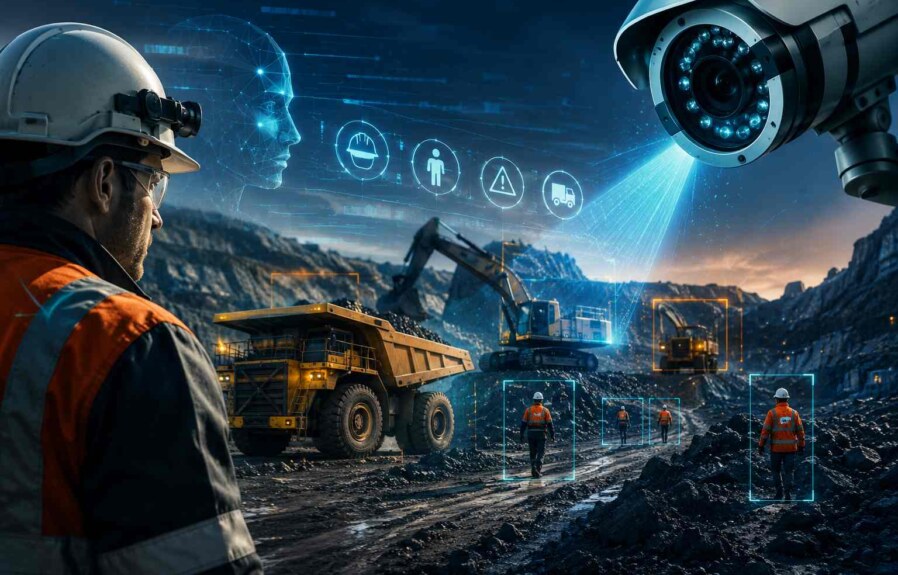
Instead of simply recording video footage, AI models can:
- Detect people and vehicles
- Identify unsafe behavior
- Recognize protective equipment
- Track movement patterns
- Trigger alerts instantly
Think of it as a 24/7 digital safety supervisor that never gets tired.
How AI-Powered Mine Safety Systems Actually Work
Here’s the practical side most articles skip.
A typical AI mine safety system combines:
Smart cameras
Edge devices or cloud AI models
Real-time analytics
Alert systems
Dashboards for supervisors
The AI continuously scans live footage and looks for predefined safety risks.
The moment it detects a violation, it sends alerts immediately.
For example:
Worker without helmet → instant alert
Person near dangerous machinery → warning notification
Vehicle speeding in restricted area → automated flag
Worker collapse detection → emergency response trigger
The goal is simple:
Prevent small mistakes from becoming major accidents.
Real Use Cases of Computer Vision in Mining
1. PPE Detection
This is one of the most common and practical use cases.
AI cameras can detect whether workers are wearing:
- Helmets
- Reflective jackets
- Gloves
- Safety goggles
- Face masks
Instead of relying only on supervisors, the system continuously monitors compliance automatically.
And unlike humans, AI doesn’t get distracted after 10 hours on shift.
Why Mining Companies Are Investing in AI Safety Systems
The obvious reason is worker safety.
But there’s also a major business reason behind this shift.
Mining accidents are expensive.
Not just because of compensation claims, but because accidents can cause:
- Production shutdowns
- Regulatory penalties
- Equipment damage
- Insurance increases
- Reputation loss
Even a small operational delay can cost mining companies millions.
AI safety systems help reduce:
- Human monitoring limitations
- Delayed response times
- Manual inspection dependency
- Safety compliance gaps
In many cases, preventing just one major incident can justify the entire AI investment.
But Can AI Completely Prevent Mining Accidents?
No.
And that’s important to say clearly.
AI is not replacing human judgment, safety culture, or operational training.
What it does exceptionally well is:
- Continuous monitoring
- Real-time detection
- Pattern recognition
- Fast alerts
- Data analysis at scale
The best results happen when AI supports human decision-making instead of replacing it.
Think of it this way:
Mining teams still make the decisions.
AI simply helps them notice risks faster.
The Biggest Challenges Mining Companies Face
Despite the benefits, implementation is not always simple.
Harsh Environments
Dust, low lighting, vibrations, and underground conditions can affect camera performance.
Connectivity Issues
Remote mining sites may struggle with cloud connectivity.
Privacy Concerns
Workers may initially feel uncomfortable with AI monitoring systems.
False Alerts
Poorly trained AI models can create unnecessary warnings.
That’s why successful mining AI systems require:
- High-quality training data
- Custom AI models
- Proper camera placement
- Continuous optimization
A generic AI solution rarely works perfectly in mining environments.
The Future of AI in Mine Safety
The industry is moving beyond basic surveillance.
The next generation of mining safety systems will likely include:
- AI-powered digital twins
- Autonomous safety inspections
- Drone-based hazard monitoring
- Predictive accident analytics
- Wearable AI safety devices
- Multi-camera behavioral analysis
Eventually, mining companies may shift from “accident response” to “accident prediction.”
And that’s where things get truly interesting.
Final Thoughts
Computer vision will not eliminate every mining accident.
But it can dramatically reduce preventable ones.
That matters because most mining incidents are not caused by one catastrophic failure. They usually start with small risks that go unnoticed:
- Missing PPE
- Unsafe movement
- Delayed reactions
- Human fatigue
- Blind spots
AI-powered mine safety systems and advanced mining industry software solutions help identify those risks before they escalate.
In an industry where every second matters and every decision affects human lives, that’s not just operational improvement.
It’s a fundamental shift in how mining safety works.