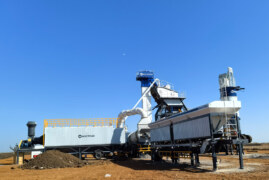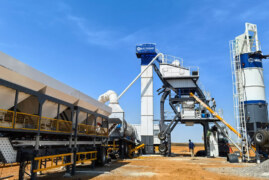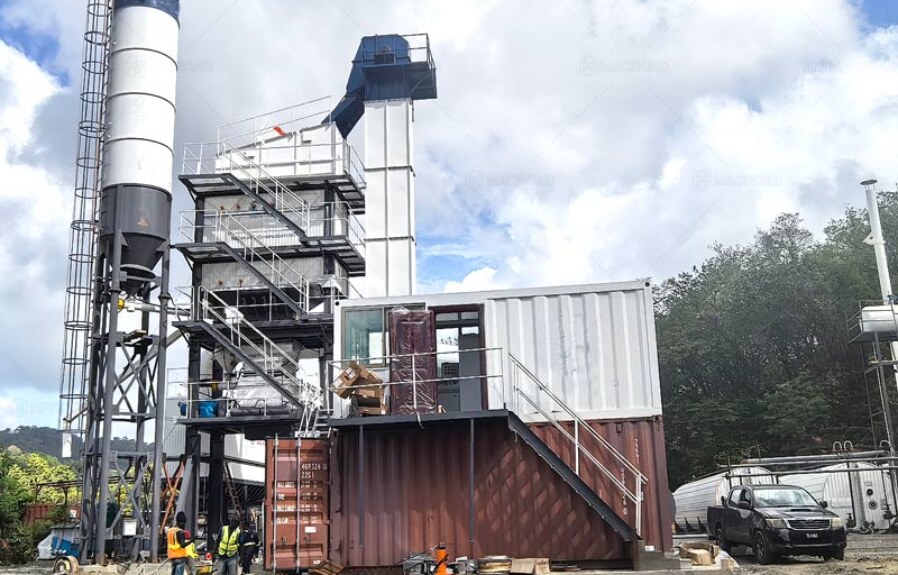
Engineering auditors evaluating an asphalt batching plant for sale against industrial EPC environmental compliance checklists who accept general burner efficiency claims without demanding thermodynamic performance documentation are leaving the compliance verification process incomplete at precisely the specification layer that regulatory audits interrogate most rigorously. Multi-fuel burner thermodynamic efficiency data and aggregate drying flight design documentation are not supplementary technical annexes — they are the engineering evidence that distinguishes a compliant asphalt mixing plant configuration from one whose hydrocarbon volatile emission profile will fail industrial site environmental approval regardless of how competitive the equipment price appeared during EPC tender evaluation.
Thermodynamic Efficiency Data Engineering Auditors Must Demand From Burner Systems
Multi-fuel burner systems on an asphalt batching plant for sale generate thermodynamic performance data across multiple fuel types and firing rate conditions — and EPC compliance auditing requires this data in a form that industrial environmental review can evaluate against site-specific emission limit values rather than manufacturer marketing figures. The primary data categories that engineering auditors must demand are net thermal efficiency curves mapped against firing rate percentage across the full operational range, excess air coefficient values at each fuel type’s stoichiometric combustion point, and carbon monoxide emission concentration at minimum, design, and peak firing conditions.
Net thermal efficiency curves reveal whether the burner maintains combustion quality across the variable firing rates that aggregate moisture fluctuation imposes during continuous production — a compliance-critical characteristic because burner efficiency degradation at reduced firing rates produces carbon monoxide and unburned hydrocarbon emissions that stack testing captures as regulatory exceedances. An asphalt batching plant for sale whose burner documentation provides efficiency figures only at design load is presenting best-case combustion performance without confirming that off-design operation — which constitutes a significant portion of real production time — remains within compliance boundaries.
Excess air coefficient documentation confirms that combustion stoichiometry is controllable across fuel type transitions on multi-fuel configurations. Insufficient excess air produces fuel-rich combustion with elevated hydrocarbon emission; excessive excess air reduces flame temperature and increases nitrogen oxide formation while wasting thermal energy. Engineering auditors evaluating an asphalt mixing plant for EPC compliance must confirm that the burner control system maintains excess air coefficient within the range that both combustion completeness and emission limit compliance require — not at a fixed factory calibration point that field conditions will shift.
How Advanced Flight Design Mitigates Hydrocarbon Volatile Emissions
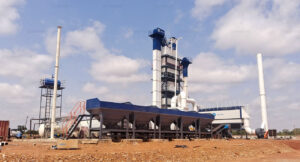
Aggregate drying flight geometry within the asphalt batching plant for sale dryer drum directly influences hydrocarbon volatile emission through its control of aggregate curtain density, residence time distribution, and the thermal contact uniformity that determines whether moisture evaporation is complete before aggregate reaches temperatures where residual organic compounds volatilize into the exhaust stream. Standard lifting flight designs that generate inconsistent aggregate curtains at variable throughput rates create hot zones between curtain paths where drum shell and flight steel surfaces exceed aggregate temperature — conditions that accelerate hydrocarbon volatile generation from aggregate surface organic matter without providing the thermal mass that would oxidize these compounds before exhaust exit.
Advanced flight designs on a compliant asphalt mixing plant chassis address this mechanism through closer flight spacing and modified flight profile geometry that maintains curtain coverage continuity across the throughput range the plant will actually operate at — not only at peak rated output where standard flight geometry was originally optimized. Specifically, engineering auditors should request the flight layout drawing and curtain density calculation at minimum, design, and peak throughput conditions — confirming that hot zone formation is prevented across the full operating range rather than only under the steady-state production scenario that compliance testing typically uses.
Flight material specification interacts with volatile emission management through the surface temperature differential that high-conductivity flight steel maintains against aggregate contact temperature. Chromium-carbide overlay flights whose thermal mass and conductivity characteristics differ from standard mild steel alter the heat transfer relationship at the aggregate-flight contact zone — a specification variable that emission-focused engineering auditors should confirm against the burner temperature profile at the drum section where volatile generation risk is highest.
Conclusion
Engineering auditors demanding EPC compliance evidence from an asphalt batching plant for sale must require multi-fuel burner thermodynamic efficiency curves across the full firing range, excess air coefficient documentation at each fuel type, and advanced flight layout drawings with curtain density calculations at variable throughput — because an asphalt mixing plant whose compliance evidence is limited to design-point performance data is presenting regulatory approval documentation that field production conditions will contradict at the first independent emission audit.