MINING SERIES – Part 8
Turning Cost Data into Cost Control Across the Project Lifecycle
Mining projects involve multiple cost centres, departments, contractors, equipment, materials, and activities. A project may begin with an approved budget, but costs can change as procurement requirements shift, project scopes evolve, equipment needs increase, or maintenance work becomes necessary.
The challenge is not simply recording these expenses. The real challenge is knowing where the money is going, how actual costs compare with the plan, and where corrective action is required.
This is where job costing within a mining ERP system becomes important.
From Budget to Actual Cost: Why Job Costing Matters in Mining
Job costing tracks expenses against a specific project, activity, or job rather than looking at expenditure only at an overall financial level.
For a mining organisation, this can bring together:
- Labour and workforce costs
- Materials and procurement expenses
- Equipment and maintenance costs
- Contractor and subcontractor costs
- Direct and indirect overheads
- Project variations
- Capital expenditure
- Exploration-related costs
When these costs remain scattered across finance, procurement, inventory, maintenance, and project records, it becomes difficult to establish the true cost position of a project.
An integrated ERP approach connects these areas and provides a more structured view of:
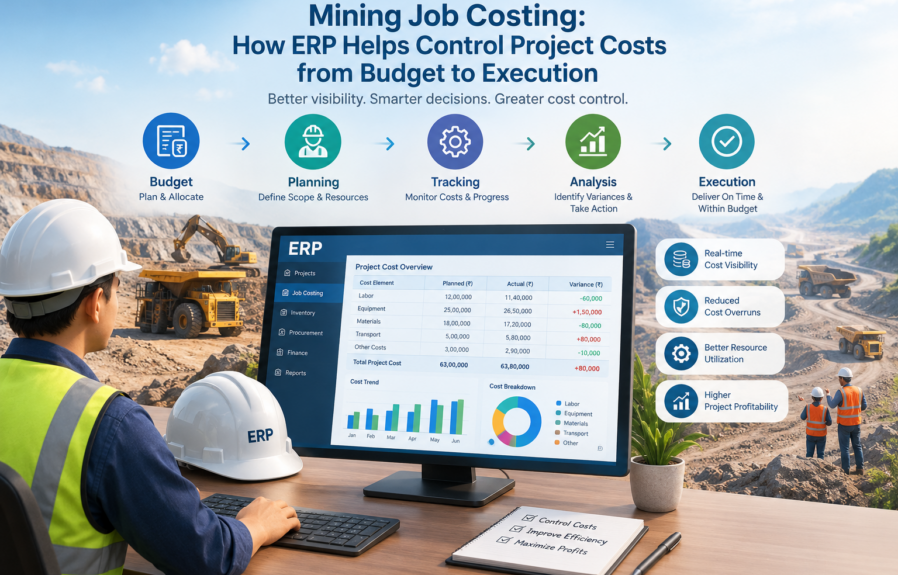
Budget → Committed Cost → Actual Cost → Variance → Forecast
This allows management to identify deviations earlier instead of discovering them only after the project is completed.
Where Does Mining Job Costing Become Critical?
Mining organisations manage different types of projects simultaneously. Exploration, mine development, capital projects, maintenance shutdowns, and equipment rebuilds can each have different cost structures.
A mining-focused job costing system therefore needs to support more than basic accounting.
1. Budget Planning and Cost Control
Effective cost control begins before the project starts.
Budget preparation may require inputs from HR, procurement, inventory, and finance. Labour rates, material requirements, supplier quotations, indirect expenses, and other anticipated costs need to be brought together to establish a realistic project budget.
Once approved, the budget should provide a clear baseline against which actual expenditure can be measured.
A structured system can help maintain:
- Planned project costs
- Labour allocations
- Material and procurement estimates
- Indirect and miscellaneous expenses
- Budget revisions
- Actual vs. estimated cost comparisons
This creates a consistent reference point throughout project execution.
2. Capital Projects and AFE: Controlling Major Expenditure
Capital projects can involve significant expenditure and therefore require stronger financial governance.
A mining ERP can support this process by assigning unique project identifiers, maintaining budget revisions, and routing expenditure approvals according to organisational hierarchies.
The connection between project costing and fixed-asset accounting is also important.
Once a capital project is completed, its eligible costs can move from the project or construction-in-progress stage into fixed assets for subsequent accounting and depreciation.
This creates a more traceable journey:
Project Approval → Expenditure → Project Costing → Completion → Fixed Asset
3. Exploration and Tenement Cost Management
Exploration projects have their own cost and reporting requirements.
Costs may need to be classified according to project type and appropriately allocated between capitalised and non-capitalised expenditure.
When project costing is integrated with the General Ledger, organisations can reduce manual reconciliation and maintain clearer visibility of how exploration expenditure is being treated financially.
This is particularly relevant where multiple exploration activities or tenements are being managed simultaneously.
4. WBS-Based Project Cost Tracking
Knowing the total cost of a mining project is useful—but knowing where that cost is being generated is even more valuable.
Work Breakdown Structure (WBS) integration allows a project to be divided into smaller activities or work packages.
For example: Mining Project
Site Development → Equipment → Materials → Labour → Contractors → Maintenance → Other Project Costs
Costs can then be associated with the appropriate project structure rather than being recorded only at a broad organisational level.
This provides greater visibility into project progress and financial performance and helps management identify areas where actual expenditure is moving away from the original plan.
5. Managing Variations and Contractors
Mining projects rarely remain completely unchanged from the original scope.
Additional work, changing requirements, contractor variations, or operational challenges can affect the final project cost.
If these changes are not properly recorded, the original budget may no longer provide a realistic picture of project performance.
A structured job costing system can therefore connect:
Original Budget → Variation Request → Approval → Revised Budget → Actual Cost
Contractor quotations, progress updates, and related project expenditure can also be brought into the same cost view.
This helps distinguish between the original planned cost and the current expected cost of the project.
6. Maintenance Shutdowns: Knowing the Cost of Downtime
Planned shutdowns are an important part of mining equipment maintenance.
However, shutdown costs can extend beyond a single maintenance invoice. They may include work orders, labour, spare parts, external services, and other associated expenses.
Job costing can bring these costs together under the shutdown activity.
This enables teams to compare:
- Planned shutdown cost
- Actual expenditure
- Work completed
- Additional work identified
- Final shutdown cost
Post-shutdown analysis can then provide useful information for planning future maintenance activities and budgets.
7. Rotable Components and Rebuild vs. Replace Decisions
High-value components such as engines and other equipment parts can have significant lifecycle costs.
When a component requires attention, mining organisations may need to determine whether rebuilding or replacing it is more appropriate.
An integrated job costing and maintenance system can capture:
Component → Maintenance History → Internal Costs → External Rebuild Costs → Total Lifecycle Cost
This creates a better financial basis for evaluating rebuild and replacement decisions.
It also connects equipment maintenance history with actual expenditure rather than treating each repair as an isolated transaction.
The Bigger Picture: Connecting Operational and Financial Data
The real value of mining job costing comes when financial information is connected with operational information.
Instead of having separate records across:
Finance | Procurement | Inventory | HR | Maintenance | Projects
an integrated mining ERP can bring these processes into a connected environment.
This allows management to move from simply asking:
“How much have we spent?”
to more useful questions:
- Where has the expenditure occurred?
- How does actual cost compare with the approved budget?
- Which project activities are creating the largest variance?
- How much has already been committed?
- What additional expenditure is expected?
- Which equipment or maintenance activities are increasing project cost?
These questions turn cost data into information that can support operational and financial decision-making.
From Cost Recording to Cost Control
Job costing should not be viewed simply as another accounting function.
For mining organisations, its value lies in creating visibility across the project lifecycle—from initial budgeting and approvals through procurement, execution, maintenance, variations, and final project accounting.
A mining ERP with integrated project cost management can help establish a continuous cost-control cycle:
Plan → Allocate → Execute → Track → Compare → Identify Variance → Act
As mining projects become more complex, having a connected view of project expenditure becomes increasingly important.
The objective is not only to record what a project has already cost, but to provide the visibility required to understand where costs are moving, why they are changing, and how they can be better controlled.