MINING SERIES – Part 10
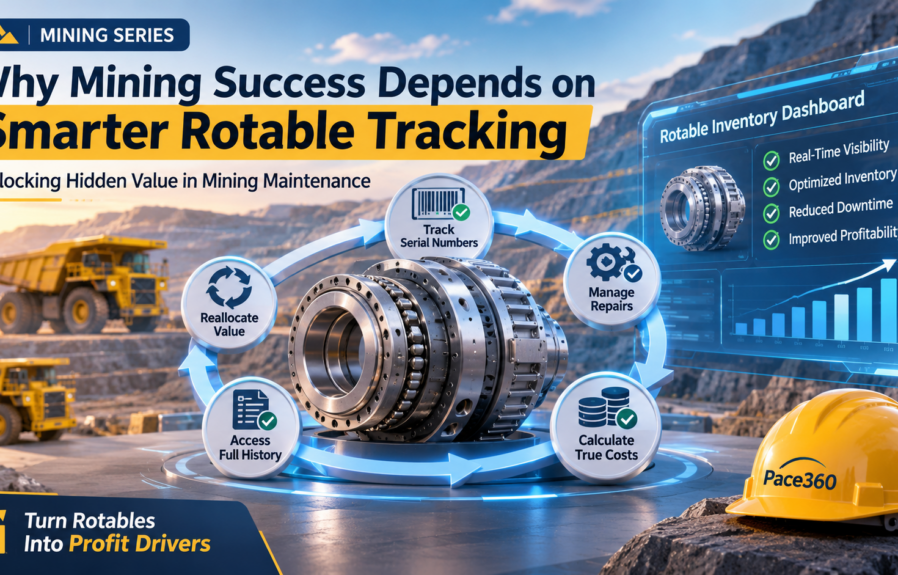
Why Mining Success Depends on Smarter Rotable Tracking
In mining, conversations around maintenance usually revolve around labor, schedules, and consumables. But there’s a less obvious factor that directly influences profitability—Rotable Inventory Management.
While most ERP systems claim to handle inventory, very few are equipped to manage rotables effectively—and that gap can cost millions.
Understanding Rotables: The Capital Assets You Can’t Ignore
Rotables are high-value components—engines, transmissions, pumps—designed to be repaired, reused, and cycled through multiple machines.
They’re not disposable. They’re not always new. But they are assets with significant capital value. Poor tracking means poor costing—and ultimately, wasted money.
The Cost of Neglect: Where Value Disappears
When rotables aren’t managed properly, common issues arise:
- Duplicate purchasing of parts already under repair.
- No visibility into serial numbers or reconditioned status.
- Maintenance costs recorded inaccurately—sometimes at zero value.
- Asset values misrepresented in financial reporting.
The result? Companies either undervalue assets or overspend on unnecessary replacements—both of which damage margins.
What Efficient Rotable Management Looks Like
A mining-focused ERP like Pace360 goes beyond basic inventory control to provide true lifecycle visibility of high-value components. It allows you to:
- Track Serial Numbers across installations, removals, and repairs.
- Manage Repair Workflows with QA holds, rework tracking, and cost allocation.
- Calculate Precise Costs for each serial number—avoiding reliance on averages.
- Access Full Component Histories across all equipment and assets.
- Reallocate Repair Costs Back To Inventory instead of misclassifying them as expenses.
With Pace360, you gain clear insights into what each component is worth, where it is in its lifecycle, and when it will return to service—eliminating guesswork and improving cost control.
Turning Rotables Into Profit Drivers
When managed correctly, rotables transform from cost drains to value generators. The benefits include:
- Eliminating unnecessary purchases through repair-first strategies.
- Cutting downtime with real-time availability insights.
- Delivering accurate maintenance cost reporting.
- Extending equipment life with documented reconditioning cycles.
- Enhancing capital efficiency through controlled asset utilization.
Why Many ERP Systems Fall Short
Most ERP platforms are built for manufacturing or general inventory—not the complex rotable life cycle in mining. Effective management requires:
- Serial traceability to follow each component.
- Asset linkage to track where parts have been installed.
- Repair loop costing to capture and reallocate true repair expenses.
Without these capabilities, companies end up patching gaps with spreadsheets—or bleeding value with every component swap.
Final Word
Rotable inventory isn’t just a maintenance detail—it’s a financial lever. With the right ERP approach, mining companies can achieve cost recovery, capital efficiency, and operational readiness—turning overlooked components into a strategic advantage.