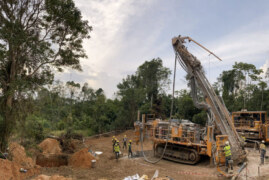
To reduce the occurrence of boulders during blasting, it’s essential to combine smart blast design, accurate drilling, and real-time monitoring. In this article we provide a structured approach based on proven techniques and current industry practices:
Optimizing blast design
Effective blast design plays a critical role in achieving good fragmentation. One proven strategy is using a combination of blasthole diameters to balance energy distribution, which helps reduce the formation of oversize boulders and hard-to-blast toe zones (Leng et al., 2020).
Precise timing between detonations also matters. For example, using a 17 ms delay between holes in the same row and 67 ms between rows can create ideal free faces for following blasts, improving rock breakage and minimizing boulders (Masunga, n.d.).
Additionally, adjusting stemming length—or using smaller charges at the top of the borehole—can help manage gas pressure and reduce the risk of oversized fragments in the caprock without compromising safety. Avoiding the overuse of explosives is equally important, as excessive energy can lead to flyrock and violent breakage, increasing the risk of boulder formation.
Accurate drilling and burden control
Borehole deviation and irregular bench faces can lead to poor burden control, which negatively impacts fragmentation. Adjusting hole spacing, burden, and sub-drilling based on the specific rock mass conditions helps ensure that explosive energy is distributed effectively.
Models like the Kuz-Ram fragmentation model are valuable tools that allow engineers to fine-tune design parameters—such as charge length and hole geometry—to achieve targeted fragmentation outcomes.
Proactive monitoring and use of technology
Modern monitoring tools are making a big difference. For instance, systems like TruckMetrics can detect oversized material before it reaches the crusher, allowing operators to adjust blast designs to prevent similar issues in the future.
In difficult conditions, weakening the caprock before blasting, using hydraulic hammers or expansive cement, can help reduce the volume of oversized material, especially in the stemming zone.
Dealing with boulders: safer alternatives to secondary blasting
When boulders still appear, there are safer and more efficient alternatives to traditional secondary blasting. Techniques like using drop balls or low-energy options such as detonating cord can break up oversized rocks without the hazards associated with high-explosive secondary blasts.
Economic and safety benefits
Well-designed blasts don’t just improve fragmentation; they also reduce downstream processing costs (e.g., crushing and loading) and enhance operational safety. Proper delay sequencing and hole alignment contribute to better wall stability, which lowers the risk of slope failures.
In fact, studies show that customized blast designs can reduce secondary blasting costs by up to 30%, while also improving overall site safety.
Conclusion
By combining optimized blast designs, precise drilling, modern monitoring tools, and safer handling of boulders, mining operations can achieve finer fragmentation, reduce costs, and maintain safer working conditions. Ongoing evaluation, using fragmentation analysis tools and AI-based monitoring, helps ensure continuous improvement and long-term success.
References
Leng, Z., Fan, Y., Gao, Q., & Hu, Y. (2020). Evaluation and optimization of blasting approaches to reducing oversize boulders and toes in open-pit mine. International Journal of Mining Science and Technology, 30(3), 373–380. https://doi.org/10.1016/j.ijmst.2020.03.010
Masunga, M. N. (n.d.). MINIMIZATION OF BOULDERS DURING BLASTING AT OPEN PIT. Retrieved June 4, 2025, from https://www.academia.edu/10201166/MINIMIZATION_OF_BOULDERS_DURING_BLASTING_AT_OPEN_PIT