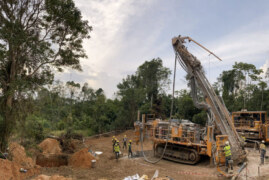
Explosives are the primary source of energy for rock breaking in the mining, quarrying and construction industries. The work into which the energy is converted transforms rock into a distribution of fragments and displaces them so that they can be conveniently loaded and hauled for further comminution and processing (Sanchidrián et al., 2007).
Several factors influence how energy is distributed during blasting operations, including the type of explosive, charge distribution, rock mass properties, and the blast design. Understanding these factors is crucial for optimizing fragmentation, minimizing environmental impact, and ensuring safe blasting practices. Let’s explore the various factors in detail.
The distribution of energy during blasting is influenced by several key factors related to both the design of the blast and the physical environment:
Blasting stress wave and blasting gas: the energy from an explosive is primarily partitioned into the generation of a stress wave and the expansion of blasting gas. These are the main drivers for rock fragmentation, with the blasting gas often accounting for a larger share of the usable energy, especially under strong confinement conditions.
Borehole confinement (blocking constraint): the material used to block or confine the explosive in the borehole (such as plasticine or fine sand) significantly affects how much of the explosive energy is utilized effectively. Stronger confinement leads to higher energy utilization, as more energy is directed into fragmenting the rock rather than escaping as gas or vibration. For example, strong constraint conditions can achieve up to 64% utilization efficiency, while weak constraints may drop this to 33%.
Charge distribution: the spatial arrangement of explosive charges (whether concentrated or distributed) greatly impacts energy distribution and fragmentation efficiency. Uniformly distributed smaller charges tend to produce more effective fragmentation and better energy utilization compared to a few large, concentrated charges. This results in finer particle sizes and lower energy requirements for subsequent comminution (grinding).
Powder factor and geometry: the powder factor (amount of explosive per unit rock volume or mass) is a basic measure of energy distribution, but actual energy delivered to the rock depends on burden, spacing, bench height, hole diameter, and charge length. The three-dimensional arrangement of charges determines the energy concentration at any given point in the rock.
Explosive properties: the type and energy content of the explosive itself (e.g., detonation velocity, gas volume produced) influence how energy is partitioned between stress waves and gas expansion, and thus how effectively the rock is fragmented.
Delay timing: the timing of detonation between charges (delays) can influence the interaction of stress waves and the movement of fragmented rock, affecting both fragmentation and energy efficiency.
Rock properties: the geological environment, including rock strength, structure, and existing fractures, also plays a crucial role in how the blasting energy is absorbed and distributed.
In summary, energy distribution during blasting is most strongly influenced by the confinement of the explosive, the spatial and geometric distribution of charges, the powder factor, the properties of the explosive, delay timing, and the physical properties of the rock. Optimizing these factors is essential for maximizing fragmentation efficiency and minimizing energy loss.
Reference
Sanchidrián, J. A., Segarra, P., & López, L. M. (2007). Energy components in rock blasting. International Journal of Rock Mechanics and Mining Sciences, 44(1), 130–147. https://doi.org/10.1016/j.ijrmms.2006.05.002