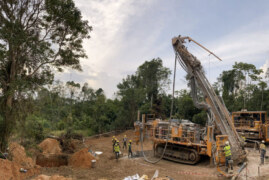
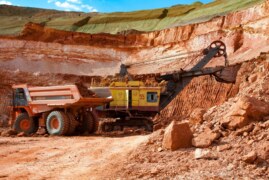
In mining, the pit wall refers to the sloped sides of an open pit mine. These walls are the exposed rock or earth surfaces that form the boundary of the pit excavation. The pit walls are typically designed as stepped or terraced slopes to maintain stability and safety during mining operations. The inclined sections of the pit wall are called the batter, while the flat parts of the steps are known as benches or berms. These terraces help prevent continuous rock falls by interrupting potential sliding and provide access for equipment and personnel (“Open-Pit Mining,” 2025).
Factors affecting pit wall design primarily include geological, geotechnical, structural, and hydrological conditions, as well as economic and operational considerations in mining.
Key factors detailed in the search results are:
- Geological structures and rock mass properties: the orientation and strength of discontinuities (joints, faults), intact rock strength, and rock mass fabric significantly influence pit wall stability. Structural analyses using tools like DIPS and Swedge help understand discontinuity orientations to design stable slopes.
- Groundwater conditions: presence and movement of groundwater affect slope stability by altering rock mass strength and hydrostatic pressures. Fault zones and alteration zones can act as permeability barriers or weak planes, impacting the pit’s geotechnical model.
- Pit geometry and slope parameters: overall slope angle (OSA), inter-ramp angle, bench heights, bench face angles, berm widths, and ramp design are critical. Steeper slopes reduce waste stripping but require rigorous stability analysis and monitoring. Safety factors (typically 1.2 to 1.5) are applied depending on temporary or permanent slope classifications.
- Rock mass strength and geotechnical domains: the pit is divided into geotechnical domains with similar rock properties, and slope design varies accordingly. Strong, competent rock can support steeper slopes, while weaker rock requires flatter angles and additional support.
- Mining operational factors: ore body geometry, mineralization distribution, and economic considerations affect the pit wall design to optimize profitability and safety simultaneously.
- Slope design methodologies: new approaches involve optimizing non-planar pit wall profiles that vary with depth, offering steeper slopes without compromising safety using advanced limit equilibrium and numerical modelling analyses.
- Monitoring and management strategies: practices such as slope displacement monitoring, blast design for reducing damage, and berm placement influence the long-term stability of pit walls.
- Transition to underground mining: considerations of pit wall stability also affect planning for underground operations beneath or adjacent to the pit, requiring factoring in zones of geotechnical influence and safety margins.
In summary, pit wall design is a complex, multidisciplinary process balancing geological conditions, rock mechanics, groundwater, geometry, safety factors, and economic imperatives. Sophisticated structural analyses, geotechnical modelling, and monitoring are integral to producing stable, economically viable pit designs.