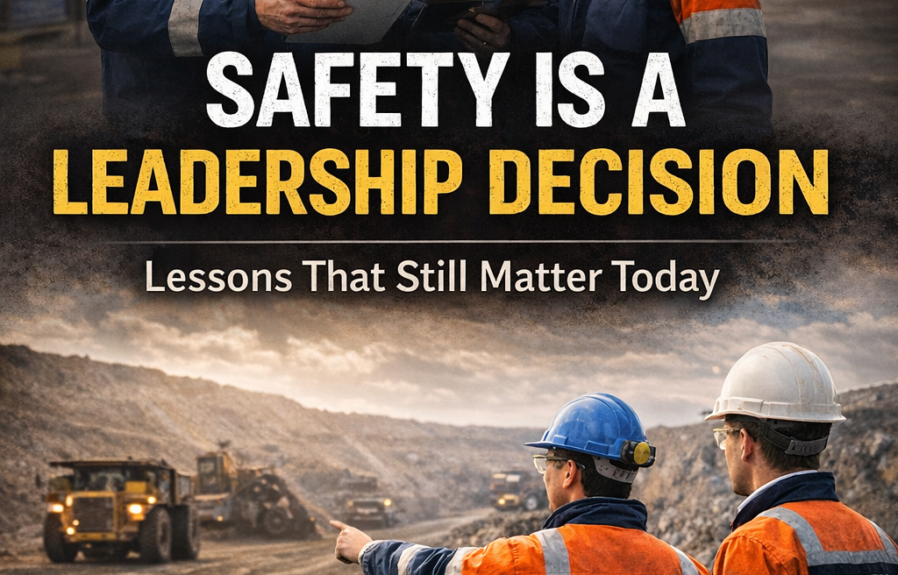
The Westray Mine Disaster is often remembered as a tragic moment in Canadian mining history. But for those of us working in mining, engineering, and high-risk industries, Westray is not just history. It is a warning that remains painfully relevant today.
In 1992, 26 miners lost their lives at the Westray coal mine in Nova Scotia. The official investigations did not simply point to methane gas or coal dust. They exposed deeper, more uncomfortable truths:
- Warnings were ignored
- Production pressure outweighed safety
- Known risks were normalized
- Workers’ concerns were not acted on
Westray was not a random accident. It was a failure of leadership, systems, and culture.
The Tradeoffs We Make — Every Day
Across mining and heavy industry, every site faces real pressures:
- Production vs. protection
- Schedule vs. safeguards
- Cost vs. controls
These tradeoffs are not abstract. They show up in everyday decisions:
A repair that gets deferred.
A hazard that becomes “acceptable.”
A concern that doesn’t get escalated because “that’s how we’ve always done it.”
Over time, these small compromises stack up. What starts as a temporary workaround can quietly become normal practice. And normalization of risk is one of the most dangerous patterns in any high-risk operation.
The Limits of Laws and Policies
The Westray Law strengthened corporate accountability in Canada, and that matters. It raised the legal stakes and made it clear that organizations and leaders can be held responsible for safety failures.
But laws alone do not create safe workplaces.
Real safety is built through culture.
Through leadership.
Through what actually happens when someone speaks up.
The strongest safety systems on paper mean very little if workers do not feel heard, supported, and protected when they raise concerns.
Why This Is Personal for Me
More than a decade ago, a friend and colleague of mine was involved in a serious safety incident at a well site in Northern Alberta. The incident resulted in severe, life-altering injuries. Witnessing the long and difficult recovery process firsthand was deeply impactful for me.
That experience fundamentally changed how I think about risk, responsibility, and leadership in high-risk environments. It made safety real in a way that no policy manual or training module ever could.
Seeing how quickly a single incident can change a life reinforced a simple truth for me:
No production target, schedule, or cost saving is worth a human life.
That experience, along with broader industry challenges at the time, influenced my career path and how I approach work today. It continues to shape my safety-oriented approach to site work, whether in engineering, QA/QC, or environmental remediation/monitoring.
The Question That Really Matters
Here is the question that, in my view, predicts risk better than any KPI or dashboard: If a frontline worker raised a serious safety concern today, would your organization treat it as a problem to solve or a problem to manage away?
The answer to that question says more about your true safety culture than any audit report.
On my projects, I try to operate by one simple rule: Every serious concern gets documented, communicated, and acted on even if it slows us down. Because slowing down to address risk is not a failure. Ignoring risk is. A Leadership Responsibility
Westray reminds us that safety is not just a technical issue. It is a leadership issue. It is a cultural issue. And it is a daily decision made by supervisors, engineers, managers, and executives. For those of us in mining, engineering, and operations, this is not history. It is a responsibility.