Stope stability is strongly governed by excavation geometry, with both gravity and in-situ stress playing central roles. From a gravity perspective, wall orientation is critical. Vertical walls are inherently more stable than horizontal or low-angle surfaces. As the dip reduces from 90° toward 0°, stability generally decreases, with the notable exception of the footwall, which often behaves more favorably due to its orientation relative to gravitational forces.
From a stress standpoint, geometry influences how loads are redistributed around an opening. Circular profiles provide the most efficient stress distribution and are therefore the most stable. In practice, however, fully circular excavations are rarely feasible in mining. As a result, arched backs are commonly adopted in development headings, as they approximate circular behavior while remaining practical to construct.
This approach balances both gravitational stability and stress redistribution. Where arched backs are impractical or lead to reduced ore recovery, angular profiles may be considered. While these geometries are less efficient in managing stress compared to arches, they can still offer improved performance over large, flat backs by reducing gravity-driven instability. This trade-off applies to both development drives and stopes.
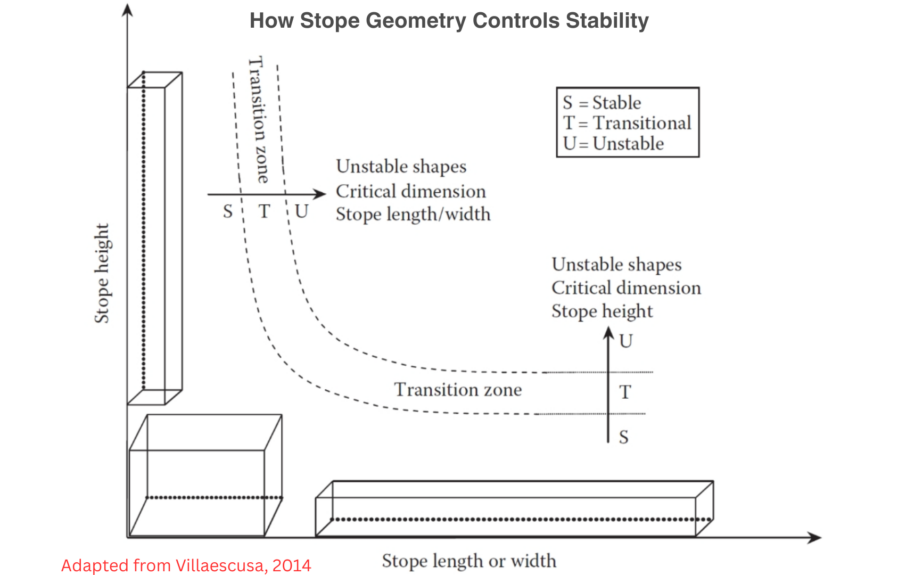
In stope design, wall stability is often assessed using the hydraulic radius (HR), defined as the ratio of stope area to its perimeter. Rather than simply reducing HR, stability can often be improved more effectively by optimizing stope dimensions to achieve a more favorable geometry.
Field observations further indicate that stope performance tends to improve with increased stope height and strike length, reflecting more stable stress redistribution at larger scales (Villaescusa, 2014).
Reference
Villaescusa, E. (2014). Geotechnical design for sublevel open stoping operations. In Y. Potvin & E. Villaescusa (Eds.), Ground Support in Mining and Underground Construction (pp. 31–52). Australian Centre for Geomechanics, The University of Western Australia.