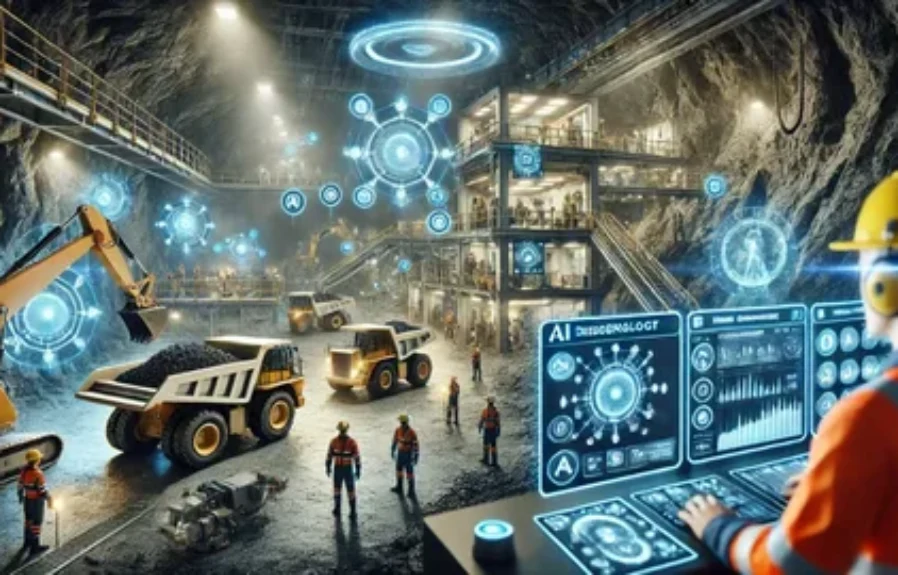
Mining companies have always faced one basic challenge: finding valuable minerals and separating them from waste rock as efficiently as possible. Traditionally, this depended on manual inspection, geological expertise, and mechanical processes that could not always keep up with the complexity of natural ore bodies. Today, deep learning is changing that. By teaching machines to “see” and interpret data the way experts do, but faster and at much larger scale, mining operations are improving accuracy, reducing waste, and making better decisions.
What Is Deep Learning in Mining?
Deep learning is a branch of artificial intelligence that uses layered neural networks to identify patterns in complex data. Unlike traditional software that follows fixed rules, deep learning models learn from examples. When trained on thousands of images of rock samples, sensor readings, or drill core scans, they can recognize subtle differences that are difficult for the human eye to detect.
In mining, this ability is especially useful because ore rarely looks uniform. Mineral content, texture, color, and density can vary from one rock to the next, and even small differences can affect value.
Smarter Ore Sorting
Ore sorting is one of the most practical uses of deep learning today. In a typical setup, rocks move along a conveyor belt past cameras and sensors. A deep learning model analyzes each piece in real time and decides whether it contains enough valuable material to be processed or should be rejected as waste. Air jets or mechanical systems then separate the material accordingly.
This approach offers several advantages:
- Less processing of waste rock: Removing low-grade material early saves energy, water, and processing costs.
- Higher-quality feed: Processing plants receive richer ore, which can improve recovery rates.
- Faster decisions: Models can evaluate material in fractions of a second, far faster than manual sorting.
- Consistency: Unlike human inspection, machines do not tire or lose focus during long shifts.
Improving Mineral Detection and Exploration
Deep learning is also transforming how companies find new deposits. Exploration generates huge volumes of data, including satellite imagery, geophysical surveys, geochemical samples, and drill core photographs. Reviewing all of this manually takes time and can miss important patterns.
Neural networks can analyze these datasets together and highlight areas with a higher probability of containing minerals. They can also classify rock types from core images, identify alteration zones, and map geological structures. This helps geologists focus on the most promising targets rather than spending resources on low-potential areas.
The Technology Behind the Results
Behind these applications are models trained on large, high-quality datasets. Many modern systems rely on computer vision, hyperspectral imaging, X-ray sensors, and other technologies that capture detail beyond what normal cameras can see. When combined with powerful computing resources, these tools allow mining teams to process data continuously and act on it quickly. For readers who want to understand the fundamentals of how neural networks learn from data, this overview of deep learning explains the core concepts that make these mining applications possible.
Benefits Beyond the Processing Plant
The impact of deep learning reaches beyond sorting and exploration. By improving how much valuable material is recovered and how much waste is processed, mining companies can reduce their environmental footprint. Less unnecessary crushing and grinding means lower energy consumption and fewer emissions. Better targeting during exploration can also reduce the number of drill holes and the amount of land disturbed.
There are safety benefits as well. Automated inspection and monitoring reduce the need for workers to be in hazardous areas, such as near moving machinery or unstable rock faces.
Challenges to Consider
Despite its promise, deep learning is not a plug-and-play solution. Models need large amounts of accurate, labeled data, and every deposit has unique characteristics. A model trained on one ore body may not perform well on another without retraining. Dust, vibration, poor lighting, and moisture in mining environments can also affect sensor quality.
There are practical hurdles too. Integrating AI systems with older equipment can be complex, and companies need skilled professionals who understand both geology and data science. Clear validation is also essential, because decisions based on faulty predictions can be costly.
Best Practices for Getting Started
Mining companies exploring this technology can improve their chances of success by following a few simple steps:
- Start with a clear problem. Focus on a specific use case, such as sorting a single ore type, rather than trying to automate everything at once.
- Invest in data quality. Accurate labeling and consistent data collection are more important than sheer volume.
- Run pilot projects. Test on a small scale, measure results against current methods, and refine before expanding.
- Involve geologists and engineers. Human expertise remains vital for validating results and interpreting edge cases.
- Plan for ongoing updates. Models should be monitored and retrained as ore conditions change.
The Future of Deep Learning in Mining
As sensors become cheaper and algorithms more efficient, deep learning will become accessible to a wider range of operations, not just large multinational companies. Future systems will likely combine exploration data, real-time sorting, and processing plant performance into a single connected workflow, allowing mines to adjust operations continuously based on what the data shows.
Conclusion
Deep learning is reshaping how the mining industry finds, evaluates, and processes minerals. From real-time ore sorting to smarter exploration and reduced environmental impact, it offers practical benefits that go well beyond hype. While challenges around data quality, integration, and skills remain, companies that adopt it thoughtfully and start with focused projects can gain a meaningful competitive advantage in an industry where precision and efficiency matter more than ever.