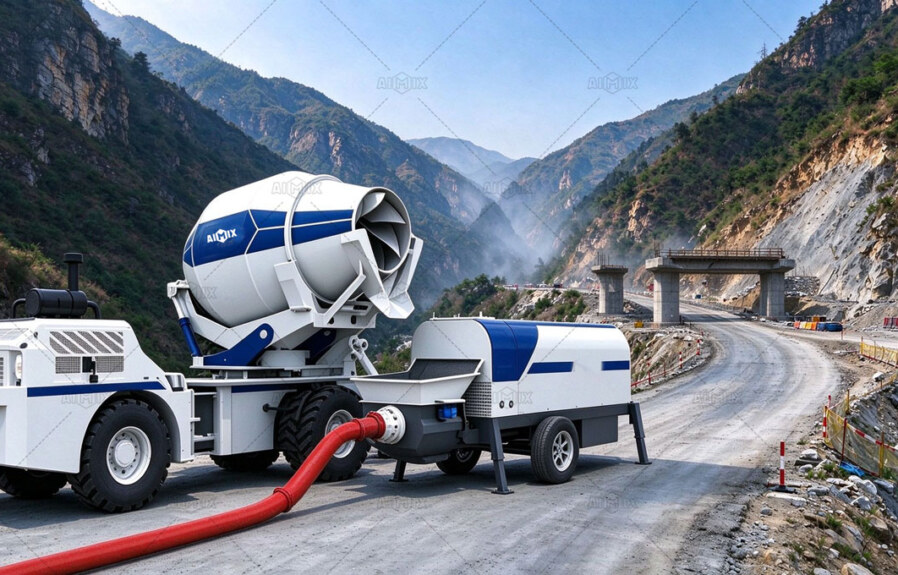
Remote copper mines in Peru present distinctive challenges for concrete supply. Mining developments in the Andes may involve steep access roads, high elevations, variable weather, and considerable distances between material storage areas and active construction zones. Concrete is needed for equipment foundations, retaining walls, drainage structures, workshops, maintenance facilities, and other supporting infrastructure. When ready-mix deliveries are impractical or inconsistent, contractors must establish a reliable on-site production and placement system. Two equipment configurations deserve consideration: a self loading concrete mixer in Peru that combines material loading, mixing, transportation, and discharge in one machine, or a separate mixer-and-pump setup that produces concrete and transfers it through a pumping system. Each arrangement offers different advantages in mobility, placement reach, production continuity, and labor coordination. The appropriate choice depends on daily concrete demand, site layout, road conditions, structural requirements, and the distance between the mixing point and the final placement location.
Assess Concrete Demand and Site Conditions Before Selecting Equipment
Determine the Required Concrete Volume
The first consideration is how much concrete the mining project consumes and how frequently it must be delivered. Small maintenance works, equipment pedestals, and drainage repairs may require intermittent batches, whereas large foundations, retaining walls, and workshop floors can demand substantial volumes within a restricted placement window. Contractors should estimate daily consumption, peak hourly demand, average batch size, and the number of active placement locations. These figures establish whether a mobile, self-contained mixer can meet the workload or whether a separate mixing and pumping arrangement is more appropriate.
Evaluate Access Roads and Elevation Changes
Remote mine sites may have narrow haul roads, uneven working platforms, and considerable elevation differences between material stockpiles and construction areas. Equipment selection must account for gradients, turning space, ground bearing capacity, and travel distances. High-altitude operating conditions also warrant attention. Engine performance, cooling requirements, and operator procedures should be checked against the manufacturer’s specifications and the site’s environmental conditions before equipment is deployed.
Self-Loading Concrete Mixer: Flexible Supply for Dispersed Work Areas
Combine Material Loading, Mixing, and Transportation
A self-loading mixer integrates a loading bucket, mixing drum, water supply, and vehicle chassis. The operator can load aggregates and cement, add the required water, mix the concrete, and drive toward the placement area without relying on a separate batching and transportation sequence. For contractors considering a self loading concrete mixer in Peru(hormigonera autocargable en Perú), this integrated configuration can simplify concrete supply when work areas are scattered across a mining property. One machine can serve several smaller construction tasks throughout the day, reducing the need to coordinate multiple pieces of equipment for every batch. However, the actual output depends on the machine’s effective batch capacity, cycle time, travel distance, and unloading conditions. Contractors should calculate achievable hourly production rather than relying exclusively on the manufacturer’s nominal capacity.
Understand Its Limitations for Large Concrete Pours
A self-loading mixer is particularly useful for relatively small, distributed, or intermittent concrete requirements. Examples include equipment bases, drainage channels, minor retaining structures, and maintenance building foundations. Its limitations become more apparent when concrete must be placed continuously over a large area or delivered to elevated and inaccessible positions. Repeated travel and discharge cycles can constrain production, while direct discharge may be unsuitable for locations requiring long-distance or high-rise concrete delivery.
Mixer-and-Pump Setup: Controlled Supply for Larger Placement Requirements
Separate Concrete Production from Placement
A mixer-and-pump configuration uses a concrete mixer or batching system to prepare the concrete and a separate pump to transport it toward the placement point. Depending on the project, the arrangement may include a mixer, a trailer-mounted concrete pump, delivery pipelines, and supporting material-handling equipment. A concrete pump in Peru can be useful for mining construction where concrete must reach foundations behind restricted access points, elevated structures, or locations distant from the mixing area. Pipeline delivery reduces the need to drive the mixer directly to every discharge position. This arrangement also allows production and placement activities to be organized separately. Nevertheless, the mixer, pump, delivery equipment, and workforce must remain synchronized to avoid interruptions or excessive waiting.
Check Pumping Distance and Concrete Compatibility
Before selecting a pump, contractors should determine the required horizontal and vertical delivery distances, pipeline configuration, aggregate size, and specified concrete properties. Long pipelines, steep vertical lifts, and numerous bends can increase pumping resistance. The mix must have suitable workability and cohesion for the intended pumping conditions. A pump with sufficient rated output cannot compensate for an unsuitable mix, poorly prepared pipeline, or inadequate concrete supply.
Self-Loading Mixer vs. Mixer-and-Pump Setup: Key Differences
| Selection factor | Self-loading concrete mixer | Mixer-and-pump setup | |—|—|—| | Typical work pattern | Small, dispersed, intermittent tasks | Larger or concentrated placement operations | | Material handling | Loading, mixing, and transport integrated | Mixing and pumping handled by separate equipment | | Mobility | Suitable for moving between accessible work areas | Depends on mixer mobility, pump transport, and pipeline layout | | Placement method | Direct discharge | Pumped delivery through a pipeline | | Labor coordination | Fewer separate equipment interfaces | More coordination between mixing and pumping operations | | Production constraints | Batch cycle and travel time | Mixer supply, pump capacity, and pipeline conditions | | Main planning priority | Travel efficiency and batch frequency | Continuous supply and placement synchronization | Neither configuration is universally superior. The decision depends on whether the principal constraint is moving small batches between dispersed locations or maintaining a sufficiently high, continuous supply rate for larger placements.
Match Equipment Selection to Mining Construction Tasks
Foundations, Drainage, and Remote Maintenance Structures
For isolated equipment foundations, culverts, drainage channels, and maintenance structures, a self-loading mixer can reduce the logistical burden of arranging separate loading and mixing equipment. A self loader concrete mixer machine may be especially practical when concrete is required at several locations throughout a shift and the travel routes remain accessible. Contractors should still consider aggregate storage, cement protection, water availability, and the need for consistent mix proportions. Remote production does not remove the requirement for accurate batching and quality control.
Large Foundations, Retaining Walls, and Elevated Placement
Large foundations, workshop slabs, and retaining walls may require higher sustained output or concrete delivery to locations that direct discharge cannot reach efficiently. In these cases, a mixer-and-pump arrangement can provide a more suitable placement method. The system should be sized around the required placement rate, not simply the pump’s maximum rated capacity. Concrete production, transport cycles, pump performance, and finishing operations must all support the same practical output target.
Calculate the Total Cost of Concrete Supply
Compare the Cost per Cubic Meter
The initial purchase price is only one part of the decision. Contractors should include fuel, labor, maintenance, equipment transport, pipeline setup, material handling, and expected downtime when evaluating the alternatives. A practical calculation is: Total concrete supply cost per m³ = Total operating and equipment costs ÷ Total acceptable concrete volume delivered For a meaningful comparison, both configurations should be evaluated over the same project period and against the same concrete quality requirements. Costs associated with rejected batches, interruptions, and additional handling should also be included where reliable estimates are available.
Consider Equipment Utilization Across the Mine
A self-loading mixer may offer greater operational flexibility when several small projects need concrete at different times. A mixer-and-pump setup may be more productive when a sustained placement schedule keeps the equipment working near its planned operating rate. Contractors should assess the workload across the entire mining development rather than evaluating one isolated pour. Equipment that serves multiple work areas efficiently may provide better overall utilization, even if its individual production rate is lower.
Conclusion
Concrete supply for remote copper mines in Peru requires a balance between mobility, production capacity, placement reach, and operating cost. A self-loading concrete mixer suits many dispersed construction tasks where batches are relatively small and direct discharge is practical. A separate mixer-and-pump setup is more appropriate when larger volumes must be placed efficiently or concrete needs to travel through a pipeline to restricted or elevated locations. The final selection should follow a site-specific assessment of concrete demand, access conditions, elevation, placement methods, and total operating costs. By matching the equipment configuration to the actual construction workload, contractors can establish a more reliable concrete supply system for remote mining infrastructure.