Introduction
The scale of operation significantly impacts unit mining costs, primarily through the principle of economies of scale. In essence, as the size of a mining operation increases, the cost to produce each unit (e.g., a tonne of ore or an ounce of a mineral) tends to decrease. However, this relationship is not limitless and can be influenced by various factors. Let’s explore how scale of operation impact unit mining cost.
Economies of scale in mining: driving unit costs down
Larger mining operations can achieve lower unit costs through several mechanisms:
Spreading fixed costs: mining involves substantial fixed costs, which are expenses that do not change with the level of production [1]. These include the costs of infrastructure (roads, processing plants), equipment, and administrative overhead. In a large-scale operation, these fixed costs are spread over a much larger volume of production, significantly reducing the cost attributed to each unit.
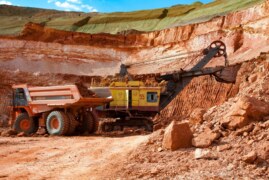
Technological and specialization advantages: bigger mines can invest in larger, more efficient machinery and advanced technologies like automation. For instance, using larger haul trucks means fewer trips and less labor is needed to transport the same amount of material [2]. Furthermore, larger operations can afford to have a more specialized workforce, leading to increased efficiency and productivity in specific tasks.
Purchasing power: large mining companies have greater bargaining power when purchasing inputs like fuel, explosives, and equipment [3]. They can negotiate lower prices by buying in bulk, which directly translates to lower operating costs per unit.
Improved capital efficiency: the capital cost of major infrastructure and equipment does not always increase proportionally with production capacity [3]. For example, doubling the capacity of a processing plant may not double its construction cost. This is often due to engineering principles like the square-cube law, where a vessel’s volume (capacity) increases by the cube of its dimensions, while its surface area (and often the material required to build it) increases only by the square.
Limitations and potential for diseconomies of scale
While the trend is for unit costs to decrease with scale, there are limitations and even a point where costs can begin to rise, a phenomenon known as diseconomies of scale.
Ore body characteristics: the geology of the ore deposit is a critical factor. As a mine expands, it may encounter lower-grade ore, meaning more rock must be mined and processed to extract the same amount of mineral, which can increase unit costs. The mine might also need to go deeper, increasing hauling and ventilation costs.
Management and coordination complexity: as a mining operation grows, its management and coordination become more complex. This can lead to inefficiencies, communication breakdowns, and increased administrative overhead, which can start to counteract the benefits of scale.
Increased maintenance and downtime: while larger equipment can be more efficient, it also comes with higher maintenance costs [2]. Unscheduled downtime of a very large piece of machinery can have a much more significant impact on production and overall costs than the breakdown of a smaller machine in a smaller operation.
Logistical challenges: larger mines require more extensive transportation and logistics networks to bring in supplies and ship out products. Bottlenecks in these systems can lead to costly delays and inefficiencies.
The scale spectrum: from artisanal to large-scale mining
The impact of scale is evident when comparing different types of mining operations:
Artisanal and Small-Scale Mining (ASM): these operations are typically labour-intensive with minimal mechanization [4]. Their unit costs are often high due to a lack of access to efficient technology, limited purchasing power, and inefficiencies in their processes.
Large-Scale Mining (LSM): these are capital-intensive operations that leverage advanced technology and economies of scale to achieve lower unit costs and higher overall production.
Conclusion
A larger scale of operation is a key driver for reducing unit mining costs up to a certain point. By effectively managing fixed costs, leveraging technology, and capitalizing on purchasing power, large mines can be significantly more cost-effective than their smaller counterparts. However, the optimal scale for any given mine is ultimately determined by a complex interplay of the ore body’s characteristics, technological capabilities, and the effectiveness of its management.
Reference
[1] I. Batrancea et al., “An econometric approach on production, costs and profit in Romanian coal mining enterprises,” Economic Research-Ekonomska Istraživanja, vol. 32, no. 1, pp. 1019–1036, Jan. 2019, doi: 10.1080/1331677X.2019.1595080.
[2] P. A. Roman and L. Daneshmend, “ECONOMIES OF SCALE IN MINING – ASSESSING UPPER BOUNDS WITH SIMULATION,” The Engineering Economist, vol. 45, no. 4, pp. 326–338, Jan. 2000, doi: 10.1080/00137910008967556.
[3] “Economies of scale,” Wikipedia. May 22, 2025. Accessed: Oct. 09, 2025. [Online]. Available: https://en.wikipedia.org/w/index.php?title=Economies_of_scale&oldid=1291681045
[4] “Chapter 8: Artisanal and Small-Scale Mining.” Accessed: Oct. 09, 2025. [Online]. Available: https://www.sgu.se/en/itp308/knowledge-platform/8-artisanal-and-small-scale-mining/