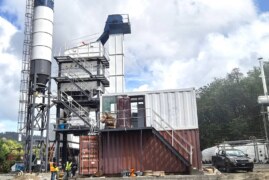
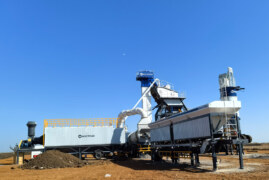
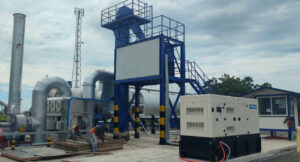
Mining enterprises verticalizing their supply chain through in-house asphalt production face an aggregate challenge that standard road construction projects rarely encounter: highly abrasive mining waste slag carries hardness and angularity levels that accelerate drum flight wear and shell scouring at rates no generic equipment specification anticipates. Before committing to any asphalt drum mix plant for sale, consulting reputable asphalt plant manufacturers about slag-specific drum metallurgy is not a precautionary step — it is the technical foundation that determines whether vertical integration delivers cost efficiency or generates a maintenance liability that erodes the supply chain advantage within a single production season.
Why Mining Slag Exceeds Standard Aggregate Wear Assumptions
Standard asphalt drum mix plant for sale configurations are designed and tested against conventional quarried aggregate — limestone, granite, or basalt — whose abrasion indices fall within predictable ranges. Mining waste slag, particularly from ferrous and non-ferrous processing operations, combines extreme particle hardness with irregular angular morphology that concentrates impact energy at flight contact points far beyond what conventional aggregate generates at equivalent throughput. Each drum rotation drives slag particles against flight steel in a high-velocity impact-and-sliding wear sequence that removes material from unprotected surfaces through a combination of micro-cutting and surface fatigue mechanisms.
In light of this, any asphalt plant manufacturers quoting a drum configuration for slag processing without requesting your slag’s hardness index, particle size distribution, and bulk density data are applying road construction assumptions to a mining material environment — a mismatch that produces wear rates the initial specification never reflected.
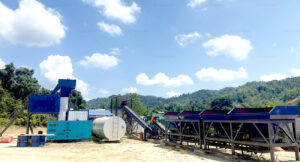
Flight Metallurgy and Shell Protection Against Continuous Slag Processing
The flight material specification is the first technical checkpoint when evaluating an asphalt drum mix plant for sale for mining waste aggregate. Standard mild steel flights adequate for limestone processing lose material rapidly under continuous slag impact, compressing replacement intervals from seasonal to monthly on high-throughput mining supply chain operations. Reputable asphalt plant manufacturers engineering for abrasive aggregate specify chromium-carbide overlay flights or high-chrome cast iron alternatives whose surface hardness exceeds the abrasive mineral phase of most industrial slag types — extending service life substantially against the micro-cutting wear mechanism that slag angularity generates.
Shell protection at high-wear zones deserves equal specification scrutiny. The drum shell at aggregate cascade impact zones — typically the mid-drum section where flight-lifted material falls back across the shell interior — experiences progressive wall thinning under slag processing that standard shell plate thickness does not account for. Specifically, request wear liner specifications for the shell interior impact zones from every asphalt drum mix plant for sale supplier. Replaceable ceramic or hardened steel wear liners at these locations protect the permanent shell structure and are field-replaceable without drum replacement — a maintenance architecture that directly protects operational continuity on a mining site where production schedules do not accommodate extended plant downtime.
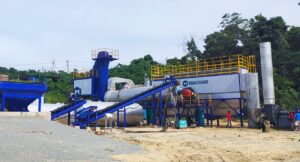
Evaluating Asphalt Plant Manufacturers on Slag-Specific Engineering Evidence
The distinction between asphalt plant manufacturers who have genuinely engineered for abrasive mining aggregate and those offering standard configurations with verbal assurances lies entirely in the documentation they produce without being asked. A manufacturer with credible slag processing experience will provide flight wear rate data against comparable aggregate hardness indices, shell plate thickness specifications for high-wear zones, and wear liner replacement interval estimates calibrated to your slag throughput rate. Consequently, any asphalt plant manufacturers unable to produce wear rate documentation for abrasive aggregate applications should be removed from the mining enterprise shortlist regardless of how competitive their asphalt drum mix plant for sale price appears.
From a supply chain integration perspective, total cost of ownership under slag processing conditions requires flight and liner replacement frequency to be quantified as scheduled maintenance costs — not discovered reactively after premature failures interrupt production at the mining operation’s most critical throughput periods.
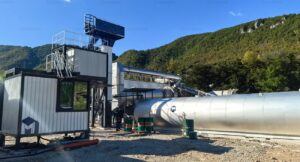
Conclusion
An asphalt drum mix plant for sale selected for mining waste slag processing must demonstrate chromium-carbide or high-chrome flight metallurgy, replaceable interior shell wear liners, and documented wear rate data from asphalt plant manufacturers with verified abrasive aggregate experience — because premature flight burnout and shell failure under continuous slag processing are entirely predictable outcomes when drum metallurgy was specified for road construction aggregate rather than the hardness realities of mining supply chain integration.