Every demolition site tells a story of endings. Buildings come down, pavements are ripped apart, and what remains is a sprawling landscape of fractured concrete — jagged, heavy, and seemingly purposeless. For decades, this rubble was carted away to landfills, treated as an inconvenient byproduct of progress rather than a resource worthy of reinvention. That perception has shifted dramatically. The construction industry is now waking up to a remarkable possibility: that the broken concrete of yesterday can become the structural material of tomorrow, provided the right processing and integration systems are in place.
The convergence of broken concrete crusher plants with concrete batching systems represents one of the most compelling circular economy applications in modern construction. It is a marriage of demolition and production — a closed-loop philosophy that transforms waste streams into productive feedstock. Understanding how these two systems can be intelligently connected, and what technical and logistical considerations govern that connection, is increasingly essential knowledge for contractors, plant operators, and infrastructure developers who are serious about building sustainably and economically.
The Science and Process of Crushing Demolished Concrete
From Rubble to Refined Aggregate: The Crushing Workflow
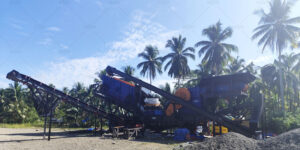
Demolished concrete arrives at a crushing plant in a highly heterogeneous state. Slabs, beams, column sections, and pavement fragments vary enormously in size, reinforcement content, and residual contamination. Before any productive crushing can occur, this material must be pre-processed. Primary jaw crushers receive the oversized feed and reduce it to a manageable intermediate fraction, typically below 150 millimeters. Impact crushers or cone crushers then perform secondary and tertiary reduction, progressively refining the material toward target gradations.
Embedded steel reinforcement — rebar, mesh, prestressing tendons — poses a particular challenge. Magnetic separation systems, positioned at strategic transfer points along the conveyor circuit, extract ferrous contaminants with high efficiency. Eddy current separators address non-ferrous metals where present. The result, after screening into classified size fractions, is Recycled Concrete Aggregate — or RCA — a material whose physical and chemical properties have been studied extensively and whose performance in new concrete mixes is now well-documented across international standards bodies.
Quality Parameters That Govern Downstream Usability
Not all RCA is created equal. The quality of recycled aggregate is a direct function of the parent concrete’s original specification, the crushing methodology employed, and the rigor of contamination removal. Key parameters include particle shape — which influences workability and packing density in new mixes — along with Los Angeles abrasion value, water absorption rate, and the presence of residual cement paste adhering to aggregate surfaces.
This adhered mortar fraction is the defining characteristic that differentiates RCA from virgin aggregate. It elevates water absorption, reduces particle density, and can introduce sulfate or chloride contamination if the source concrete was exposed to deicing salts or marine environments. Rigorous incoming material assessment — including petrographic analysis, chemical testing, and mechanical property evaluation — is therefore not optional. It is the quality gateway that determines whether crushed material is suitable for structural concrete production or limited to lower-specification applications such as road base or fill.
Engineering the Integration Between Crushing and Batching
Physical Layout and Material Transfer Architecture
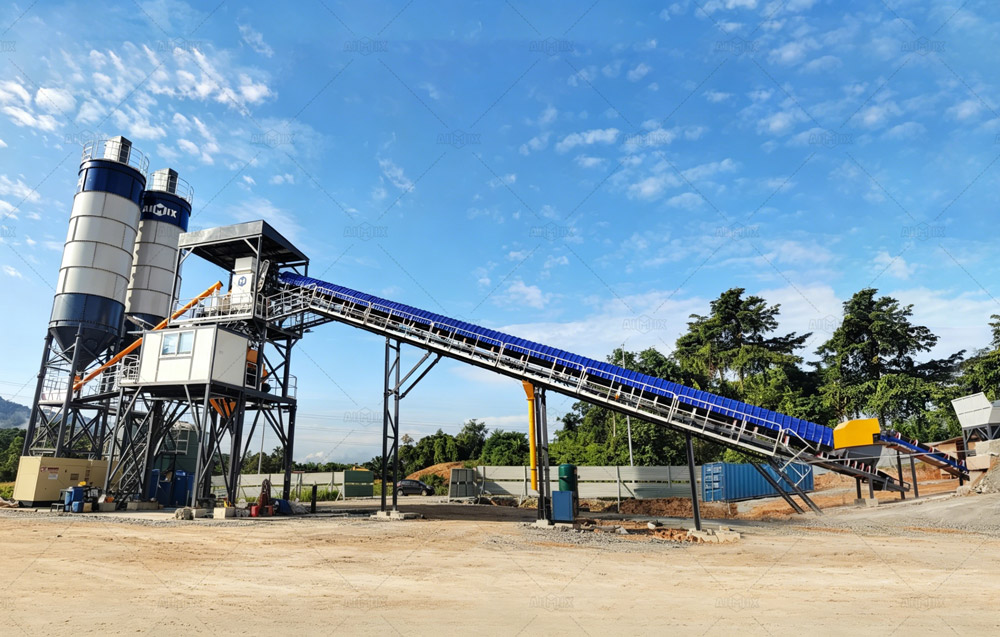
Integrating a crushing plant with a ready mix concrete batching plant system is fundamentally a material flow engineering challenge. The two systems must be physically configured to enable efficient, contamination-free transfer of classified RCA from crusher output to batching plant aggregate storage. In co-located configurations — where crushing and batching operations share a common site — covered conveyor systems provide the most efficient transfer mechanism, minimizing segregation, moisture uptake, and dust generation during transit.
Aggregate storage at the batching plant must accommodate RCA as a distinct material stream, separate from virgin aggregate bins. Dedicated compartmentalization prevents cross-contamination and enables precise proportioning control. Weigh batchers calibrated for the slightly different bulk density characteristics of RCA ensure that mix design targets are met consistently. Some advanced facilities employ automated material tracking systems that log the provenance, quality test results, and storage location of each RCA batch — providing full traceability from demolition origin to finished concrete pour.
Mix Design Adaptation for Recycled Aggregate Concrete
Introducing RCA into a concrete batching system is not a simple substitution exercise. The elevated water absorption of recycled aggregate — typically two to five times that of virgin crushed stone — demands careful pre-wetting protocols or mix water adjustments to prevent absorption-driven workability loss after batching. Two-stage mixing processes, where RCA is pre-saturated before contact with cement paste, have demonstrated measurable improvements in fresh concrete consistency and hardened strength development.
Mix designs incorporating RCA typically specify partial replacement rates rather than full substitution. Replacing 30 percent of coarse aggregate with RCA is achievable in structural concrete without significant strength penalty, provided water-cement ratio discipline is maintained. Higher replacement rates — up to 100 percent — are viable for non-structural applications. The batching system’s computerized mix management software must be configured to accommodate these RCA-specific parameters, treating recycled aggregate as a material category with its own absorption coefficients, density values, and quality tolerance bands.
Economic and Environmental Returns of a Closed-Loop System
Cost Reduction Across the Production Chain
The economic logic of integration is compelling. Virgin aggregate procurement, transport, and stockpiling represent significant cost components in any mobile concrete batching plant operation. Substituting a portion of that virgin material with on-site or nearby-processed RCA reduces raw material expenditure in direct proportion to the replacement rate achieved. Demolition contractors who operate or partner with crushing facilities gain an additional revenue stream — or at minimum, a tipping fee offset — by processing rubble that would otherwise incur disposal costs.
Operational synergies compound these savings. Shared site infrastructure, unified logistics management, and coordinated equipment maintenance schedules reduce overhead across both the crushing and batching operations when they function as an integrated system rather than independent entities. Capital investment in crushing plant equipment is amortized across a larger productive output when the processed material feeds directly into batching production rather than being sold into a commodity aggregate market at thin margins.
Environmental Credentials and Regulatory Alignment
The sustainability case is equally persuasive. Every tonne of RCA that displaces virgin aggregate represents a corresponding reduction in quarry extraction — with its associated land disturbance, blasting, and habitat disruption. Landfill diversion metrics improve dramatically when demolition concrete enters a productive processing circuit rather than a disposal stream. Carbon footprint calculations for concrete produced with partial RCA content consistently demonstrate emissions reductions when the full supply chain is assessed on a lifecycle basis.
Regulatory frameworks across Europe, Australasia, and increasingly in North America are formalizing recycled aggregate standards and, in some jurisdictions, mandating minimum recycled content in publicly funded construction projects. Operators who build integration capability now position themselves ahead of compliance curves that are tightening with each successive policy cycle. The closed loop between demolition rubble and fresh concrete delivery is no longer an aspirational concept reserved for sustainability reports. It is a technically mature, economically rational, and regulatorily favored operational model — one that the most forward-thinking players in the construction materials sector are already implementing at scale.