Mining ERP Series | Part 3(II)
From Reactive Repairs to Intelligent Maintenance
In the previous edition of our Mining ERP Series, we explored how Enterprise Asset Management (EAM) lays the foundation for reliable mining operations. But understanding EAM is only the first step.
The bigger question is:
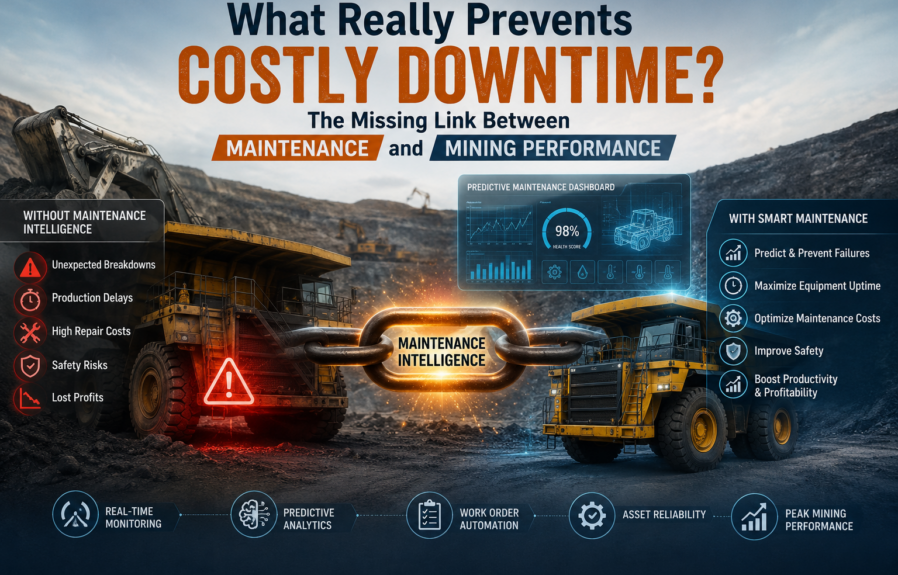
What actually prevents costly downtime?
Many mining companies assume the answer is better maintenance. In reality, maintenance alone isn’t enough.
Unexpected breakdowns are often the result of disconnected systems, delayed information, missed inspections, poor spare-parts visibility, and reactive decision-making. When maintenance, procurement, finance, inventory, and operations work independently, even the best maintenance teams struggle to keep equipment running efficiently.
Preventing downtime requires something much bigger—a connected mining ecosystem.
Why Traditional Maintenance Falls Short
Imagine an excavator showing early signs of hydraulic failure.
- The maintenance team notices unusual vibrations.
- The required spare part isn’t available.
- Procurement isn’t informed in time.
- The repair gets postponed.
Two days later, the excavator fails during production.
The result?
- Lost production hours
- Emergency repair costs
- Idle workforce
- Delayed dispatch
- Reduced profitability
The problem wasn’t the equipment.
It was the lack of connectivity between business functions.
How PACE360 Changes the Equation
PACE360 integrates Enterprise Asset Management directly into the ERP environment, allowing every department to work from the same real-time information.
Instead of reacting to failures, organizations gain the ability to predict, plan, and prevent them.
Intelligent Maintenance Planning
Condition-based maintenance schedules and automated work orders ensure maintenance activities happen before equipment failures disrupt production.
Connected Work Order Management
Maintenance requests are generated, prioritized, assigned, and monitored through a centralized workflow, improving accountability and reducing response time.
Real-Time Asset Intelligence
Live monitoring of KPIs such as uptime, downtime, MTBF, MTTR, and Overall Equipment Effectiveness (OEE) enables maintenance teams to detect performance deterioration before it becomes a costly breakdown.
IoT-Driven Predictive Maintenance
By integrating IoT sensors and real-time equipment monitoring, PACE360 continuously tracks asset health, generates intelligent alerts, and supports predictive maintenance strategies that maximize equipment availability.
Mobile Maintenance Operations
Engineers can access asset histories, inspections, manuals, and work orders directly from the field, accelerating decision-making while reducing paperwork.
Compliance Without Complexity
Inspection schedules, certifications, maintenance records, and audit documentation remain centralized and always available, simplifying regulatory compliance and improving governance.
Why Integration Is the Real Game Changer
Most organizations already have maintenance software.
What they often lack is integration.
PACE360 connects maintenance with procurement, inventory, finance, operations, logistics, and management reporting.
That means:
- A maintenance request automatically checks spare-part availability.
- Inventory updates instantly.
- Procurement receives replenishment requirements.
- Finance captures maintenance costs in real time.
- Management monitors equipment performance through live dashboards.
- Instead of isolated decisions, every department works with the same operational intelligence.
That is what truly prevents costly downtime.
Beyond Maintenance: Creating Business Value
Reducing downtime is only the beginning.
A connected Enterprise Asset Management strategy also enables mining companies to:
- Improve equipment reliability and asset utilization.
- Extend equipment lifespan through predictive maintenance.
- Reduce maintenance and inventory costs.
- Strengthen safety and regulatory compliance.
- Improve budgeting through real-time financial visibility.
- Increase productivity with data-driven operational planning.
Maintenance is no longer simply a support function—it becomes a strategic contributor to business performance.
Conclusion
Every hour of unplanned downtime affects production, profitability, and operational confidence.
The difference between reactive maintenance and intelligent asset management isn’t just technology—it’s integration.
By connecting assets, maintenance, finance, procurement, inventory, and operations into one intelligent ERP ecosystem, PACE360 empowers mining companies to prevent breakdowns before they happen, optimize asset performance, and build resilient, future-ready mining operations.
Because the smartest mines don’t just repair equipment. They prevent failures before they occur.