
Supplying C25, C30, and C40 concrete from one 100 m³/h batching plant requires more than sufficient mixing capacity. A ready-mix concrete producer must also manage several aggregate sizes, different mix proportions, cement consumption, and continuous material replenishment. If the storage configuration does not match production demand, even a high-capacity batching plant can experience material shortages and unnecessary downtime.
One of the most important decisions during plant planning is determining how many aggregate bins and cement silos to install. Should a 100 m³/h concrete batching plant have four aggregate compartments and two cement silos? Would five or six aggregate bins improve production flexibility? Do C25, C30, and C40 concrete require separate cement storage?
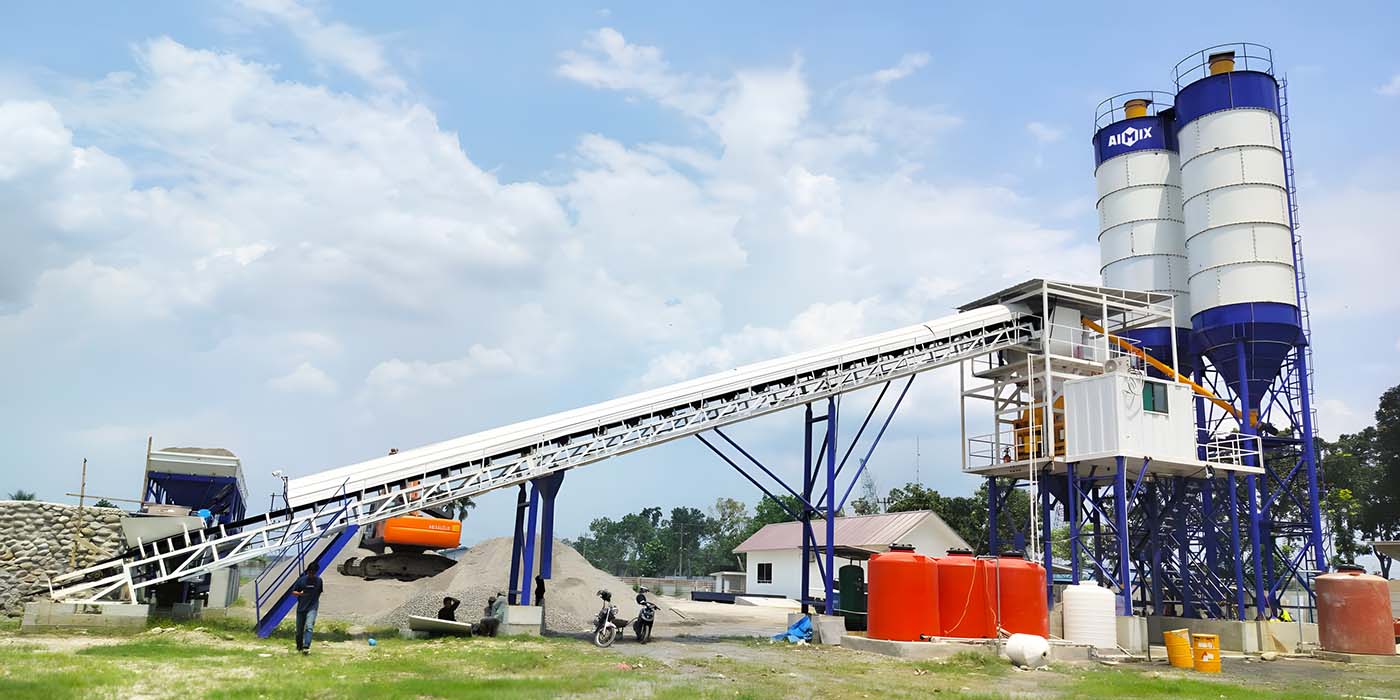
For many conventional ready-mix applications, four aggregate compartments and two cement silos provide a practical starting configuration for a 100 m³/h batching plant. However, the final arrangement depends on the number of aggregate fractions, cementitious materials, mix designs, storage requirements, and delivery schedules. Let’s examine how to determine the right configuration for your concrete production business.
1. How Many Aggregate Bins Does a 100 m³/h Batching Plant Need?
The number of aggregate bins depends primarily on how many different aggregate fractions your concrete mixes require. C25, C30, and C40 concrete do not necessarily need separate aggregate storage systems. Instead, the batching plant stores individual aggregate sizes and combines them in different proportions according to each mix design.
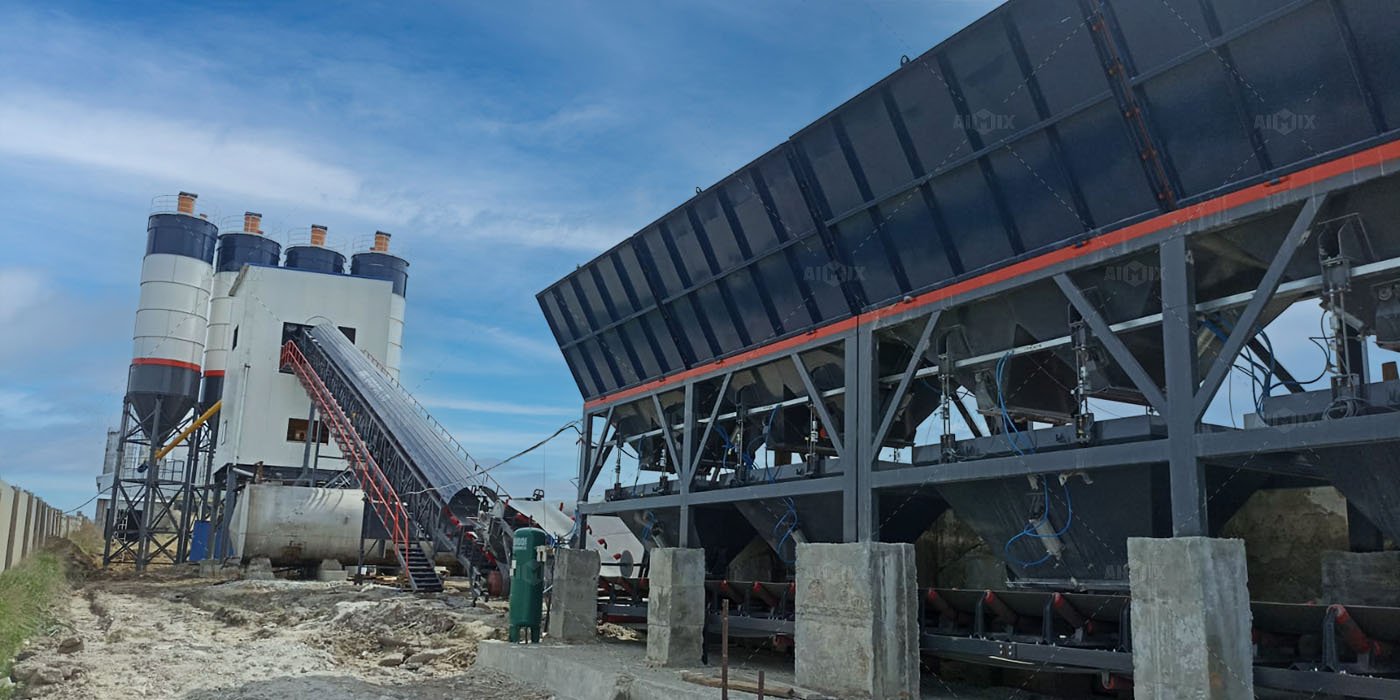
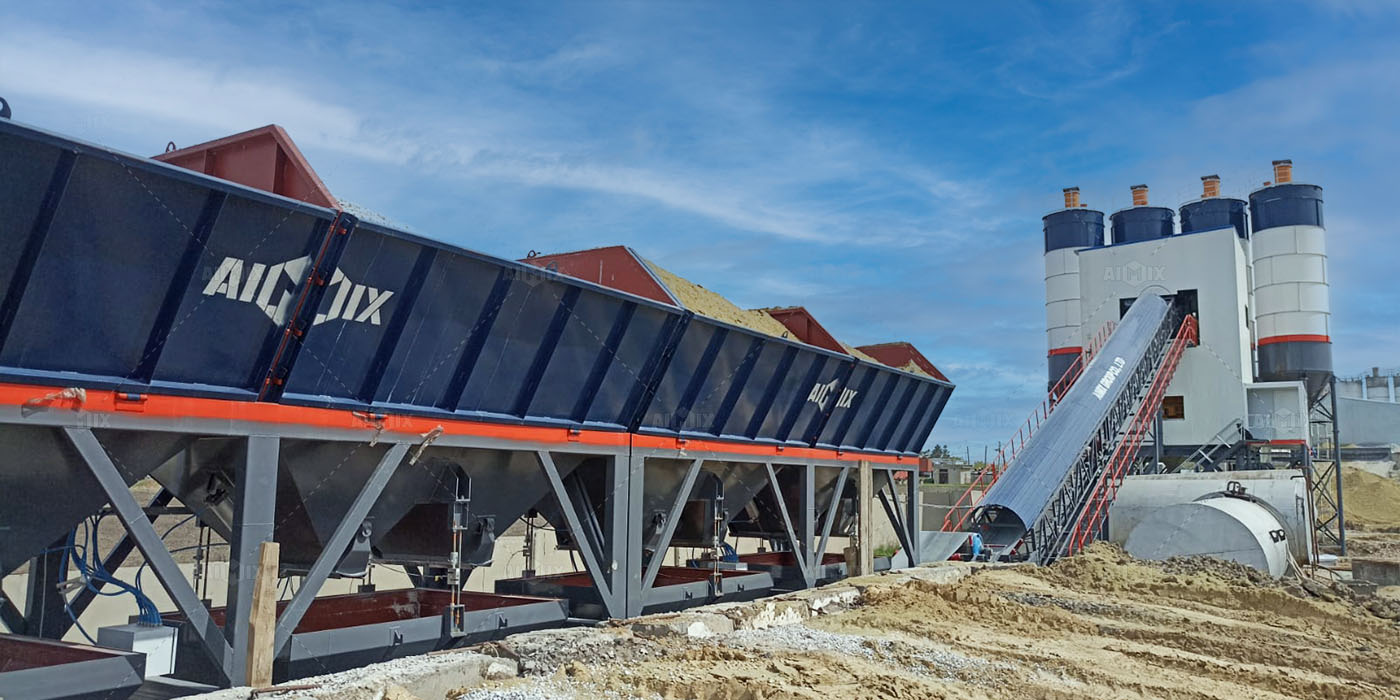
For a conventional ready-mix production line, a four-compartment aggregate storage system is a practical configuration. However, producers handling more aggregate grades may benefit from additional compartments. When selecting concrete production equipment, contractors should consider both the required output and the material storage arrangement rather than focusing on mixing capacity alone.
Recommended Configuration: Four Aggregate Compartments
A typical four-compartment arrangement can separate the following materials:
| Aggregate Compartment | Material | Main Application |
|---|---|---|
| Bin 1 | 0–5 mm sand | Fine aggregate for concrete mixes |
| Bin 2 | 5–10 mm crushed stone | Fine coarse aggregate fraction |
| Bin 3 | 10–20 mm crushed stone | Common structural concrete aggregate |
| Bin 4 | 20–25 mm crushed stone | Coarser aggregate for selected mix designs |
This is an illustrative configuration rather than a universal aggregate grading specification. Some producers use two sand grades instead of three coarse aggregate sizes. Others need different maximum aggregate sizes according to local standards and project specifications.
The main advantage of four compartments is that operators can store and weigh different aggregate fractions independently. The control system can then combine them according to the selected concrete recipe.
When Should You Choose Five or Six Aggregate Compartments?
Four compartments may be sufficient for standard ready-mix production. Nevertheless, additional compartments become useful when the plant supplies different markets or handles several aggregate sources.
Consider a producer supplying commercial buildings, residential developments, bridges, and infrastructure projects. These customers may require different aggregate grading combinations. The producer might need separate storage for natural sand, manufactured sand, fine crushed stone, medium crushed stone, and larger coarse aggregate.
In this situation, a five- or six-compartment system offers more flexibility.
- Four compartments: Suitable for many conventional C25, C30, and C40 production lines.
- Five compartments: Useful when the producer needs an additional sand grade or aggregate size.
- Six compartments: Suitable for more complex production involving multiple aggregate sources, grading requirements, or specialized concrete mixes.
However, adding compartments increases equipment dimensions and may require more space for loading, storage, and material handling. Therefore, producers should identify their actual aggregate requirements before increasing the number of bins.
2. How Many Cement Silos Are Needed for C25, C30, and C40 Concrete?
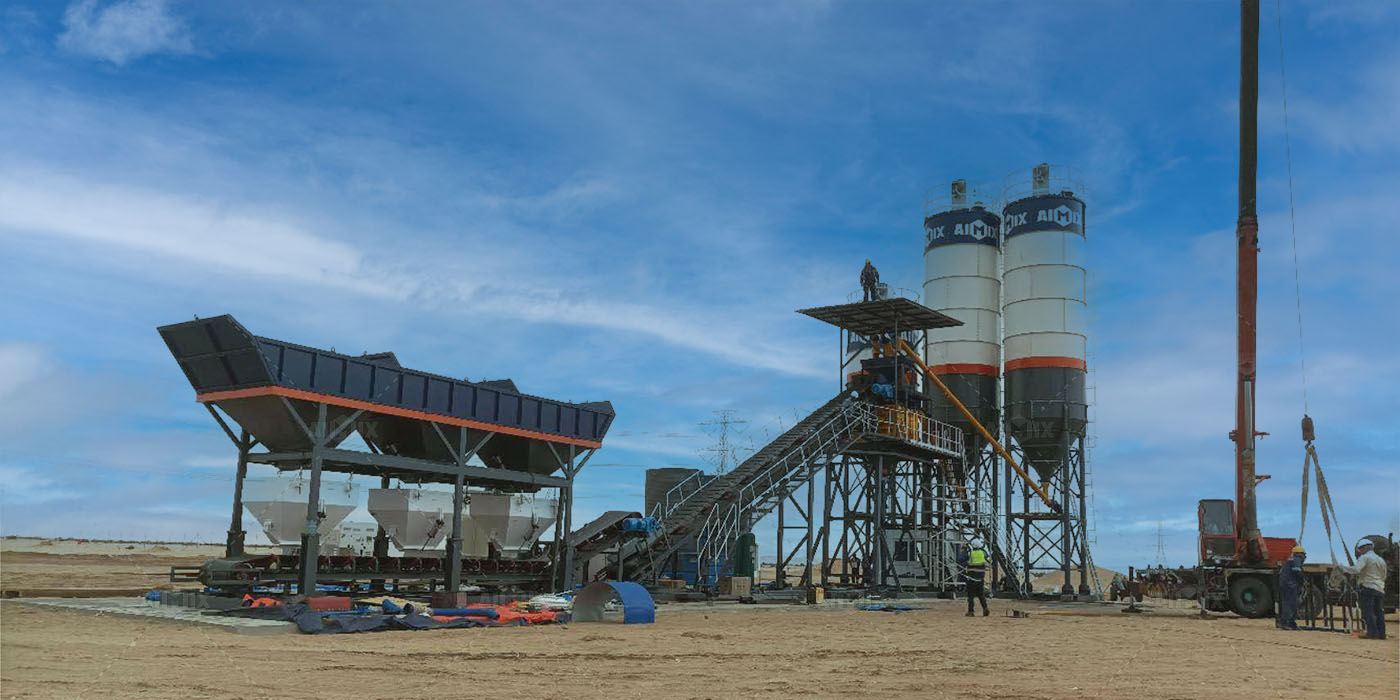
After determining aggregate storage, the next question concerns cement silos. Unlike aggregate bins, cement silos store fine powder materials that require enclosed, moisture-resistant storage and controlled feeding into the batching system.
One important point often causes confusion: C25, C30, and C40 concrete do not automatically require three separate cement silos. These grades refer to concrete strength classes. They do not represent three different types of cement.
The batching plant can produce all three grades using the same cement source while adjusting the mix proportions according to the approved mix designs.
Two Cement Silos: A Practical Starting Point
For a 100 m³/h batching plant supplying conventional C25, C30, and C40 concrete, two cement silos can provide a practical storage arrangement.
For example, the configuration may include:
| Storage Unit | Stored Material | Purpose |
|---|---|---|
| Cement Silo 1 | Ordinary Portland cement | Main cement supply for concrete production |
| Cement Silo 2 | Fly ash or another cementitious material | Supplementary binder for selected mix designs |
This arrangement allows the producer to use different binder proportions for C25, C30, and C40 concrete without physically changing the cement storage system every time the concrete grade changes.
However, the second silo should only store a material that the mix designs actually require. If the producer uses two different cement types, it may be more appropriate to dedicate the silos to those cement types instead.
When Are Three or More Cement Silos Necessary?
Some concrete producers need more than two silos because they use several cementitious materials or serve customers with different technical requirements.
For example, a larger commercial production facility may use:
- Ordinary Portland cement as the primary binder.
- Fly ash as a supplementary cementitious material.
- Ground granulated blast-furnace slag or another approved supplementary binder.
Each material needs separate storage to prevent cross-contamination and maintain accurate batching. Therefore, three silos may be more appropriate for this production strategy.
Some facilities also require additional silos for different cement grades or special-purpose binders. In that case, the number should follow the actual material supply plan rather than the number of concrete strength classes.
3. Do C25, C30, and C40 Concrete Need Different Material Storage?
Although these three concrete grades can use the same aggregate and cement sources, their mix proportions are different. This distinction is important when designing the batching plant’s storage and weighing systems.
The operator selects the required concrete grade through the control system. The system then follows the corresponding mix recipe and adjusts the quantities of cementitious materials, aggregates, water, and admixtures.
How Concrete Grades Affect Material Consumption
In general, higher-strength concrete requires a carefully designed combination of binder content, water-to-binder ratio, aggregate grading, and admixtures. However, cement consumption does not increase according to a fixed formula from C25 to C30 to C40.
For example, a C40 mix may require a lower water-to-binder ratio and a different admixture dosage. Its actual binder content depends on the target strength, aggregate properties, exposure conditions, and project specifications.
The following table illustrates the differences in production management:
| Concrete Grade | Mix Design Considerations | Storage Implications |
|---|---|---|
| C25 | Designed for the specified structural strength and workability | Uses the available aggregate and binder storage |
| C30 | Requires its own approved aggregate, binder, and water proportions | Uses the same storage compartments with different batch quantities |
| C40 | Requires tighter control of water-to-binder ratio and mix performance | May require additional binder or admixture storage depending on the recipe |
Consequently, the batching plant does not need three independent aggregate systems or three cement silos simply because it produces three concrete grades. A properly configured plant can switch between recipes through its automatic control system.
Why Separate Aggregate Storage Matters
Although different concrete grades can share the same aggregate compartments, different aggregate sizes must remain separated during storage.
If sand and crushed stone become mixed, the actual grading may differ from the intended mix design. This can affect workability, water demand, strength development, and concrete consistency.
Separate compartments also help operators manage aggregate moisture. Sand often contains more variable moisture than coarse aggregate, especially after rainfall. The control system should account for aggregate moisture and adjust the batch water accordingly.
Therefore, the number of compartments should reflect the aggregate fractions required by the producer’s mix designs, not simply the number of concrete grades.
4. How Much Cement Storage Does a 100 m³/h Batching Plant Need?
Choosing the number of cement silos is only half of the decision. Their storage capacity is equally important.
A 100 m³/h batching plant can consume a substantial amount of cementitious material during continuous production. If the silos are too small, the plant may need frequent tanker deliveries. This can interrupt production and create additional logistics pressure.
To estimate the required capacity, start with the binder consumption per cubic meter.
Calculate Cementitious Material Consumption
Assume the average cementitious material consumption across the C25, C30, and C40 production mix is 320 kg/m³. This is an illustrative planning assumption, not a recommended mix design for every project.
At the rated output of 100 m³/h:
100 m³/h × 320 kg/m³ = 32,000 kg/h
Therefore, the theoretical binder consumption reaches 32 tonnes per hour at full rated production.
If the plant operates at an illustrative sustained output of 70 m³/h, the consumption becomes:
70 m³/h × 320 kg/m³ = 22.4 tonnes/h
This calculation shows why silo capacity should reflect actual production hours, mix proportions, and delivery frequency.
Example: Two 100-Tonne Cement Silos
Suppose a producer installs two 100-tonne silos. The total nominal storage capacity is 200 tonnes.
If the plant consumes 22.4 tonnes of cementitious materials per hour, 200 tonnes represents approximately 8.9 hours of theoretical consumption, assuming both silos contain materials used in the production mix.
However, the actual usable buffer depends on the distribution of materials between silos. For example, if one silo contains cement and the other contains fly ash, the plant cannot simply treat the combined capacity as interchangeable cement storage.
Producers should also leave sufficient operating space for safe filling and avoid relying on the entire nominal silo capacity. The final design should account for usable volume, bulk density, delivery frequency, and material consumption.
5. How Should Aggregate Storage Capacity Match 100 m³/h Production?
Even with four or six aggregate compartments, insufficient storage capacity can interrupt concrete production. Therefore, aggregate bin capacity should match the plant’s hourly consumption and the frequency of aggregate deliveries.
For a 100 m³/h batching plant, consider the aggregate demand over several hours rather than calculating storage from the number of compartments alone.
Estimate Aggregate Consumption
For an illustrative calculation, assume the combined sand and coarse aggregate consumption is 1.8 tonnes per cubic meter of concrete.
At 100 m³/h:
100 m³/h × 1.8 tonnes/m³ = 180 tonnes/h
At an operating output of 70 m³/h:
70 m³/h × 1.8 tonnes/m³ = 126 tonnes/h
This means the plant may require approximately 126 tonnes of aggregate every operating hour under the assumed production conditions.
If the producer wants two hours of aggregate storage at this operating rate, the total usable aggregate inventory would need to cover approximately 252 tonnes.
The actual requirement depends on aggregate density, grading, moisture, compartment geometry, and how frequently loaders replenish the bins.
Distribute Storage Capacity According to Mix Demand
Not every aggregate fraction has the same consumption rate. A plant may use more sand and 10–20 mm stone than other aggregate sizes.
Therefore, equal-sized compartments are not always the best solution. The producer should allocate more capacity to the fractions with higher consumption or longer replenishment intervals.
For example, a plant producing large volumes of conventional structural concrete may need greater storage for its main sand and coarse aggregate fractions. A producer handling specialized mixes may require a different distribution.
6. Recommended Storage Configurations for Different Production Requirements
At this stage, the number of aggregate compartments and cement silos should become clearer. However, the ideal configuration still depends on the producer’s business model and the types of concrete supplied.
The following configurations provide practical starting points for comparing different production requirements.
| Production Requirement | Aggregate Compartments | Cement Silos | Typical Application |
|---|---|---|---|
| Standard C25, C30, C40 production | 4 | 2 | Conventional ready-mix supply |
| Multiple aggregate grading requirements | 5 | 2–3 | Commercial and infrastructure concrete |
| Multiple aggregate and binder types | 6 | 3 or more | Specialized and diversified concrete production |
These are indicative configurations rather than fixed manufacturer standards. Actual bin dimensions, silo capacities, weighing systems, and material handling arrangements require project-specific engineering.
7. Other Equipment That Supports Continuous C25, C30, and C40 Production
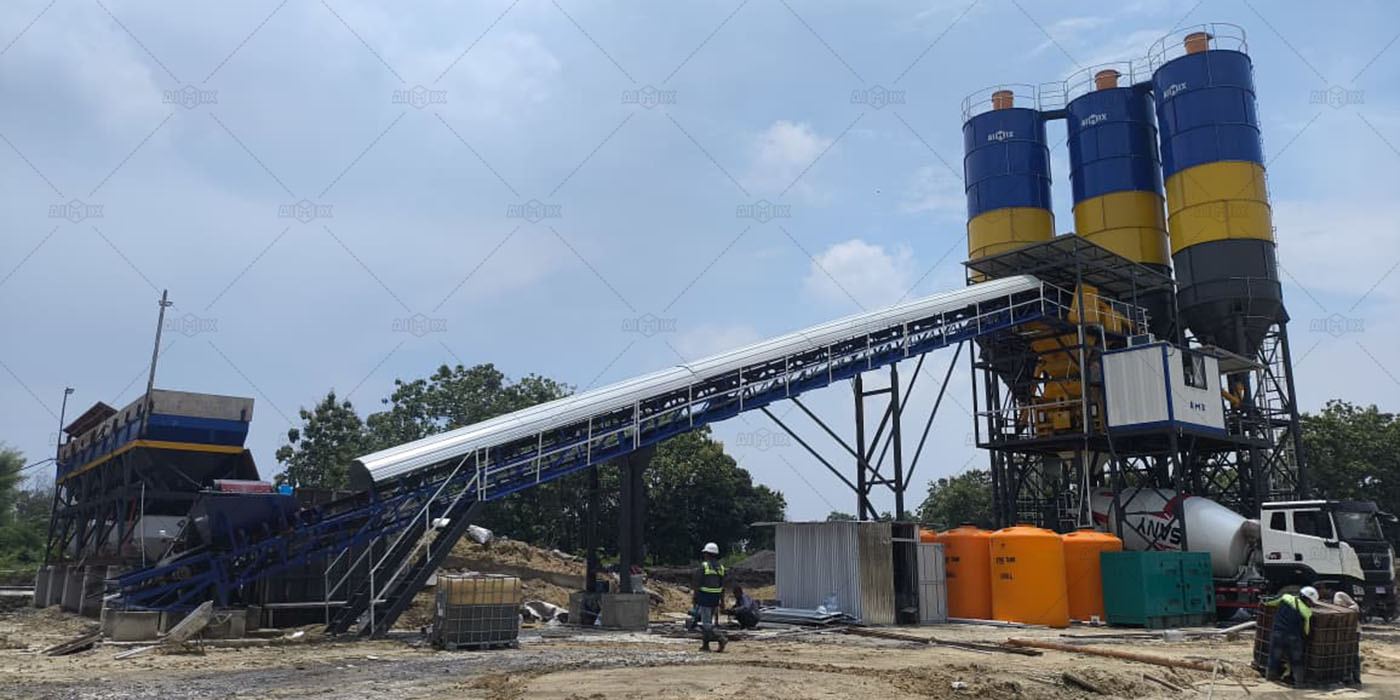
Aggregate bins and cement silos provide the basic storage infrastructure. However, a 100 m³/h plant also needs accurate weighing, reliable conveying, and appropriate material control to maintain consistent concrete quality.
For ready-mix producers evaluating an rmc plant for sale, it is important to assess the complete production line. The storage arrangement must work together with the weighing, conveying, mixing, and control systems to support the required concrete output.
Independent Aggregate Weighing System
Each aggregate fraction should enter the batching process according to the selected mix recipe. The weighing system must measure the required quantities accurately and consistently.
This becomes especially important when the plant switches between C25, C30, and C40 production. Different recipes may require different aggregate proportions, so accurate batching helps maintain the intended grading and mix consistency.
Separate Cement Weighing and Feeding System
Each cementitious material should have an appropriate feeding and weighing arrangement. Screw conveyors transport materials from the silos to the weighing hopper.
Separate material handling paths help prevent cross-contamination. They also allow the control system to adjust cement and supplementary binder quantities according to each mix design.
Water and Admixture Dosing Systems
Water control plays an important role in concrete production. The batching system should account for aggregate moisture and adjust the added water accordingly.
Admixtures also require accurate dosing. Depending on the C25, C30, and C40 recipes, the producer may use water reducers, superplasticizers, or other approved additives.
Therefore, the plant configuration should include suitable admixture storage tanks, metering equipment, and automatic dosing controls.
Automatic Control System
An automatic batching control system allows operators to store multiple concrete mix recipes and switch between them during production.
For a producer supplying C25, C30, and C40 concrete, this feature helps manage different material proportions without manually recalculating every batch. It also supports production records, batching accuracy, and operational monitoring.
8. What Mistakes Should You Avoid When Configuring a 100 m³/h Batching Plant?
Choosing the correct number of bins and silos can improve production efficiency. Nevertheless, several common planning mistakes can increase operating costs or cause unnecessary interruptions.
Choosing Three Cement Silos Just Because You Produce Three Concrete Grades
This is a common misunderstanding. C25, C30, and C40 are strength classes, not three different cement types. If all three mixes use the same cement source, separate silos for each grade are unnecessary.
Installing Too Few Aggregate Compartments
If the producer uses several aggregate sizes but installs too few compartments, operators may struggle to keep materials separated. This can affect grading accuracy and production flexibility.
Ignoring Actual Storage Consumption
A plant may have enough bins and silos by number but insufficient storage volume. This creates frequent replenishment requirements and increases the risk of production interruptions.
Overlooking Future Concrete Demand
A producer may initially supply only C25, C30, and C40 concrete. However, future customers may request different aggregate gradings, supplementary cementitious materials, or specialized concrete mixes.
Planning some additional storage flexibility can reduce the need for major equipment modifications later. However, additional compartments and silos should still have a clear operational purpose.
9. Final Recommendation: How Should You Configure Your 100 m³/h Batching Plant?
For a conventional ready-mix concrete producer supplying C25, C30, and C40 concrete, a four-compartment aggregate storage system and two cement silos are a reasonable starting point.
The four aggregate compartments can separate the main sand and coarse aggregate fractions, while two cement silos can accommodate the primary cement supply and an additional cementitious material when the mix designs require one.
If your business uses more aggregate sizes or several binder types, consider five or six aggregate compartments and three or more cement silos. More importantly, calculate the required storage capacity based on actual hourly consumption and material delivery intervals.
Before finalizing the equipment configuration, evaluate these five factors:
- Concrete grades: Confirm the approved C25, C30, and C40 mix designs.
- Aggregate types: Identify every sand and crushed stone fraction used in production.
- Binder materials: Determine whether you need cement only or additional materials such as fly ash or slag.
- Production schedule: Calculate hourly material consumption and expected operating hours.
- Supply conditions: Consider tanker delivery frequency, aggregate transportation, site space, and future production expansion.