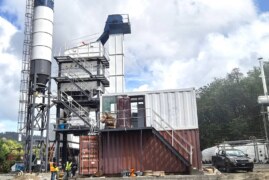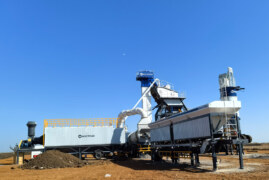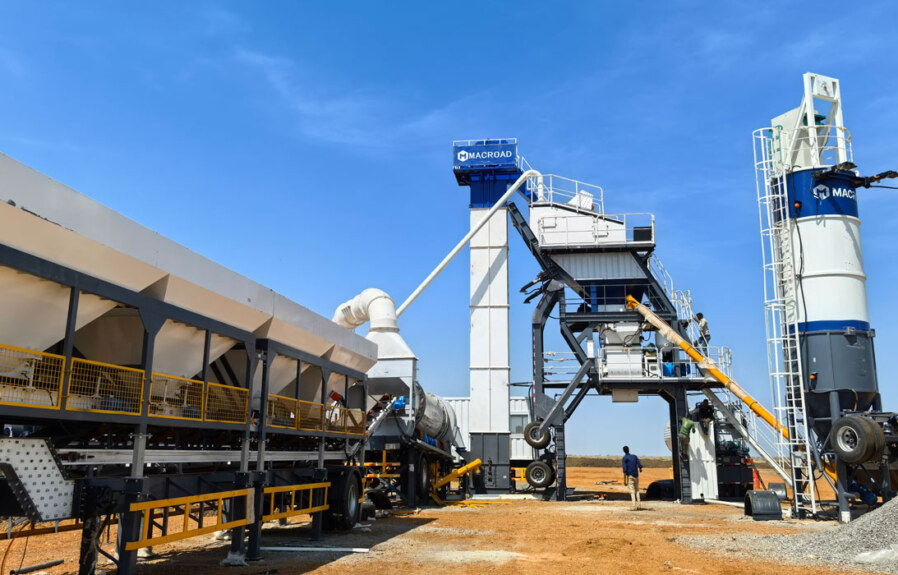
Foundation-free mobile asphalt plant deployment in restricted mining logistics directly determines thermal management requirements for asphalt paving machine for sale configurations. Thin-air burner derating at elevation reduces plant output, necessitating adjusted screed heating speed and hopper capacity to prevent thermal segregation. This equipment synchronization preserves pavement quality and mitigates liquidated damage exposure under 2026 infrastructure budget constraints.
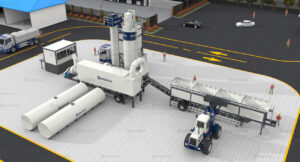
Foundation-Free Mobility Enables Proximity Positioning
Standard fixed installations require concrete foundations that remote mining corridors cannot accommodate economically. Mobile asphalt plant configurations utilizing steel skid mounting achieve operational stability without civil works, permitting positioning within 15-20 kilometers of paving faces versus 60-80 kilometer hauls from permanent facilities. This proximity compression reduces transport time from 90-120 minutes to 25-35 minutes, preserving mix temperature within workable viscosity ranges.
Thermal efficiency gains accompany logistics optimization. Reduced haul distances minimize radiative and convective heat loss, maintaining discharge temperatures within 8-12°C of plant output versus 25-30°C depression from extended mountain transport. Consequently, asphalt paving machine for sale specifications can prioritize placement precision over extreme thermal retention capacity, optimizing capital deployment across equipment classes.
From an operational perspective, rapid repositioning capability matches plant location to advancing mining faces without production interruption. This flexibility proves essential in open-pit operations where haul road geometry shifts quarterly, rendering fixed plant investments economically unviable.
Altitude Derating Adjusts Thermal Workflow
Combustion efficiency degradation at 3,000-4,000 meters reduces mobile asphalt plant output by 20-25% due to oxygen availability constraints. Standard 160 TPH configurations achieve only 120-130 TPH at altitude, extending batch cycles and creating intermittent material availability that paver operations must accommodate.
Screed heating speed adjustment compensates for reduced material head continuity. Electric screed heating systems with 8-12 kW capacity maintain 140-150°C surface temperature despite lower placement rates, preventing thermal stratification that would generate density deficiencies. Specifically, reduced paving speed from 4.5 m/minute to 3.0-3.5 m/minute ensures uniform compaction while matching derated plant output.
Hopper capacity expansion from 12-ton to 18-ton configurations provides thermal buffering during intermittent supply. This enlarged reservoir maintains material head depth above 60% during 8-10 minute truck exchange intervals, preventing auger starvation and the longitudinal streaking that results from partial hopper discharge. Insulated hopper walls with 100mm ceramic fiber reduce heat loss to 5-8°C per hour, extending workable time during supply interruptions.
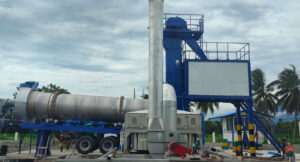
Synchronization Mitigates Financial Exposure
Thermal segregation generating density deficiencies triggers quality audit failures with catastrophic cost implications. Core sampling rejection of segregated sections mandates removal and replacement at $800-1,200 per ton, while schedule delays accumulate liquidated damages of $5,000-10,000 daily under 2026 fixed-price contracts. Equipment synchronization preventing these defects preserves retention money and commercial reputation.
Budget constraints amplify defect severity. Tighter infrastructure margins in 2026 reduce contingency allowances, transforming quality failures from recoverable overruns into project-threatening losses. Mobile asphalt plant and asphalt paving machine for sale coordination eliminating thermal defects thus determines project viability rather than merely optimizing economics.
Documentation automation supports audit defense. Integrated telemetry recording plant discharge temperatures, haul durations, and paver hopper thermal profiles provides evidence chains demonstrating specification compliance. This data preservation proves essential when agency inspectors challenge pavement uniformity in high-altitude environments where environmental stressors complicate quality attribution.
Conclusion
High-altitude mining road construction demands equipment synchronization that foundation-free mobile asphalt plant configurations enable through proximity positioning and workflow flexibility. Thin-air derating necessitates asphalt paving machine for sale adjustments in screed heating and hopper capacity to prevent thermal segregation. Consequently, thermal management coordination between plant and paver transforms elevation challenges from quality risks into manageable operational parameters, preserving project economics under constrained 2026 infrastructure budgets.