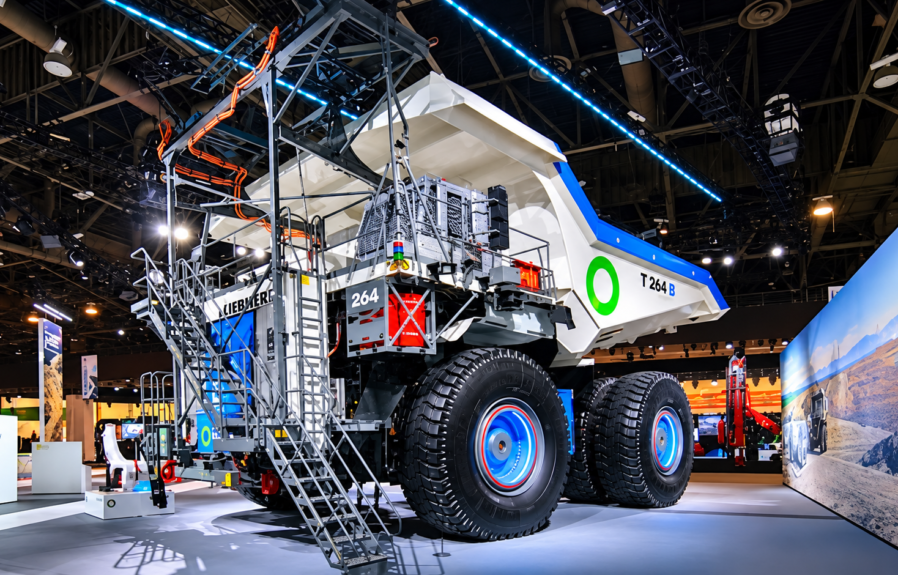
Ultra-class haul trucks are critical for surface mining with payload capacities between 270 to over 400 metric tonnes. Such trucks utilize around 30-50% of total energy at the site and produce about 68 million metric tonnes of carbon dioxide per year worldwide (Ahluwalia et al., 2023; CharIN Taskforce, 2024; TU Delft, 2026). The operators of global mines experience great pressure regarding decarbonization of such heavy fleets, which leads to a technological race between battery electric vehicles (BEVs) and fuel cell electric vehicles (FCEVs).
Both technologies offer their own mechanical and operational benefits. BEVs are characterized by high efficiency and low operation costs, while significant weight of batteries results in a considerable payload loss and requires frequent recharging time. FCEVs have the potential to recharge quickly similarly to conventional diesel trucks; however, they are characterized by thermodynamical losses, high green hydrogen production costs, and complex vehicle architecture (Ahluwalia et al., 2023; Kanchiralla et al., 2026).
This research evaluates the operational, financial, and strategic relationship between BEVs and FCEVs for hauling. According to evidence of current site trials, engineering modeling, and company strategy changes, it can be claimed that BEVs, especially those powered with a trolley system, will dominate commercial adoption soon. FCEVs will remain a specialized technological niche, which can be used in cases of extremely challenging duty cycle or off-grid mines with access to local renewable energy sources.
The operational productivity of surface mining is defined in terms of maximum haulage capacity measured in tonne-kilometers per hour. Refueling downtime impacts truck availability and income directly. Hydrogen fuel cell mining trucks need 10 minutes to be refuelled, allowing continuous 22-hour operation per day under intensive shifts (H2 Energy, 2025; TU Delft, 2026). Ultra-class battery-electric trucks, in turn, require 2 to 4 hours of static charge downtime per shift. Consequently, this means that static battery-electric trucks must lose 2,100 working hours per truck per year (H2 Energy, 2025).
Weight of energy storage is another major difference between the two types of trucks. Systems using compressed or liquid hydrogen provide greater gravimetric energy density compared to lithium-ion batteries (DoT, 2018). Weight of a fuel cell stack together with a liquid hydrogen tank will always be much lower than those of battery packs providing all-day performance. Ultra-class hydrogen haul trucks have 10 to 15 metric tonnes cargo capacity more than purely battery-electric trucks having the same gross vehicle weight (H2 Energy, 2025).
As for thermodynamic efficiency, it works in favor of battery-electric design. Well-to-wheel efficiency in direct battery electrification reaches 60% (DoT, 2018; Kanchiralla et al., 2026). Chain of hydrogen provision includes losses from 60% to 80% of the renewable energy used in water electrolysis, compression or liquefaction, transportation and reconversion into electricity (Fortescue, 2023; Kanchiralla et al., 2026). Fuel cell stacks have significant heat dissipation challenges in mining hot environments. Heat rejection is limited to 50% of total peak power due to radiator frontal area; therefore, hybrid battery packs are necessary to provide power during climbs along mine ramps (Ahluwalia et al., 2023). Liquid hydrogen has the problem with the volume of storage space onboard as it takes 2.7 to 2.8 times more volume than standard diesel fuel tank (Ahluwalia et al., 2023; Mine Sustainability, 2025).
| Performance / Economic Parameter | Battery-Electric Vehicles (BEV) | Hydrogen Fuel Cell Hybrids (FCEV) |
| Refueling / Recharging Time | 2 to 4 hours (static downtime) | 10 minutes (continuous 22-hr availability) |
| Payload Impact (300-tonne class) | Massive battery weight reduces payload | 10 to 15 tonne payload advantage preserved |
| Well-to-Wheel Energy Efficiency | High (~60% efficiency) | Low (~20–35% efficiency; 60–80% energy loss) |
| TCO Parity Threshold | Competitive at current electricity rates | Requires green hydrogen below $4.00/kg |
| Primary Operational Focus | Regional delivery & trolley-assist routes | Captive off-grid mines & heavy long-haul |
The expense of fuel is in the range of 65-75% of the total cost of ownership for ultra-class haul trucks (Ahluwalia et al., 2023). It has been found through techno-economic evaluations that hydrogen fuel cell trucks only reach parity in terms of total cost with diesel or battery-electric platforms when the price of green hydrogen is equal to or less than approximately $3.96 – $5.79 per kg (Ahluwalia et al., 2023; Rathke et al., 2025; H2 Energy, 2025). Currently, the cost of delivered green hydrogen ranges from approximately $4.95 to more than $6.00 per kg, giving a clear advantage to the other two systems (H2 Energy, 2025).
The capital investment and component replacement schedules impact the economics of a fleet as well. The fuel cells need expensive replacements or voltage clamping and catalyst overload to achieve a 25,000-hour lifetime. Electrolysers and high-pressure or cryogenic refueling stations require significant capital investments as well. This has resulted in changes in the zero-emission technology roadmap of many of the leading mining companies.
Some leading players have directed their capital into the electrification of the batteries. Fortescue has already spent significant capital on fuel cells but has changed its focus to battery-electric trucks since hydrogen requires almost thrice the amount of renewable energy production capacity as well as land usage (Fortescue, 2023).
The Anglo American company has started the nuGen project by utilizing a 290-tonne Komatsu 930E fitted with a 2 MW hydrogen-battery hybrid powertrain since May 2022 in South Africa (Anglo American, 2022). However, capital funding has been suspended in early 2024 and has delayed the zero-emission commercial launches after 2030 (TU Delft, 2026). Major OEMs and mining consortia have started the standardization process of Dynamic Charging Interfaces (DCI) of trolley-assist lines. Battery trucks can get charged using in-motion charging technology in steep mine ramps eliminating the downtime period (CharIN Taskforce, 2024).
The grid-independent captive surface mines represent the most convincing case study for fuel cell haulage (TU Delft, 2026). Remote open pit mines that are located at large distances from the main power grids avoid the cost of upgrading by producing power using renewable sources such as solar or wind energy. Electrolysers produce hydrogen from renewable energy sources that are available locally, thus avoiding infrastructure restrictions and energy losses (TU Delft / NBI, 2021). Within this closed system, fast refueling capability and no payload reduction compensate for the lower efficiency of fuel cells.
Commercialization outside the captive sites faces several structural challenges. Traditionally, fuel cell projects involved one corporate sponsor that took over most risks related to funding and technological development. Project discontinuation usually occurs due to company restructuring or financial problems resulting in the underutilization of existing assets (TU Delft, 2026). The lack of public and private co-funding as well as risk sharing discourages the second mover operators from ordering their vehicles (TU Delft, 2026). Finally, the information collected from single truck pilots is stored privately by companies and does not reach the rest of the mining industry (TU Delft, 2026).
Battery electric power assisted by dynamic trolley charging systems has taken an unmistakable lead in short-term decarbonization of heavy mine haulage systems. The energy efficiency advantage of battery systems combined with lower energy costs and OEM standardization makes them a favorable choice for majority of open-pit mining projects. Hydrogen fuel cells play an important role in mining and are not intended to become a full replacement of diesel power sources. Fuel cells are best suited for heavy haul range extender hybrid applications, high altitude and cold environment operations or remote off-grid mines having cheap renewable energy supply. Three main advancements are needed to bring hydrogen mining operations to commercial level. Firstly, the price of green hydrogen must fall under $4.00 per kilogram. Secondly, there is a need to harmonize standards of heavy duty refueling worldwide. Lastly, co-funding framework should appear to take on the risks of early adopters.
References
Ahluwalia, R. K., Wang, X., Papadias, D. D., & Star, A. G. (2023). Performance and Total Cost of Ownership of a Fuel Cell Hybrid Mining Truck. Energies, 16(1), 286.
CharIN Taskforce & ICMM. (2024). White Paper Dynamic Charging Interface (DCI) of CharIN Mining Taskforce (Version 1.0).
Fortescue / Global Road Technology. (2023). Fortescue Pursues Battery Haul Trucks over Hydrogen.
H2 Energy Solution. (2025). Operational Time Value Disrupts the Economics of Mine Haulage.
Kanchiralla, F. M., Laurin, M. O., Brynolf, S., & Grahn, M. (2026). Battery-Electric vs. Hydrogen: Modeling decarbonization pathways and environmental trade-offs of global road freight. Advances in Applied Energy, 22, 100278.
Mine Sustainability Modeling Research Group. (2025). Retrofitting Diesel Haul Trucks with Hydrogen: Challenges and Design Imperatives.
Rathke, P., Filsinger, D., Di Modica, D.-V., Fink, S. K., Pohl, E., & von Unwerth, T. (2025). Investigation on total cost of ownership for fuel cell truck in heavy duty long haul application. International Journal of Hydrogen Energy, 193, 152352.
TU Delft Repository. (2026). MASTER THESIS Explaining the Deployment Gap for Fuel-Cell Vehicles in South Africa.