
Choosing between a cone crusher and an impact crusher for secondary crushing depends mainly on raw material characteristics, required aggregate quality, production capacity, and operating costs. A cone crusher is generally more suitable for hard, abrasive rocks such as granite and basalt, while an impact crusher is often preferred for softer, less abrasive materials such as limestone. The right choice helps a stone crushing plant maintain stable production while controlling wear costs and meeting final product specifications.
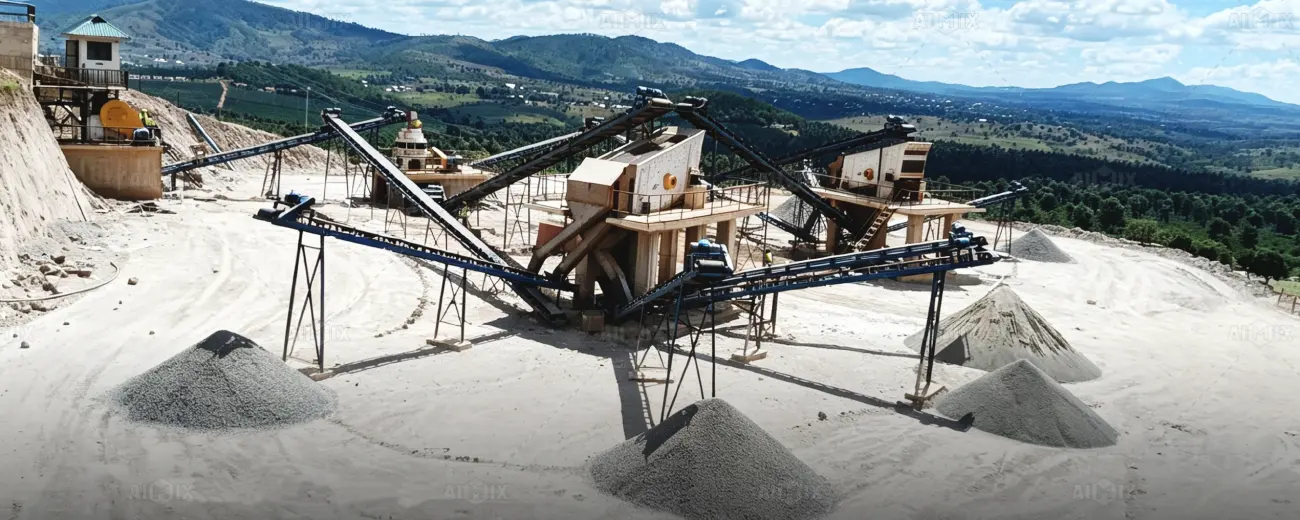
1. Evaluate Raw Material Hardness and Abrasiveness
Raw material properties should be the first consideration when selecting secondary crushing equipment. Although both machines can reduce material from a primary crusher, their crushing mechanisms respond differently to rock hardness and abrasiveness.
A cone crusher uses compression to break stones between a moving mantle and a stationary concave. This mechanism makes it suitable for processing hard and abrasive materials, including granite, basalt, and quartzite. Its wear components are generally better suited to continuous hard-rock production, helping control long-term operating costs.
An impact crusher uses high-speed rotating blow bars to strike materials against impact plates. It is effective for softer to medium-hard rocks, such as limestone and dolomite, because these materials can be reduced efficiently without excessive wear on the blow bars.
For highly abrasive materials, an impact crusher may require more frequent replacement of wear parts. Therefore, operators should evaluate both compressive strength and abrasion characteristics rather than selecting equipment based on rock hardness alone. Material testing and trial crushing can provide a more reliable basis for equipment selection. <Cite refs={[“turn502767search1″,”turn502767search4”]}/>
2. Compare the Required Aggregate Particle Shape
The final aggregate specification is another important factor. Different construction applications require different particle shapes, and the secondary crusher directly influences the finished product.
Impact crushers generally produce more cubical particles because the material fractures under repeated impact. This makes them attractive for producing aggregates used in concrete and asphalt, where particle shape can affect workability, compaction, and performance.
Cone crushers produce aggregates through compression and interparticle crushing. Their particle shape depends on factors such as chamber design, feed distribution, closed-side setting, and operating conditions. Proper choke feeding helps improve product consistency and reduce elongated particles.
If the project requires a high proportion of cubical aggregate, an impact crusher may offer an advantage. However, a properly configured cone crusher can also produce suitable aggregate shapes, particularly when processing hard rock. The final decision should be based on actual product testing rather than assuming one machine always delivers better quality.
3. Consider Reduction Ratio and Production Requirements
The required size reduction determines how effectively each crusher can handle the material discharged from the primary stage.
Impact crushers can achieve a relatively high reduction ratio in one crushing stage. This can simplify the production circuit when the feed material is suitable and the required output size can be achieved without additional crushing.
Cone crushers are commonly used for secondary and tertiary crushing in high-capacity aggregate operations. They provide controlled reduction of hard materials and can maintain consistent production when the feed size, chamber configuration, and operating settings are properly matched.
Before choosing either machine, calculate the required hourly output and identify the target sizes of finished aggregates. Then compare the crusher’s actual capacity under the expected feed conditions. A machine’s rated capacity alone does not guarantee that the entire stone crushing plant will achieve the required production volume.
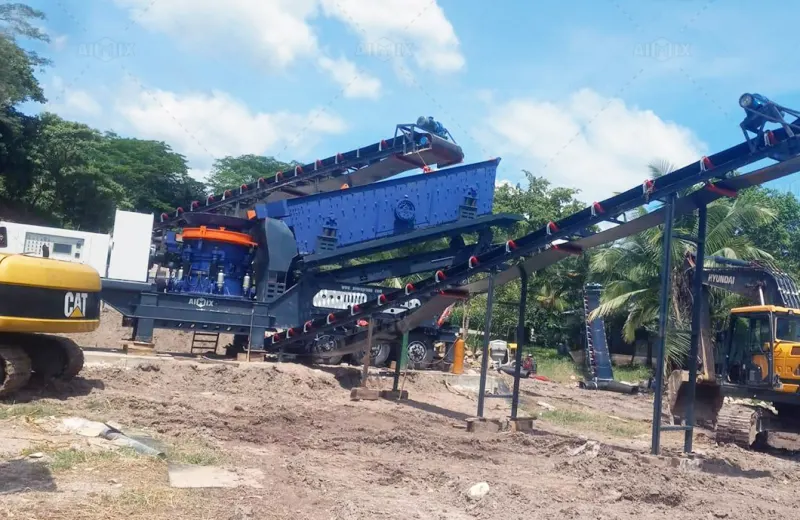
4. Compare Wear Parts and Long-Term Operating Costs
The initial equipment investment is only one part of the total cost of operating a crushing plant. Wear parts, maintenance frequency, energy consumption, and production interruptions all influence the cost per ton.
For hard and abrasive rocks, cone crushers often offer lower operating costs because their crushing mechanism is better suited to sustained compression duty. Impact crushers can have higher wear-part consumption when processing abrasive materials, particularly when blow bars and impact plates need frequent replacement.
For softer limestone or other less abrasive materials, an impact crusher may provide an economical solution by achieving substantial size reduction and producing well-shaped aggregates in a single stage.
When evaluating the stone crusher plant price, buyers should therefore compare the complete operating arrangement rather than focusing only on the purchase price of the secondary crusher. A lower initial investment may not represent better value if wear-part expenses and downtime increase significantly over the plant’s service life.
5. Match the Secondary Crusher to the Complete Plant Configuration
A secondary crusher should not be selected independently of the other equipment in the production line. Its performance depends on the primary crusher, feeder, vibrating screen, conveyors, and finished-product requirements.
For example, a hard-rock plant processing granite may use a jaw crusher for primary reduction, followed by a cone crusher for secondary crushing. If additional particle shaping or fine aggregate production is required, another crushing stage may be added.
For a limestone plant, a jaw crusher followed by an impact crusher may be sufficient for producing several construction aggregate sizes. The screening system can separate finished products and return oversized material for further crushing when a closed circuit is required.
The equipment configuration should also account for feed size, material flow, screening efficiency, and the capacity of downstream equipment. An oversized secondary crusher cannot compensate for an undersized feeder or poorly matched screening system.
6. Use Project Conditions to Make the Final Decision
The best secondary crusher depends on the specific production target and operating environment.
| Selection factor | Cone crusher | Impact crusher |
|---|---|---|
| Suitable materials | Hard and abrasive rock | Soft to medium-hard, less abrasive rock |
| Crushing mechanism | Compression | High-speed impact |
| Particle shape | Depends on feeding and settings | Generally more cubical |
| Wear considerations | Often lower wear costs on abrasive rock | Higher wear risk on abrasive materials |
| Typical application | Granite, basalt, quartzite | Limestone, dolomite, suitable recycled materials |
| Main advantage | Durable hard-rock processing | High reduction and particle shaping |
For projects with variable raw materials, operators should assess whether one machine can handle the full range economically or whether different configurations are needed. Actual material samples, target product specifications, and production trials provide useful evidence before purchasing equipment.
Conclusion
A cone crusher is generally the stronger choice for secondary crushing of hard, abrasive materials, while an impact crusher is often more suitable for softer rocks that require high reduction and cubical aggregates. When comparing options, evaluate material properties, product specifications, production capacity, wear-part consumption, and the complete plant configuration. This approach helps buyers select equipment that meets project requirements and delivers better long-term production economics.