Peru’s mining industry operates across a geographically diverse landscape, from high-altitude Andean regions to remote areas where conventional construction infrastructure can be limited. Mining contractors may need concrete for foundations, access roads, equipment bases, drainage structures, retaining walls, workshops, and temporary facilities, often with these work areas distributed across a large project site. A centralized concrete supply model can become cumbersome when transportation distances are long and construction schedules change frequently. Flexible concrete production therefore becomes an important operational consideration. Equipment such as a self loading mixer in Peru contractors can deploy directly at different work zones offers a practical way to produce and deliver fresh concrete closer to where it is required.
Why Scattered Mining Work Areas Create Concrete Supply Challenges
Long Distances Increase Transportation Complexity
Mining projects are rarely organized around a single compact construction area. A contractor may simultaneously develop haul roads, processing facilities, foundations, drainage channels, worker facilities, and supporting infrastructure at different locations. When concrete is produced at a distant stationary batching plant, every batch must travel from the production point to the placement area. Mountainous terrain and winding access roads can make this journey considerably more complicated than the physical distance suggests. Travel time also affects concrete handling. Fresh concrete needs to maintain suitable workability until placement, while unexpected delays can complicate pouring operations. For remote mining projects, relying entirely on external ready-mixed concrete suppliers may therefore introduce logistical uncertainty.
Concrete Demand Changes as Mining Projects Progress
Concrete requirements are not uniform throughout a mining project. One construction phase may require substantial quantities for foundations, while another may involve relatively small but frequent concrete works distributed across several locations. A large stationary plant can be highly productive, but its fixed nature may not align with this fluctuating demand. Moving concrete production closer to individual work areas can provide greater operational flexibility.
Small Batches Can Be Produced When Needed
Mobile concrete equipment allows contractors to produce concrete according to actual site requirements. Instead of transporting large quantities from a centralized facility, the contractor can prepare smaller batches close to the work area. This approach can be particularly useful for maintenance work, isolated foundations, drainage structures, equipment pads, and other applications where concrete demand is intermittent.
How Mobile Concrete Equipment Supports Peru’s Mining Contractors
Self Loading Mixers Combine Mobility and Concrete Production
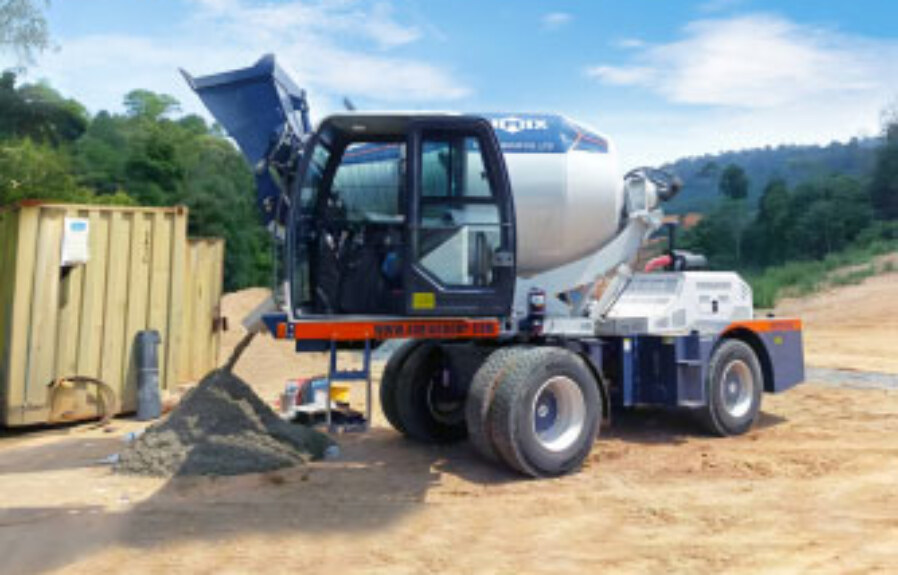
A self-loading mixer integrates material loading, weighing, mixing, and concrete transportation into one mobile machine. This configuration gives contractors greater independence from fixed concrete production facilities. For mining operations, mobility is especially valuable. The machine can travel between different work zones and produce concrete close to the placement location. A self loading mixer Peru solution can therefore function as a mobile concrete production unit rather than simply a transport vehicle. The operator can load aggregates, cement, and water into the mixer, complete the mixing process on site, and then discharge the concrete where required. This reduces the number of separate equipment units involved in the workflow.
A Practical Option for Remote and Difficult Terrain
Peru’s mining regions can present challenging site conditions, including steep gradients, rough access roads, high elevations, and considerable distances between facilities. Equipment intended for these environments needs to combine maneuverability with robust construction. A Peru self loader mixer can be advantageous when concrete must be supplied to areas that are difficult for conventional mixer trucks to access. Rather than depending on a rigid delivery route from a central plant, contractors can move the equipment toward the active construction zone.
Supporting Multiple Concrete Applications
The same mobile mixer can support a range of mining-related construction activities, including: * Equipment foundations and concrete bases * Mine access and service road structures * Drainage channels and culverts * Retaining walls and support structures * Workshops and maintenance facilities * Concrete floors and slabs * Small-scale infrastructure repairs This versatility allows one machine to support multiple phases of construction instead of being dedicated to a single fixed location.
What to Consider When Selecting a Concrete Supply Solution in Peru
Match Equipment Capacity to the Actual Workload
The appropriate concrete production capacity depends on the contractor’s daily demand, placement method, project duration, and distance between work areas. Buying equipment based solely on maximum theoretical output can result in unnecessary capital expenditure, while selecting an undersized machine can create production bottlenecks. Contractors considering a concrete mixer for sale Peru should therefore evaluate the complete operating cycle. Loading time, mixing efficiency, travel distance, discharge time, and the frequency of relocation all influence actual productivity. A machine with moderate output but excellent mobility may be more useful for scattered mining applications than a higher-capacity unit that requires extensive site preparation.
Prioritize Mobility and Independent Operation
Mobility becomes increasingly important when construction points change frequently. A self-loading mixer can move independently between locations, reducing the need for additional loading and transportation equipment. Independent operation also simplifies site logistics. Fewer machines need to be coordinated, and concrete production can be organized around the construction schedule rather than the availability of an external supplier.
Consider Serviceability and Local Support
Mining environments are demanding, so equipment selection should extend beyond specifications. Contractors should consider component durability, ease of maintenance, spare-parts availability, technical support, and operator training. Reliable after-sales support can be particularly important for remote projects because equipment downtime may be more disruptive when replacement machinery or technicians must travel long distances.
Flexible Concrete Supply Improves Overall Project Control
For Peru’s mining contractors, flexible concrete production is ultimately about controlling the relationship between location, timing, and material demand. Scattered work areas make a rigid concrete supply chain increasingly difficult to manage. Mobile equipment provides another route. A self loading mixer Peru contractors deploy across different work zones can reduce transportation dependency, while a Peru self loader mixer can support concrete production where conventional supply methods become inefficient. Contractors comparing a concrete mixer for sale Peru should therefore look beyond purchase price and evaluate mobility, productivity, operating conditions, maintenance, and long-term utilization. In mining construction, concrete does not always need to come from a centralized plant. Sometimes, the more effective solution is to bring concrete production closer to the work itself. For projects spread across Peru’s demanding mining landscapes, that flexibility can translate into simpler logistics, better schedule control, and more responsive construction operations.