Machine learning ore sorting has now moved beyond pilot projects for proof-of-concept studies and is moving into actual industrial implementation, bringing measurable pre-concentration results such as up to 20-40% reduced mill feed, 10-30% increase in head grade, and return on investment periods ranging from 12-36 months when run on full scale. This development is not only made possible by sensing innovations but by machine learning algorithms capable of generalizing over ore variations, interfacing with process control systems, and running according to phased and mine-specific implementation processes.
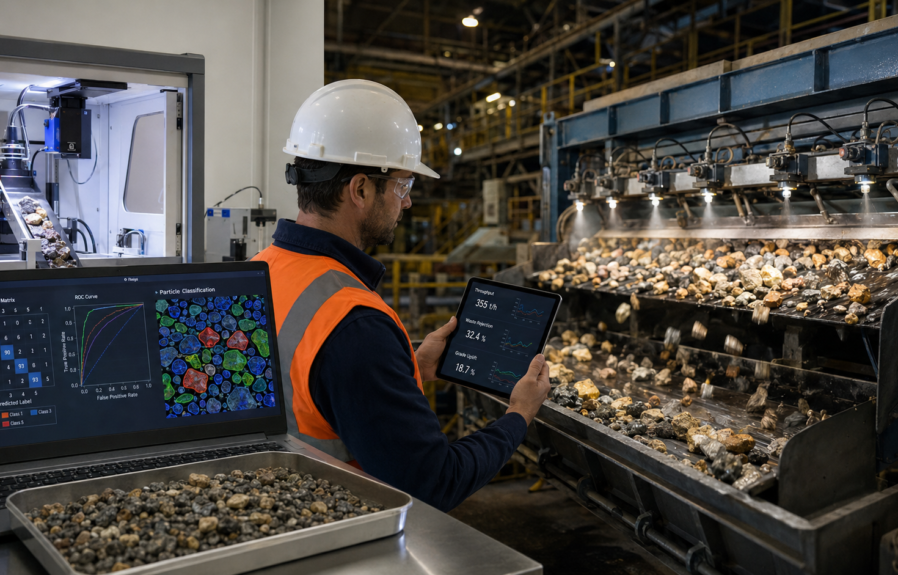
Modern commercial solutions incorporate X-ray transmission (XRT), near-infrared (NIR), hyperspectral or optical cameras, and sometimes X-ray fluorescence (XRF) in combination with machine learning classifiers (usually convolutional neural networks or other types of deep learning models) for enabling particle-by-particle decisions on the conveyor belt at high speed. Sensing and computer vision innovations coming from academic research are being applied in commercial applications as turnkey solutions which include calibration, model training on the mine data, and integration with process control systems/SCADA.
Several recent trials and deployments have consistently yielded economic and operational benefits for several different commodities. For example, a Southern African platinum group metal (PGM) mine using convolutional neural network (CNN) models trained on hyperspectral imagery saved up to 30% in mill feed mass with losses below 2%, saving millions of dollars per year before energy and water benefits were considered.
In the Granada Gold Project, the XRT sorting improved the feed grade from 2.93 g/t to 7.87 g/t with 88% gold recovered and diverting almost two-thirds of the mass before the processing stage. Sorting of low-grade European copper ore via sensors resulted in an increase in grade by 1.82 times (up to 0.91% from 0.48% of Cu), with more than 95% recovery in laboratory and industrial sorters and performing better than selective mining in preliminary assessments.
AI-XRT technology trial by Brazil Potash company at Autazes is targeted towards improving the recovery and grade of potash minerals from the waste rock by sorting them in real-time, specifically to lower costs and improve sustainability parameters. Simulations performed on drill core datasets have shown a potential for doubling or even tripling of head grades and rejection of around 50-60% of mass.
Industry studies and market reviews always feature the return on investment (ROI) story. Payback times quoted for industrial-scale operations are usually between 12 and 36 months. Savings quoted include 20–40% reduced mill feed tonnage, while savings in energy consumption due to grinding can be put at US$1.50–$3.00 per tonne ground. An improvement in the head grade of the mill feed by 10–30% leads to higher metal recovered per kilowatt-hour and reduces bottlenecks in downstream circuits.
Lower quantities of rejects to be fed to the plant lead to a smaller mill size as well as decreased requirements for water and tailings handling infrastructures, in addition to reduced land disturbance – all contributing to faster permitting and ESG objectives achievement. For an intermediate copper operation (5 Mt/y), a sorting plant in the $15–$25 million category has been noted to generate operational savings of $8–$18 million per year, corresponding to a payback period of less than two years at current copper prices.
Previous methods of sorting using sensors were highly dependent on thresholds and rule setting. Machine learning changes the economic dynamics because of its ability to address difficult mineralogy problems, generalize using fewer data points, and increase robustness due to variation. Deep learning models are capable of recognizing small spectral and textural features based on multiple sensors, thus increasing the capability of classification between ores of different types.
Transfer learning and mine-specific fine-tuning help in adapting to the new ore body using only a few thousand labeled examples rather than hundreds of thousands, thus decreasing the time of commissioning. Adaptive real-time analysis reduces false positive and negative classifications due to changing feed compositions (e.g., moisture content, particle size distribution, fouling). As a result, these developments make sorting possible for ore bodies which were not considered viable enough in the past, thus changing cutoff grades and converting “Tier-3” ore bodies into core reserves.
Commercial viability requires more than model performance. Pilot testing needs to cover the entire range of feed variability within representative time periods, as well as end-of-line material under realistic moisture, particle-size, and fouling scenarios. Progressive rollouts, which begin with pre-concentration applications that produce quick wins, provide operating information to back further investment. Sensor fusion, controls and training for operations and maintenance staff are required to ensure sustained performance. Multiple suppliers, flexible business models (like equipment-as-a-service), and local service support help reduce tariff and transportation risks.
In cases where ore grades are declining, energy costs are rising, or where tailings options are limited, machine learning-driven ore sorting has proven itself to be a reliable pre-concentration solution with measurable benefits on numerous commodity types and geographic regions. It lowers the costs per ton, lowers the energy intensity of processing, raises effective cut-off grades, lengthens mine life, reduces tailings volumes, and enhances ESG performance. The next practical step for a specific ore body would be a representative pilot study that considers real operating constraints and a clear return-on-investment model, accounting for energy, water, reagents, and tailings-rather than just throughput.
Machine learning based ore sorting technology has proven itself to be a valid pre-concentration tool, yielding tangible advantages irrespective of commodities or geographic locations. Such advantages involve lower costs per unit, achieving greater cut-off grades, extending the life of mines, and creating less volume of tailings. In mining operations where declining grades, higher energy costs, and tailing limitations exist, the technology is a definite solution for improving economics and ESG, subject to its use through pilot trials and subsequent roll-out.