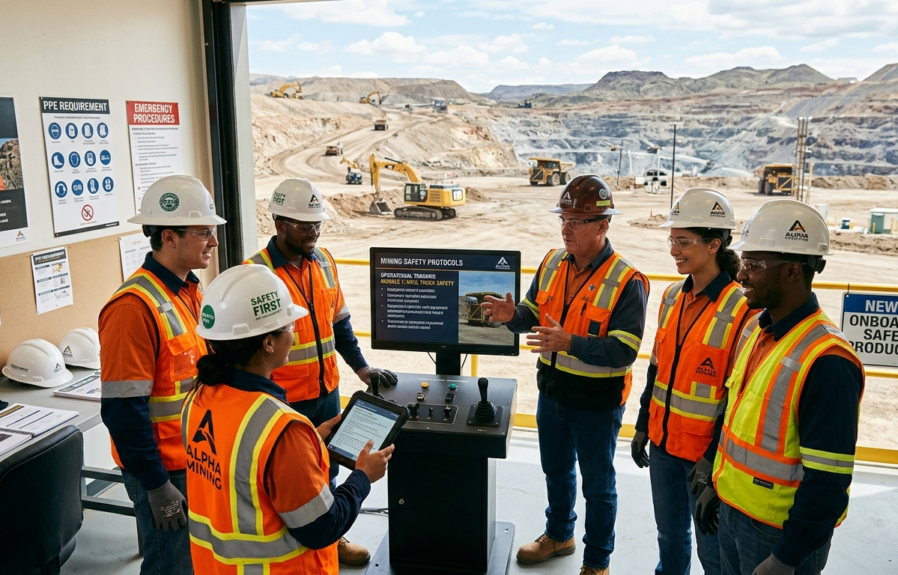
The mining industry depends on skilled workers who can perform their responsibilities safely and efficiently from their first day on site. However, bringing a new employee into a mining operation involves much more than completing paperwork and introducing them to their team.
Mining employees may need to understand site-specific hazards, equipment, emergency procedures, communication protocols, environmental requirements, and operational processes before they can work independently. A structured employee onboarding process can help companies reduce confusion, improve safety awareness, and help new workers become productive more quickly.
Why Employee Onboarding Matters in Mining
Mining environments can be complex. New employees may be working around heavy machinery, vehicles, explosives, processing equipment, underground operations, or other high-risk environments.
A poorly structured onboarding process can leave employees unsure about procedures or responsibilities. In contrast, a well-designed onboarding program gives workers the information and practical knowledge they need before they begin performing their regular duties.
Effective onboarding can help mining companies:
- Improve understanding of workplace hazards
- Introduce employees to site-specific safety procedures
- Reduce mistakes caused by unfamiliarity
- Improve communication between workers and supervisors
- Build confidence among new employees
- Support faster integration into mining teams
- Establish expectations around safety and performance
Onboarding should therefore be viewed as part of the company’s overall workforce and safety strategy rather than simply an administrative process.
Start Before the Employee Arrives
A strong onboarding process can begin before a worker reaches the mining site.
Companies can provide new employees with basic information about the operation, their role, required personal protective equipment, transportation arrangements, accommodation, work schedules, and important workplace policies.
Providing this information in advance allows employees to arrive prepared and reduces the amount of administrative work that must be completed on their first day.
Digital onboarding platforms can also help companies organize documents, training requirements, certifications, and employee information before the worker begins.
Introduce Workers to Site-Specific Risks
Generic safety training is not enough for mining operations. Every mine has its own layout, equipment, procedures, environmental conditions, and hazards.
During onboarding, employees should receive information about the specific site where they will work. This may include:
- Emergency exits and evacuation routes
- Muster points
- Restricted areas
- Vehicle and pedestrian routes
- Communication procedures
- Required PPE
- Equipment hazards
- Emergency response procedures
- Reporting processes for incidents and near misses
A site orientation can make this information easier to understand because employees can connect the training with their actual working environment.
Combine Classroom Training With Practical Learning
Traditional classroom training has an important role, but mining onboarding should not rely entirely on presentations and written materials.
New employees can benefit from practical demonstrations, supervised activities, equipment familiarization, and site tours.
For example, an equipment operator can learn the relevant procedures in a classroom before completing supervised practical training. This approach gives employees an opportunity to understand both the theory and the real-world application of their responsibilities.
Technology can also support this process. Mining companies are increasingly exploring tools such as virtual reality for training and familiarization, allowing employees to experience simulated environments before entering certain high-risk situations.
Assign an Experienced Mentor
One of the simplest ways to improve onboarding is to connect new employees with experienced workers.
A mentor can help a new employee understand how work is actually performed on site, answer questions, explain informal processes, and provide guidance during the early stages of employment.
Mentorship is particularly valuable in mining because experienced workers often possess operational knowledge that cannot be fully captured in manuals or classroom training. Mining Doc has also covered mentorship as an important strategy for knowledge transfer and employee retention.
Use a Structured Onboarding Checklist
A standardized onboarding checklist can help ensure that important steps are not missed.
For example, a mining onboarding checklist could include:
- Employment and identification documents
- Medical and fitness requirements
- Site induction
- Safety training
- PPE requirements
- Emergency procedures
- Equipment-specific training
- Environmental responsibilities
- Role-specific training
- Mentor assignment
- Supervisor review
- Final competency assessment
The checklist should be adapted to the employee’s position and the requirements of the specific mining operation.
Measure Onboarding Effectiveness
Mining companies should not assume that onboarding is successful simply because an employee completed the required training.
Companies can evaluate onboarding by monitoring factors such as:
- Training completion rates
- Assessment results
- New employee feedback
- Safety observations
- Near-miss reporting
- Early performance indicators
- Employee retention
- Time required to reach competency
Regular feedback can also reveal where new employees are struggling. If several workers have difficulty understanding the same procedure, the company can improve that part of the onboarding program.
Make Onboarding an Ongoing Process
Employee onboarding should not end after the first day or first week.
Mining employees may need additional training as they move into new roles, operate different equipment, or take on additional responsibilities.
A strong onboarding program can therefore continue throughout the employee’s first several months. Regular check-ins with supervisors and mentors can help identify knowledge gaps and provide additional support.
Conclusion
Effective employee onboarding is an important part of building a safer and more productive mining workforce. By combining site-specific safety training, practical learning, mentoring, digital tools, and continuous performance reviews, mining companies can help new employees become confident and competent members of their teams.