Mining ERP Series | Part 4
When Every Missing Part Costs More Than Its Price
Mining companies invest millions in heavy machinery, automation, and infrastructure, yet one overlooked spare part can bring an entire operation to a standstill. While production and maintenance often receive the spotlight, inventory and procurement quietly determine whether mining operations run efficiently or face costly disruptions.
The challenge is rarely about having too much or too little inventory—it is about having the right materials, at the right location, at the right time. Without real-time visibility and connected procurement processes, organizations risk unnecessary downtime, rising costs, and inefficient capital utilization.
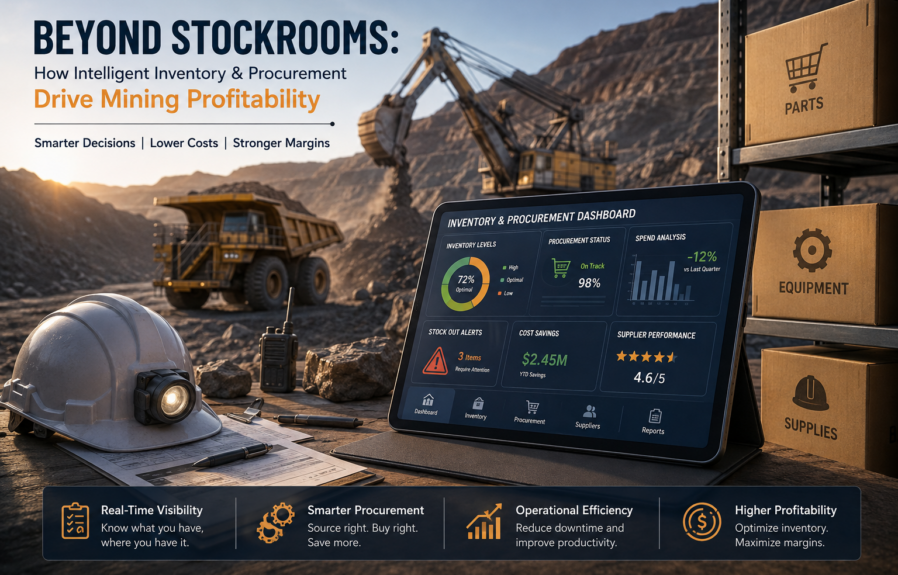
In this fourth chapter of our Mining ERP Series, we turn to the often-overlooked impact of inventory and procurement management. Modern ERP connects inventory visibility, automated procurement, IoT, telematics, and supplier collaboration—helping mining organizations reduce waste, control costs, and build a more resilient supply chain.
This is where modern ERP solutions redefine inventory and procurement, transforming them from back-office functions into strategic business enablers.
The Real Cost of Poor Inventory Visibility
In mining, inventory extends far beyond warehouse shelves. It represents operational readiness.
When inventory data is fragmented across multiple sites or managed manually, organizations face challenges such as:
- Excess stock that ties up valuable working capital.
- Shortages of critical spare parts that delay maintenance activities.
- Duplicate inventory across remote mining locations.
- Limited visibility into consumption patterns and material movement.
These issues not only increase storage costs but also affect production continuity and equipment availability.
Why Traditional Procurement Slows Mining Operations
Many mining organizations continue to rely on manual procurement processes involving emails, spreadsheets, paper approvals, and disconnected vendor communications.
Without an integrated procurement system, businesses often experience:
- Delayed purchase approvals.
- Inconsistent supplier pricing.
- Duplicate purchase orders.
- Limited budget visibility.
- Weak audit trails and compliance risks.
As procurement becomes reactive rather than planned, operational efficiency and financial control begin to decline.
Transforming Inventory & Procurement Through ERP
A modern ERP platform connects inventory, procurement, finance, and operations into one intelligent ecosystem, enabling mining companies to make faster and more informed decisions.
Real-Time Inventory Intelligence
Track inventory levels, material movement, and warehouse availability across multiple mining sites through a centralized platform.
Automated Procurement Workflows
Digitize purchase requisitions, approvals, supplier selection, and purchase orders to accelerate procurement while improving governance.
Smart Replenishment Planning
Automatically trigger replenishment based on consumption trends, minimum stock levels, and operational demand, reducing both stockouts and overstocking.
Supplier Performance Visibility
Evaluate vendors through delivery performance, pricing consistency, quality metrics, and procurement history to strengthen supplier relationships.
Integrated Budget & Cost Control
Connect procurement decisions with financial planning, ensuring purchases remain aligned with approved budgets and operational priorities.
From Cost Centre to Strategic Advantage
When inventory and procurement become fully integrated within an ERP environment, organizations gain much more than process automation.
They gain the ability to:
- Improve equipment availability through timely spare parts management.
- Reduce inventory carrying costs.
- Optimize working capital.
- Strengthen supplier collaboration.
- Improve forecasting accuracy.
- Increase operational transparency across departments.
The result is a more resilient supply chain that supports uninterrupted mining operations and sustainable business growth.
The Next Step: Intelligent Procure-to-Pay (P2P)
Digital procurement extends beyond purchasing materials—it connects the entire Procure-to-Pay (P2P) lifecycle into a single automated process.
By integrating procurement with inventory, finance, supplier management, and production planning, P2P automation enables mining organizations to control spending, eliminate manual inefficiencies, improve supplier collaboration, and maintain complete visibility from purchase request to final payment.
Rather than reacting to supply chain disruptions, mining companies gain the agility to anticipate demand, optimize procurement strategies, and make confident business decisions backed by real-time data.
Conclusion
Inventory and procurement are no longer support functions—they are strategic drivers of operational continuity and profitability.
With an integrated ERP platform, mining organizations gain complete visibility over materials, suppliers, budgets, and procurement workflows, ensuring that every purchasing decision contributes to higher productivity, stronger financial control, and long-term operational resilience.
Because in modern mining, competitive advantage isn’t built solely on what you extract—it’s built on how intelligently you manage the resources that keep your operations moving.
Coming Next
Mining generates massive amounts of operational data every day—but how much of it actually drives decisions? In the next chapter, we’ll explore how real-time dashboards, business intelligence, and analytics transform mining data into measurable business outcomes.