Author: Mr. Jean Marais, Founder & Group Executive Chairman
Sanodea Group. Rooted in Africa. Driven by Innovation. Built for Global Impact.
Presence: Africa, Europe, Middle East, Asia, North America
It defines the ore body, guides investment decisions, reduces geological ambiguity, and sets the foundation for whether a project becomes a world-class asset or an expensive failure.
Across more than 30 years leading and advising mining operations, I have seen billions lost not due to geology — but due to poor drilling strategy, unreliable contractors, and inefficient execution.
As mining across Africa accelerates, the industry must re-engineer how it views drilling: not as a procurement activity, but as a core strategic capability. This case study outlines a forward-looking framework for how African operations can leverage elite drilling partners and precision engineering to unlock value, reduce risk, and accelerate development timelines.
Executive Summary: Why Exploration Drilling Quality Determines Mining Success
The global mining environment is tightening: capital is selective, ESG compliance is mandatory, and investors expect clear geological visibility before committing funds. Drilling is no longer merely a physical operation — it is the analytical engine that drives valuation.
Across projects I’ve overseen, the difference between high-quality drilling and poor execution has produced swings of:
-
20–40% in inferred vs indicated resource classification
-
30–50% variance in cost per metre due to re-drilling or poor recovery
-
12–24 months delays in feasibility timelines
-
Tens to hundreds of millions in NPV impact
The stakes are even higher at today’s commodity prices. At USD 4,000/oz+ gold, a feasibility decision delayed by six months can erase up to USD 250–400 million in unrealised value for a mid-tier project.
In this environment, drilling excellence is not a service — it is strategic infrastructure.
Chapter 1: The Hidden Costs of Poor Drilling Quality
From West Africa to East Africa to the Copperbelt, I have observed recurring failure patterns in exploration drilling environments:
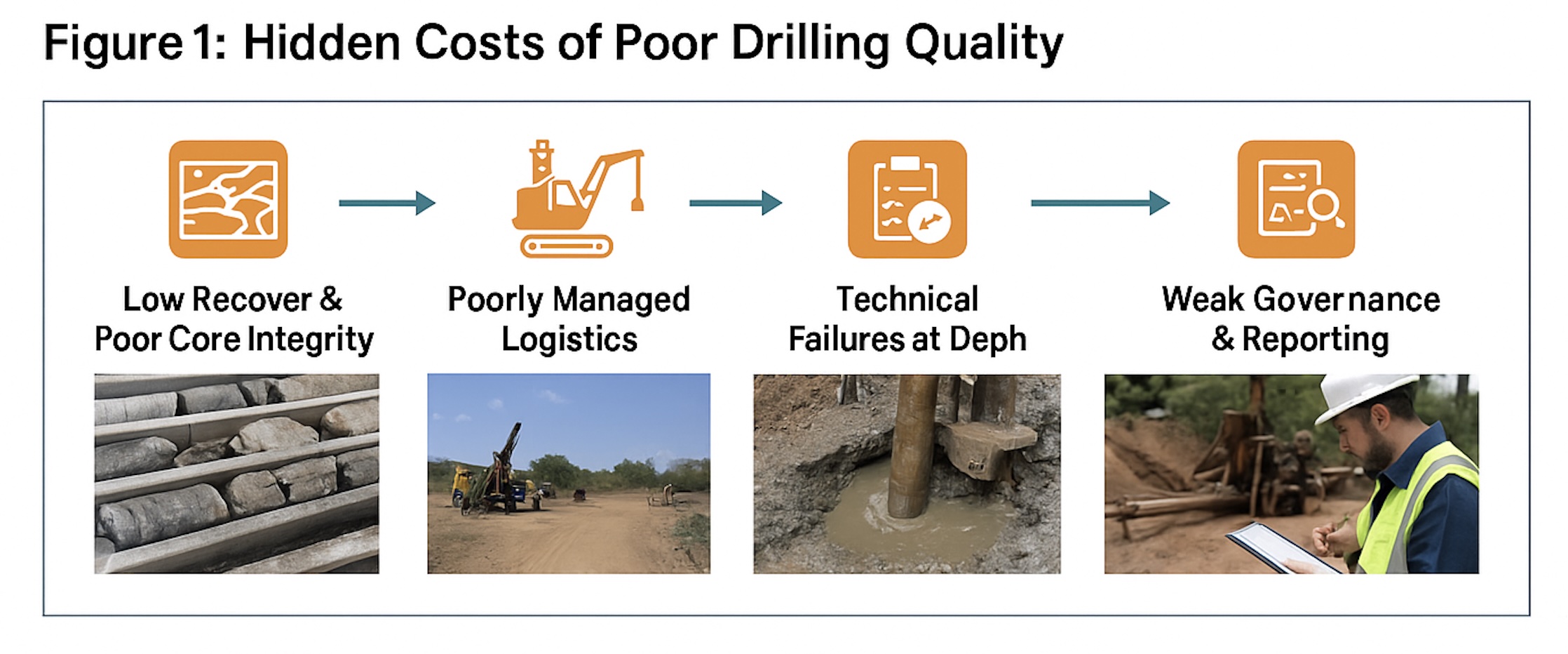 1. Low Recovery & Poor Core Integrity
Broken core, washed-out intersections, and inconsistent recovery undermine geological confidence.
A single campaign can lose 20–30% usable geological data.
2. Misaligned Drilling Technology
Using rigs not suited for terrain, depth, or access constraints leads to:
-
Excessive downtime
-
Slow penetration rates
-
Unsafe working conditions
3. Poorly Managed Logistics
Remote sites with limited access amplify risks:
-
Delayed rig mobilisation/demobilisation
-
Lost drilling days
-
Emergency cross-border spares
4. Technical Failures at Depth
Unstable holes, collapsing walls, stuck rods, or poor fluid management can destroy an entire hole and force a complete re-drill.
5. Weak Governance & Reporting
Inconsistent daily drill logs, low-resolution geological data, and undocumented deviations create inaccurate block models.
Case Example (Anonymised):
A West African gold project experienced a 14-day shutdown due to repeated drilling assembly failures. The NPV reduction from delayed feasibility exceeded USD 90 million — more than 20× the cost of a premium drilling contractor.
Poor drilling is not a cost issue — it is a valuation erosion issue.
Chapter 2: The Sanodea Exploration Drilling Excellence Framework
To mitigate drilling risk and accelerate project viability, we deploy a six-pillar framework:
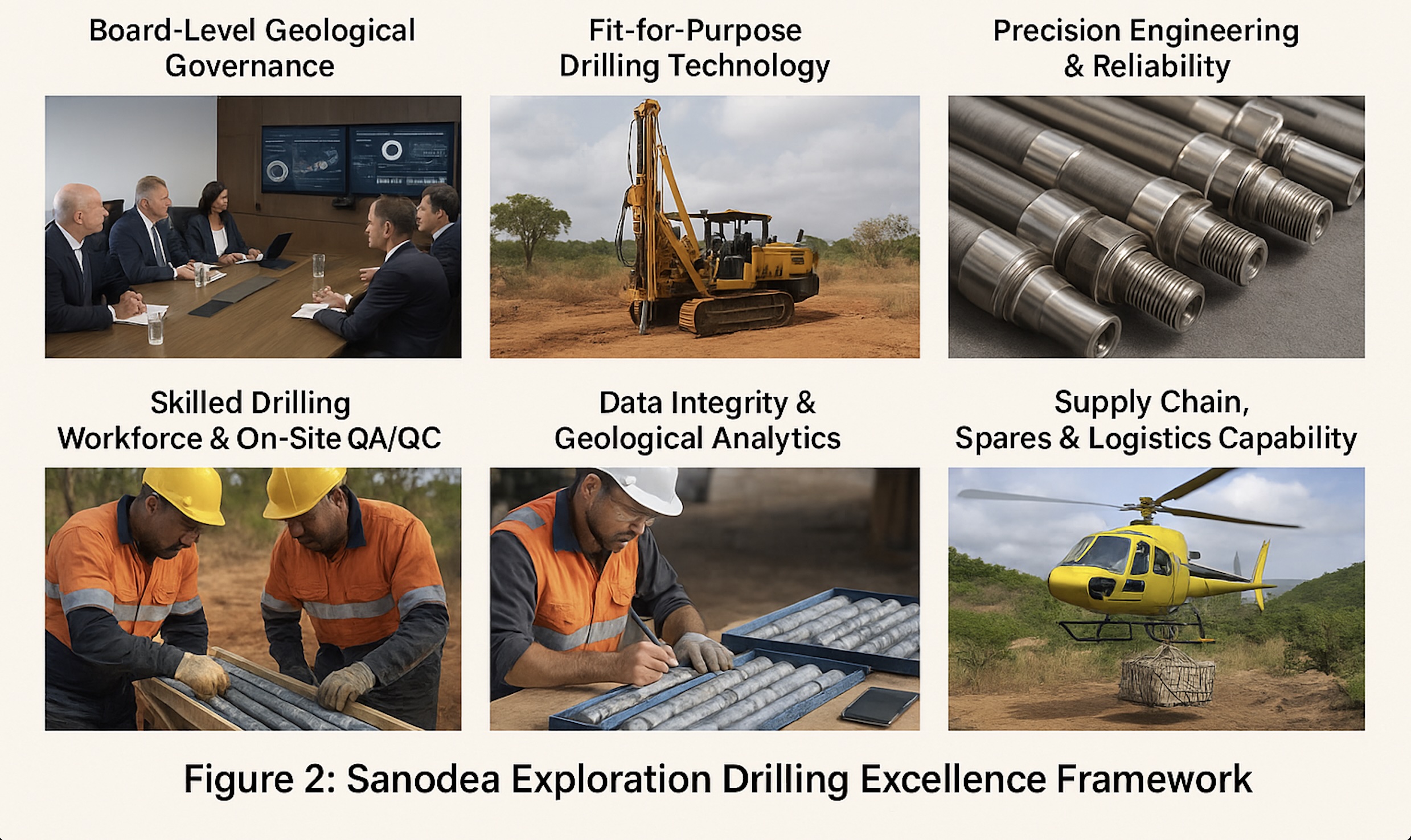
1. Board-Level Geological Governance
Boards must own drilling KPIs:
-
Cost/meter
-
Recovery %
-
Penetration rates
-
Time to depth
-
OHSE adherence
-
Variance against planned metres
In every high-performing project I’ve advised, these metrics are reviewed at board or investment committee level.
2. Fit-for-Purpose Drilling Technology
This includes advanced heli-portable and man-portable rigs, RC/aircore systems, and modular support units designed for ultra-remote access. The goal is simple: reach the ore body where trucks and heavy equipment cannot.
3. Precision Engineering & Reliability
Drilling rigs must operate as engineered ecosystems — not collections of parts.
We emphasise:
-
High-performance rod handling
-
Stabilised torque systems
-
Optimised drilling fluids
-
Remote terrain package engineering
-
Certified components and ISO-driven QC
4. Skilled Drilling Workforce & On-Site QA/QC
The calibration of the operator often matters more than the machine:
-
Proper alignment
-
Correct bit selection
-
Angle tolerance
-
Fluid dynamics
-
Real-time recovery oversight
5. Data Integrity & Geological Analytics
Exploration drilling today requires:
-
Digital daily logs
-
Automated recovery tracking
-
Geo-referencing
-
Photogrammetry
-
Downhole telemetry
In one copper project, implementing a structured QC protocol improved core utility by 37%.
6. Supply Chain, Spares & Logistics Capability
A drilling program is only as strong as its logistics chain.
This includes:
-
Guaranteed spares delivery
-
Remote-site maintenance capability
-
Fast recovery plans for equipment failures
The mines that succeed treat drilling logistics as mission-critical infrastructure.
Chapter 3: Anonymised Case Studies — Operational Proof Points
Case Study A — Greenfield Gold Project, West Africa
A remote, canopy-dense region required lightweight yet high-torque rigs capable of deep drilling without heavy equipment access.
Intervention:
-
Switched to modular heli-portable rigs
-
Introduced high-strength, low-weight assemblies
-
Implemented onsite geotech QA/QC protocols
Outcomes:
-
Drilled 20% faster
-
Reduced logistics costs by 35%
-
Improved recovery to >92%
-
Completed the program 2 months ahead of schedule
Case Study B — East African Multi-Commodity Project
Frequent rod failures and collapsing boreholes undermined geological modelling.
Intervention:
-
Introduced engineered coupling systems
-
Stabilised torque & pressure envelopes
-
Retrained drill teams on fluid dynamics
-
Deployed incident-prediction analytics
Outcomes:
-
Rod failure incidents dropped by 70%
-
Hole collapse reduced by 60%
-
Feasibility timelines recovered by 8 months
Case Study C — Copperbelt Exploration Program, Southern Africa
The project was located in rugged, high-altitude terrain with no conventional road access.
Intervention:
-
Deploy ultra-mobile, man-portable rigs
-
Establish aerial resupply chain
-
Embed predictive component monitoring
Outcomes:
-
Exploration completed with zero lost-time incidents
-
Achievement of full planned metres under budget
-
Faster conversion from inferred to indicated resources
Chapter 4: Expected Outcomes & Benchmarks for Modern Drilling Partnerships
Mines that adopt a modern drilling excellence model consistently achieve:
-
25–45% faster drilling progress
-
20–35% higher recovery rates
-
40–60% reduction in technical failures
-
15–30% improvement in resource classification
-
20–30% savings in drilling cost per usable metre
-
Enhanced valuation uplift through accelerated feasibility
This is the new baseline for Africa’s mining competitiveness.
Chapter 5: Strategic Value Across Stakeholders
For Investors
Higher-quality geological data reduces uncertainty → lower discount rates → higher valuations.
For Governments
Accelerated resource definition → faster royalties → stable development timelines.
For Communities
Fewer disruptions → safer operations → stronger social licence.
For Operators
Better forecasting → more accurate mine planning → faster project execution.
Drilling excellence is value creation at the earliest stage of the mining lifecycle.
Chapter 6: Sanodea Group’s Role in Drilling Transformation
Sanodea Group works across the entire drilling ecosystem to deliver high-confidence exploration outcomes:
-
Sanodea Advisory — governance, strategy, feasibility alignment
-
Sanodea Innovations — digital tracking, predictive systems, telematics
-
Sanodea Commerce — partnerships with premium equipment manufacturers & component suppliers
-
Sanodea Resources — execution oversight and performance management
-
Sanodea Life — OHSE systems and workforce competence
-
Sanodea Legacy — training, skills development, and national content
Our approach embeds drilling excellence into the operation’s DNA, not as a contract — but as a transformation capability.
Conclusion
Africa’s mining resurgence will not be driven by luck or high commodity prices — it will be driven by precision, reliability, and disciplined execution during exploration. Drilling excellence determines project viability, investor confidence, and long-term competitiveness. Mines that embrace engineered drilling ecosystems, robust QC, and strategic partnerships will secure an undeniable advantage in the decade ahead.
Sanodea Group
Advisory | Innovations | Commerce | Resources | Life & Wellness | Legacy & Education
explore. Engage. EVOLVE.
References
-
AusIMM. Exploration Drilling Practice: Guidelines for Core, RC, and Aircore Drilling. Australasian Institute of Mining & Metallurgy, 2022.
-
CSA Global. Core Recovery, Geological Logging, and QA/QC Best Practices in Exploration Programmes. CSA Global Technical Bulletin, 2021.
-
International Council on Mining & Metals (ICMM). Safety Performance in Exploration and Drilling Operations. ICMM Report, 2023.
-
International Finance Corporation (IFC). Environmental, Health, and Safety Guidelines for Mining and Exploration Activities. World Bank Group, 2022.
-
JORC Committee. JORC Code: Australasian Code for Reporting of Exploration Results, Mineral Resources and Ore Reserves. JORC, 2012 (updated 2024).
-
McKinsey & Company. Optimising Exploration Productivity Through Technology-Enabled Drilling Systems.McKinsey Metals & Mining Insight, 2023.
-
NI 43-101 Standards of Disclosure for Mineral Projects. Canadian Securities Administrators (CSA). Updated 2023.
-
PwC. Mine 2024: Trends in Exploration, Discovery, and Resource Conversion. PwC Global Mining Outlook, 2024.
-
Sanodea Group. Exploration Drilling Excellence, Field Reliability, and Operational Transformation Reports (2025). Internal Publications.
-
SRK Consulting. Best Practice Guidelines for Exploration Drilling QA/QC and Geological Data Integrity. SRK Technical Paper Series, 2023.