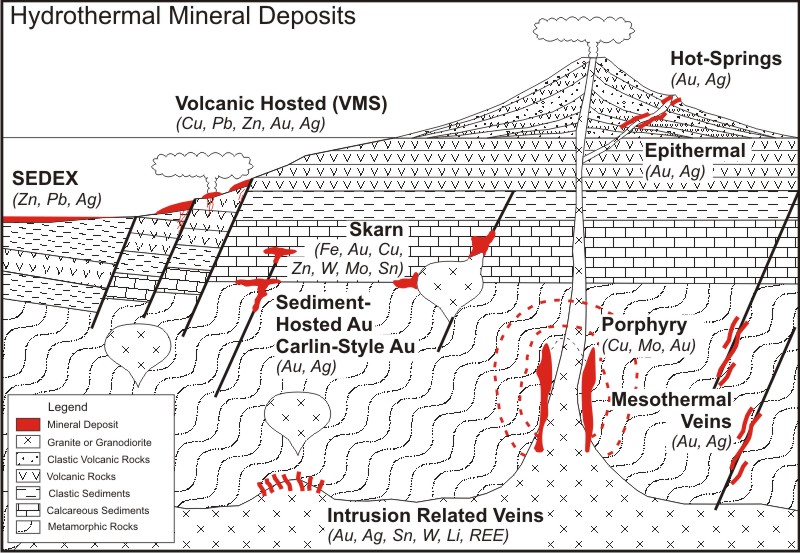
In economic geology, understanding how and when minerals are deposited in relation to their host rocks is crucial for identifying and evaluating ore deposits. Two key classifications based on timing are syngenetic and epigenetic mineralization. Though both result in valuable mineral deposits, they differ significantly in formation processes and geological settings.
Syngenetic mineralization
Syngenetic mineralization occurs at the same time as the formation of the host rock. In this case, minerals are deposited during sedimentation or magmatic activity, becoming an integral part of the rock’s original structure. These deposits are typically stratiform, meaning they follow the layering of the surrounding sedimentary or volcanic rocks. Common examples include Banded Iron Formations (BIFs) and Sedimentary Exhalative (SEDEX) deposits. Because they form during rock formation, syngenetic ores often appear conformable with bedding planes and may be later modified by metamorphism or tectonics.
Epigenetic mineralization
In contrast, epigenetic mineralization takes place after the host rock has already formed. Mineralizing fluids, often hydrothermal, migrate through fractures, faults, or porous rocks, depositing minerals as they go. This results in cross-cutting structures such as veins or replacement zones. Classic examples include epithermal gold veins, porphyry copper deposits, and Mississippi Valley-Type (MVT) lead-zinc ores. Because these deposits form later, they may show clear structural disruption or alteration of the host rock.
Key differences
| Aspect | Syngenetic | Epigenetic |
| Timing | Same time as host rock | After host rock formation |
| Relationship to bedding | Conformable | Often cross-cutting |
| Structural control | Weak to moderate | Strong |
| Typical geometry | Stratiform, layered | Veins, lenses, stockworks |
| Fluid involvement | Limited or depositional | Dominant (hydrothermal) |
Conclusion
Understanding the difference between syngenetic and epigenetic mineralization is fundamental in mineral exploration. It influences the geological models used, exploration techniques applied, and interpretation of mineral potential. While syngenetic deposits provide clues in stratigraphy and basin analysis, epigenetic deposits often require structural and hydrothermal modeling. Distinguishing the two helps geologists more accurately locate and extract the Earth’s mineral wealth.