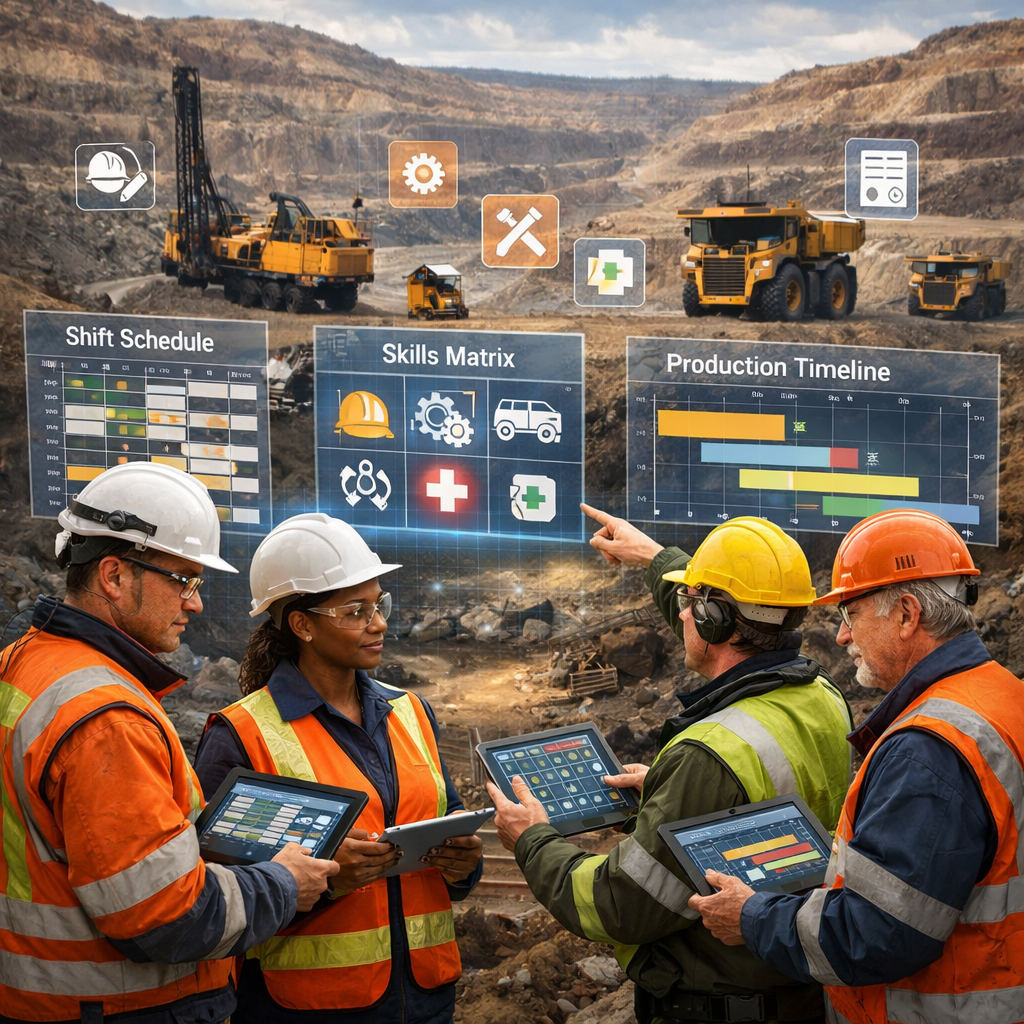
Workforce planning for mining is a rather complex process that has to consider production plans, available equipment, and talent limitations. In contrast to other business sectors, mining activities are particularly vulnerable to talent gaps because of the specialized nature of jobs like drill operators, blasting engineers, geotechnicians, and maintenance technicians.
It is no longer just about staffing the mining operation; it is a strategic process that closes the divide between the long-term LoM plan and the current skill limitations [1]. In 2026, the mining industry is expected to be caught up in the “perfect storm” of an aging mining workforce transitioning quickly to autonomous and digital mining. In order to synchronize production with available skills, the industry must transition from the traditional reactive recruitment process to ISWP [2].
Map “Skills-to-Task” (not just roles)
Traditional planning focuses on headcount (e.g., “we need 50 operators”). Optimization requires a granular Skills Catalog [3]. Instead of generic roles, map specific competencies (e.g., Autonomous Haulage System monitoring, predictive maintenance diagnostics) to specific production stages. Use mathematical modeling to determine the cost of a missing skill. For example, if you are 10 geologists short, how does that delay the “Drill & Blast” cycle, and what is the net loss in ore recovery?
Dynamic scheduling via “What-If” simulations
Use Digital Twins or Integrated Planning software (like Deswik or Dassault Systèmes) to run scenarios where production targets are the “independent variable” and skills are the “constraint.” If you ramp up production by 15% in Q3, the system should automatically flag exactly which specialized certifications (e.g., High Voltage electricians) will become a bottleneck. Simulate the impact of high absenteeism or retirement waves on specific high-value assets (like a semi-autogenous grinding mill) to prioritize recruitment for those specific skill sets.
Implement “Just-in-Time” upskilling
To avoid the high costs of specialized recruitment (which can take up to 60+ days for mining roles), build internal agility [4]:
- Cross-training loops: identify underutilized staff during lower-production cycles and put them through “Micro-Credentialing” for high-demand tasks.
- Phased retirement/mentorship: incentivize retiring subject matter experts to stay on as “Remote Support” or mentors to accelerate the proficiency of junior digital-native workers.
Leverage “Remote Operations Centers” (ROCs)
One of the most effective ways to optimize skills availability in 2026 is by decoupling the skill from the location. Instead of needing a senior maintenance engineer at every remote site, use a ROC where a single expert can support multiple sites via augmented reality and IoT data. Remote work options significantly increase your ability to attract diverse talent (Gen Z, women, and urban dwellers) who may otherwise decline fly-in-fly-out (FIFO) roles [4].
Do you have any idea to add? We will happy to receive it.
Reference
[1] “Mining industry employment and talent challenges | McKinsey.” Accessed: Jan. 16, 2026. [Online]. Available: https://www.mckinsey.com/industries/metals-and-mining/our-insights/has-mining-lost-its-luster-why-talent-is-moving-elsewhere-and-how-to-bring-them-back
[2] “Why every mine needs a strategic workforce plan | Globe 24-7.” Accessed: Jan. 16, 2026. [Online]. Available: https://globe24-7.com/news-insights/why-every-mine-needs-a-strategic-workforce-plan/
[3] A. Salles, “Optimization Techniques for Strategic Workforce Planning,” DecisionBrain. Accessed: Jan. 16, 2026. [Online]. Available: https://decisionbrain.com/the-complete-guide-to-workforce-optimization-part-6/
[4] “Proven HR Strategies to Beat Mining & Manufacturing Labor Shortages.” Accessed: Jan. 16, 2026. [Online]. Available: https://tpd.com/blog/overcoming-the-mining-and-manufacturing-labor-shortage-proven-strategies-for-hr-professionals-in-2025/