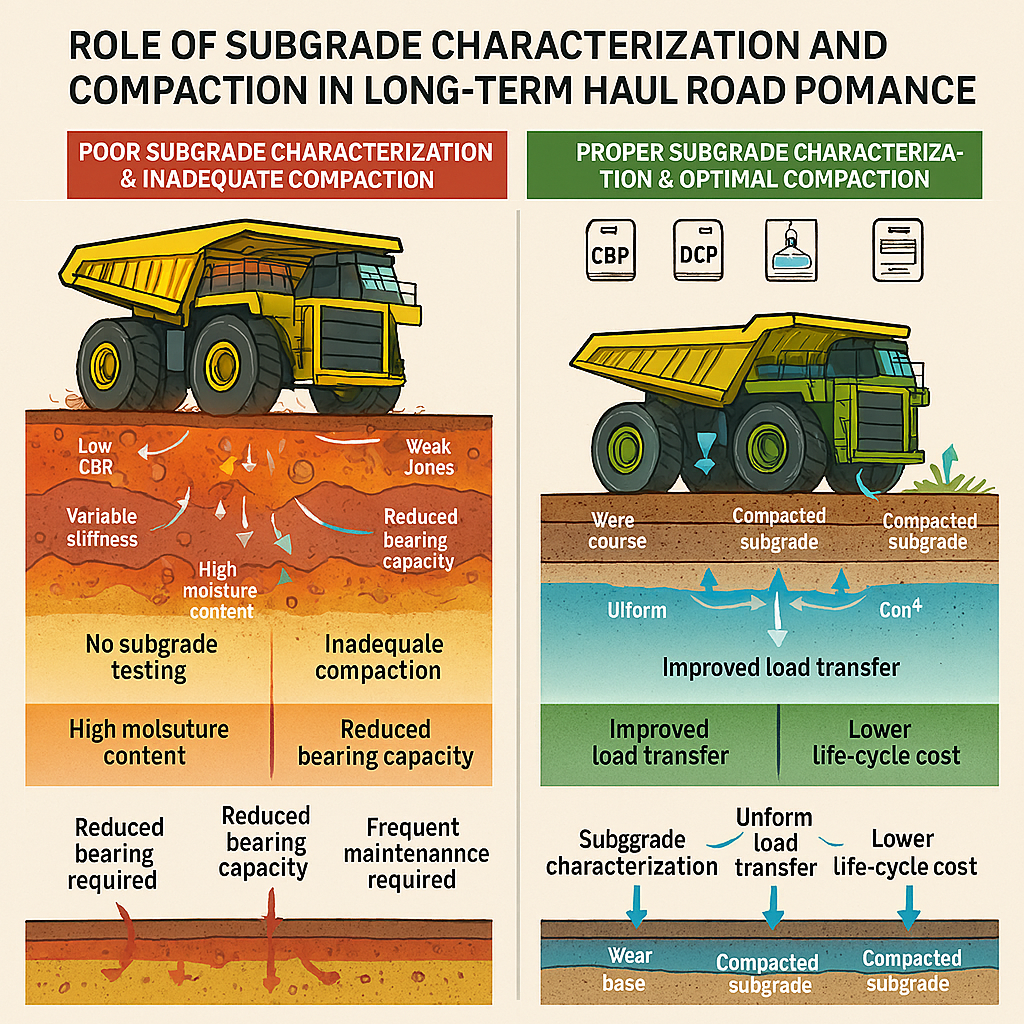
In the demanding environment of surface mining, haul roads serve as the critical arteries for production. The long-term performance of these roads—measured by their ability to support ultra-heavy vehicle loads with minimal maintenance—is fundamentally dictated by the quality of the subgrade. Subgrade characterization and compaction are not merely preliminary construction steps; they are the primary determinants of a road’s structural integrity and its impact on overall haulage operating costs (Gouda et al., 2024).
The role of subgrade characterization
Subgrade characterization involves identifying the geotechnical properties of the in-situ soil to predict how it will behave under the immense stress of haul trucks, which can now exceed 350 tons (Gouda et al., 2024). Key parameters include the California Bearing Ratio (CBR), shear strength, and the dynamic resilient modulus.
Research indicates that a subgrade must maintain a minimum CBR value (typically at least 10) to prevent the upper layers from deflecting in unison with the foundation (Institute for Transportation, 2019). If the subgrade is characterized as weak or non-uniform, the overlying base layers will suffer accelerated deterioration. Furthermore, modern characterization recognizes that subgrades are multi-phase media—comprising soil particles, water, and gas—meaning their response to heavy axle loads is highly dependent on moisture content and depth-specific dynamic stress (Li et al., 2024). Accurate characterization allows engineers to determine the necessary “cover thickness” of the road to protect the subgrade from excessive vertical strain.
The impact of compaction on longevity
Compaction is the process of increasing soil density by removing air voids, which directly enhances the soil’s load-bearing capacity and stiffness (Hao et al., 2023). For haul roads, proper compaction provides several long-term benefits:
- Reduced rolling resistance: a well-compacted, stable subgrade prevents “flexing” of the road surface. This reduces rolling resistance, which can lower fuel consumption by up to 1.5 times compared to poorly constructed granular roads (Gouda et al., 2024).
- Mitigation of settlement and rutting: inadequate compaction leads to localized settlement and deep rutting. Studies show that when trucks transition from 170-ton to 240-ton payloads, roads with insufficient subgrade support quickly suffer cross-sectional deterioration (Gouda et al., 2024).
- Environmental resilience: compaction at Optimum Moisture Content (OMC) creates a denser matrix that is less permeable, preventing undrained water from softening the subgrade or causing frost heave (Institute for Transportation, 2019; University of British Columbia, n.d.).
Performance and maintenance optimization
The relationship between the subgrade and long-term performance is cyclical. A weak subgrade leads to surface defects such as potholes, corrugations, and washboards. These defects generate impact forces that are transferred back through the truck’s suspension and frame, exponentially increasing vehicle maintenance costs (University of British Columbia, n.d.).
By investing in rigorous subgrade characterization and achieving high compaction degrees (e.g., increasing compaction from 0.91 to 0.95 can increase the resilient modulus by over 27%), mine operators can significantly extend the maintenance cycle of the wearing course (Hao et al., 2023). This leads to higher “asset utilization”—allowing trucks to operate at higher speeds with less downtime for repairs to tires, frames, and engines (Gouda et al., 2024).
References
Gouda, J., Rami Reddy, D. S., Srinivasan, V., & Butle, V. (2024). Comprehensive review of haul road design methods: A comparative approach. Archives of Mining Sciences, 69(3), 529–554. https://doi.org/10.24425/ams.2024.151449
Hao, J., Wang, H., Zhang, X., Lin, T., Jiang, X., Liu, C., & Li, X. (2023). Dynamic resilient modulus of subgrade silty clay for heavy-haul railway: An experimental investigation and the predicted method. Frontiers in Earth Science, 11. https://doi.org/10.3389/feart.2023.1276116
Institute for Transportation. (2019). Design guide for improved quality of roadway subgrades and subbases. Iowa State University. https://www.intrans.iastate.edu/wp-content/uploads/sites/10/2019/01/Design-Guide-for-Improved-Quality-of-Roadway-Subgrades-and-Subbas.pdf
Li, Y., Du, Y., Liu, L., Zhang, J., Hao, J., Zhang, X., Jin, Q., Tian, C., Li, X., & Zhang, X. (2024). Influence depth of highway subgrade under heavy vehicle loads based on a theoretical model. Frontiers in Built Environment, 10. https://doi.org/10.3389/fbuil.2024.1497868
University of British Columbia. (n.d.). Guidelines for mine haul road design. https://open.library.ubc.ca/media/download/pdf/52383/1.0102562/1