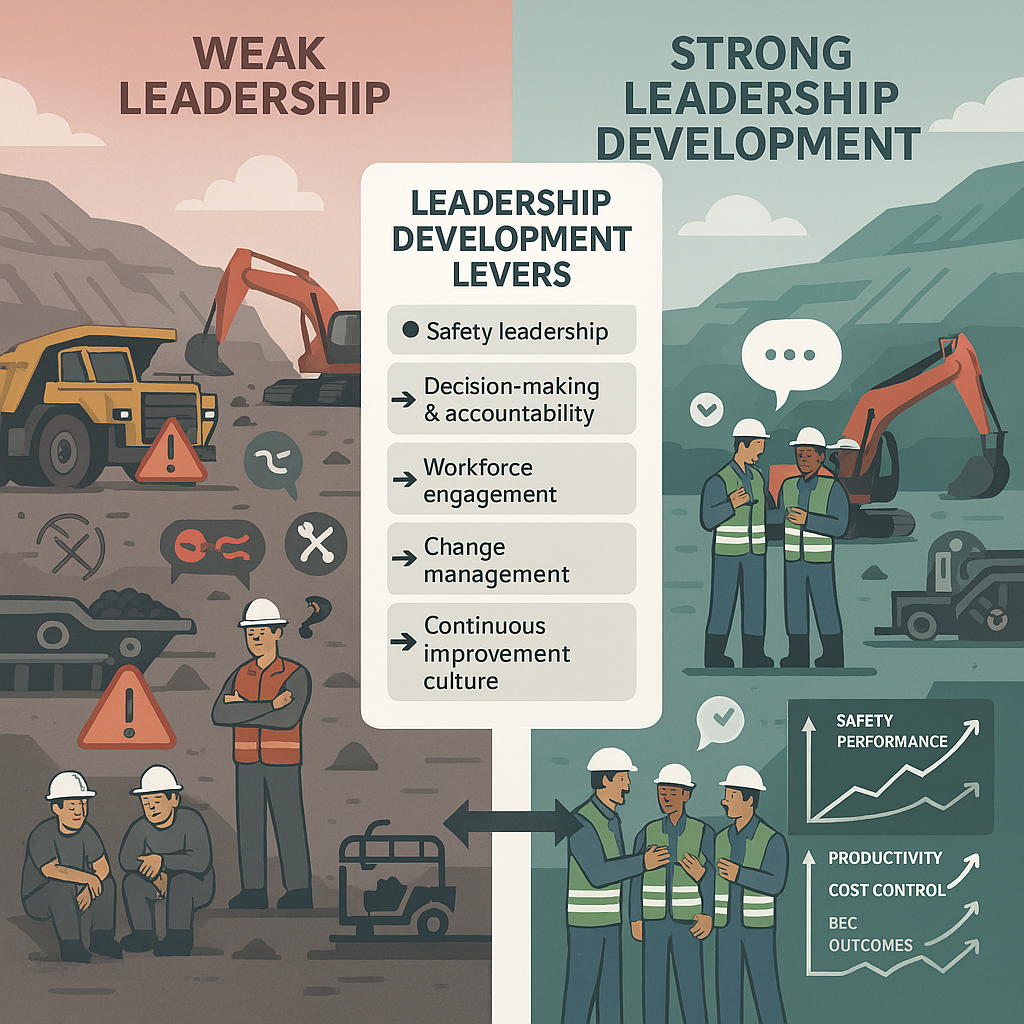
In the modern mining landscape of 2026, the industry is no longer defined solely by the volume of earth moved, but by the precision of the strategy behind it. As ore grades decline and ESG (Environmental, Social, and Governance) requirements tighten, the link between leadership development and operational performance has moved from a “soft” human resources initiative to a hard operational necessity.
Driving safety as a performance metric
In mining, safety is the primary leading indicator of operational health. Research consistently shows that “the safest months are the most productive” because they reflect a state of high operational control [1]. Leadership development programs—specifically Advanced Safety Leadership Training (ASLT)—have been shown to reduce workplace accidents by 20% to 50% [2].
When supervisors are trained in behavioral safety and proactive risk management, they move beyond mere compliance [2]. Instead of just enforcing rules, developed leaders foster a “safety citizenship” where miners feel empowered to pause work when hazards are identified. This cultural shift directly impacts the bottom line by reducing the massive costs associated with equipment damage, legal liabilities, and unplanned shutdowns.
Bridging the “innovation-execution” gap
The mining sector has seen a surge in digitalization, from AI-driven predictive maintenance to autonomous haulage systems. However, McKinsey notes that many companies struggle to turn these technological investments into lasting gains. Leadership development acts as the bridge in this “innovation-export” gap.
Operational excellence is rarely achieved by the technology itself; it is achieved through standardization and continuous improvement (Kaizen). Developed leaders are trained to:
- Identify waste: Recognizing inefficiencies in the value chain that automated systems might overlook.
- Empower teams: coaching workers to use new digital tools effectively rather than reverting to “the old way” of doing things.
- Root-Cause problem-solving: ensuring that an equipment failure or productivity drop is addressed at its source, preventing recurrence.
Cultivating the “leadership factory”
Mining companies like Rio Tinto and Barrick are increasingly adopting a “leadership factory” approach. This strategy treats leadership as a strategic asset, ensuring a pipeline of talent is ready at every level, from the pit boss to the C-suite.
|
Impact Area |
Specific Leadership Contribution |
Operational Outcome |
|
Asset Reliability |
Predictive leadership and maintenance oversight |
15–25% improvement in equipment uptime |
|
Talent Retention |
Mentorship and career development paths |
Retention rates exceeding 90% in outperforming sites |
|
ESG & Social License |
Sophisticated stakeholder and community engagement |
Reduced project delays and smoother permitting |
Navigating geopolitical and ESG complexity
As of 2026, mining leaders must navigate a “minefield of paradoxes,” balancing short-term profit with long-term sustainability [3]. Leadership development equips managers with the ESG literacy needed to manage the “critical minerals rush” responsibly. Leaders who can transparently manage trade-offs, such as water usage versus production targets, protect the company’s “social license to operate,” preventing the costly community-led blockades that frequently derail mining operations.
Conclusion
Leadership development is the “strategic engine” that powers operational performance. By fostering a culture of safety, driving the adoption of technology, and building a resilient talent pipeline, it ensures that mining companies don’t just survive market volatility but thrive within it. In an industry where the physical environment is increasingly challenging, the strength of the human “infrastructure” remains the greatest competitive advantage.
References
[1] “Leadership in Mining: Building Teams, Culture and Success – Mining International Ltd.” Accessed: Jan. 22, 2026. [Online]. Available: https://www.mining-international.org/leadership-in-mining/
[2] P. Olise, L. Opoku, and N. Mensah, “The impact of advanced safety leadership training programs on reducing workplace accidents and enhancing asset reliability in U.S. industrial sectors,” International Journal of Science and Research Archive, vol. 14, pp. 025–033, Jan. 2025, doi: 10.30574/ijsra.2025.14.1.2594.
[3] J. De Klerk and B. Swart, “Paradoxes and dilemmas of responsible leadership in the mining industries of emerging economies – it is complex,” Emerald Open Research, vol. 1, no. 11, Jul. 2023, doi: 10.1108/EOR-11-2023-0001.