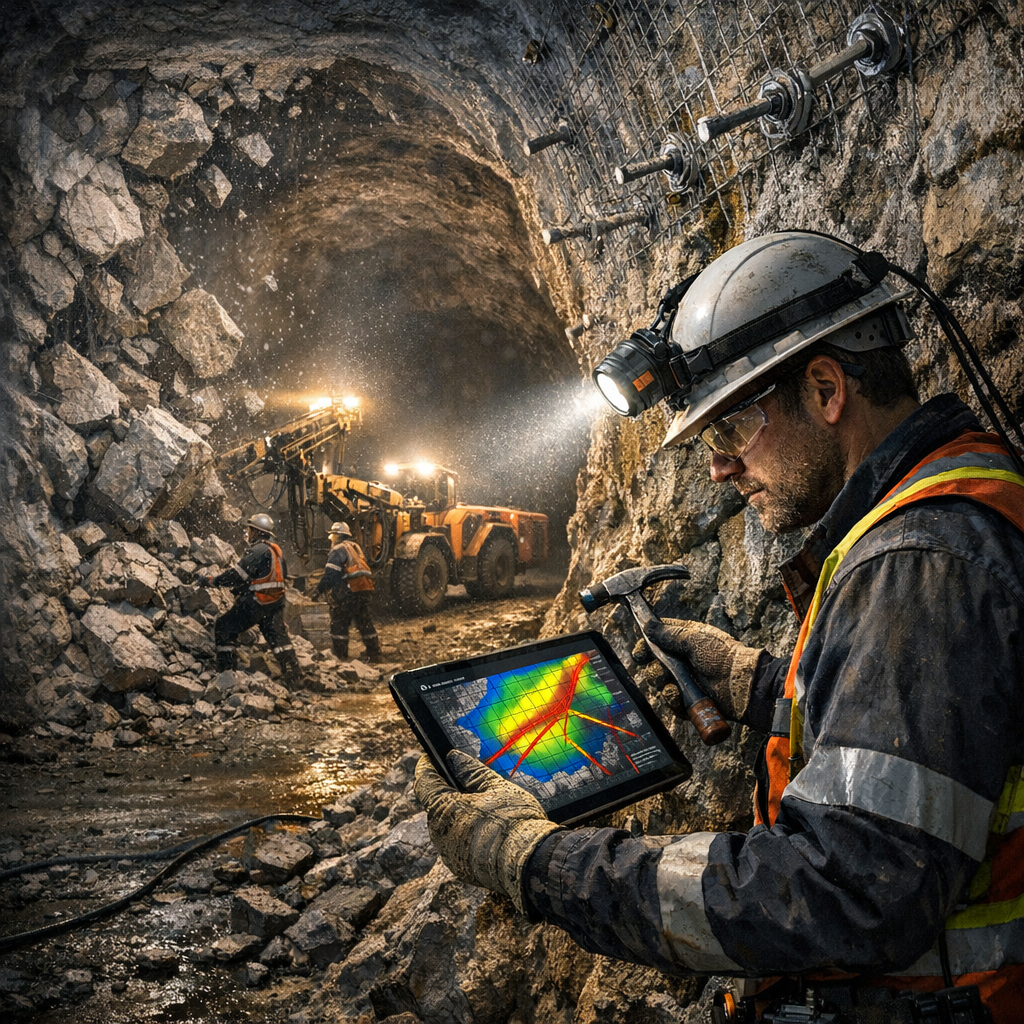
Underground environments, ranging from deep-level mines to transit tunnels, are among the most hazardous workspaces in engineering. The inherent heterogeneity of rock masses and the presence of high-magnitude in-situ stresses create a landscape where the margin for error is razor-thin (Bawden, 2023). However, the evolution of geotechnical engineering between 2020 and 2026 has transformed these spaces from unpredictable voids into monitored, engineered environments. By integrating probabilistic modeling, real-time monitoring, and advanced risk assessment, geotechnical insights are directly responsible for preventing catastrophic collapses and safeguarding human life.
The high stakes of underground excavation
The complexity of underground construction stems from the “joint work of mining equipment and people” within a limited space, where the uncertainty of geotechnical data can lead to an inevitable increase in accident risks (Spyridis, 2021). Unlike surface structures where environmental loads like floods or earthquakes are the primary drivers of failure, tunnel collapses are predominantly driven by construction-related factors. Statistics reveal that earthquakes and floods account for only 10% to 20% of tunnel collapses; the vast majority occur due to unforeseen ground conditions or structural instabilities during the excavation phase (Spyridis, 2021).
In deep-mining contexts, the risks become even more extreme. As operations descend beyond depths of 1.0 to 1.5 km, workers face “very high rock stresses,” mine-induced seismicity, and the violent phenomenon of rock bursts (Bawden, 2023). Rock bursts involve the instantaneous release of stored strain energy, which can eject rock into mine openings at high velocities, posing a lethal threat to personnel (Zhou et al., 2024).
Advanced Risk Management and Monitoring
Modern geotechnical engineering addresses these threats through a proactive, multi-layered risk management framework. One of the primary measures for reducing risk is the implementation of continuous geotechnical monitoring (Chunyuk & Selviyan, 2023). This is no longer a static process but a “changing picture” that allows for the timely detection of deviations in soil or rock behavior (Chunyuk & Selviyan, 2023).
Probabilistic and deterministic modeling
Geotechnical insights allow engineers to move beyond simple “best-guess” scenarios. Today, safety concepts often rely on probabilistic calculations that compare calculated failure probabilities with real-world observed frequencies (Spyridis, 2021). This helps in calibrating “target failure probabilities” and ensuring that designs remain within acceptable safety margins even when ground conditions vary (Spyridis, 2021).
Real-time monitoring and BIM
The integration of Building Information Modeling (BIM) with geotechnical data has revolutionized security management. Research shows that BIM-based strategies can improve the accuracy of risk identification to as high as 98.2% (Scholar Publishing Group, 2021). Furthermore, when anomalies are detected, these systems help reduce emergency response times to as little as 27 minutes by providing a digitized, real-time map of the underground environment (Scholar Publishing Group, 2021).
Microseismic and stress-field monitoring
In deep coal and hard-rock mines, understanding the “stress-field and rock-structure” is critical for managing large-displacement disasters (Zhou et al., 2024). New monitoring techniques, including microseismic monitoring, allow engineers to listen to the rock mass. By analysing these acoustic signals, specialists can predict potential rockbursts or structural failures before they occur, allowing for the establishment of exclusion zones and re-entry times that keep workers out of harm’s way (Bawden, 2023).
Engineering solutions for life safety
Geotechnical insights do not just identify risks; they provide the technical parameters for life-saving interventions.
- Barrier pillars: in the transition from surface to underground mining, the design of “barrier pillars” is essential. These serve as unextracted buffer zones that isolate stress fields, preventing global instability that could cause a collapse (MDPI, 2025).
- Dynamic support systems: in brittle rock environments where rockbursts are a risk, geotechnical data informs the use of “dynamic support”—reinforcements designed to absorb sudden energy releases rather than snapping under pressure (Bawden, 2023).
- Tunnel boring machine (TBM) optimization: in deep tunnels, TBMs can become “jammed” due to large-scale ground displacement. Geotechnical modeling of the “fragmenting swelling mechanism” allows engineers to implement “stepwise collaborative support” methods, strengthening the rock and transferring stress peaks away from the excavation face (Zhou et al., 2024).
The human element: health and environment
Geotechnical insights also extend to the atmospheric and thermal safety of underground workers. In deep mines, the geothermal gradient can lead to “extreme temperatures” and “extremely hot water,” which pose risks of heat stroke or thermal injury (Bawden, 2023). Geotechnical assessments of thermal properties and groundwater flow are vital for designing the ventilation and cooling systems that make these depths habitable.
Furthermore, monitoring systems now track “real-time ventilation data,” including methane concentrations and air quality parameters (Atmosphere, 2023). For instance, laser methane detectors can identify “methane hotspots” in underground facilities, preventing potential explosions and ensuring that personnel are not exposed to toxic or flammable environments (Wu et al., 2023).
Conclusion
Geotechnical engineering has evolved into a sophisticated discipline that balances the raw power of the earth against the precision of digital technology. Through the use of BIM, probabilistic failure analysis, and high-fidelity monitoring, geotechnical insights provide a “scientific and technical support” system that anticipates disasters before they manifest (Chunyuk & Selviyan, 2023). By identifying “high-risk construction stages” and implementing robust mitigation measures, this field remains the primary line of defense for the thousands of individuals who work in the complex, hidden worlds beneath our feet.
References
Bawden, W. F. (2023). Geotechnical risk and risk mitigation in deep underground mines in hard, brittle rock. Atlantis Highlights in Engineering, 31–47. https://doi.org/10.2991/978-94-6463-258-3_5
Chunyuk, D., & Selviyan, S. (2023). Monitoring of geotechnical and underground construction facilities as part of risk management. E3S Web of Conferences, 410, 02014. https://doi.org/10.1051/e3sconf/202341002014
Spyridis, P., & Proske, D. (2021). Revised comparison of tunnel collapse frequencies and tunnel failure probabilities. ASCE-ASME Journal of Risk and Uncertainty in Engineering Systems, Part A: Civil Engineering, 7(1). https://doi.org/10.1061/ajrua6.0001107
Wu, T., Cheng, J., Wang, S., He, H., Chen, G., Xu, H., & Wu, S. (2023). Hotspot detection and estimation of methane emissions from landfill final cover. Atmosphere, 14(11), 1598. https://doi.org/10.3390/atmos14111598
Zhou, J., Zhang, Y., Li, C., He, H., & Li, X. (2024). Rockburst prediction and prevention in underground space excavation. Underground Space, 14, 70–98. https://doi.org/10.1016/j.undsp.2023.05.009