The evolution of the mining industry is increasingly defined by the transition toward deeper and more complex ore bodies. In this challenging environment, rock mechanics has emerged as a critical discipline, evolving from site-specific empirical investigations into a sophisticated field of engineering that ensures the safety, efficiency, and sustainability of modern operations (Zhu et al., 2025).
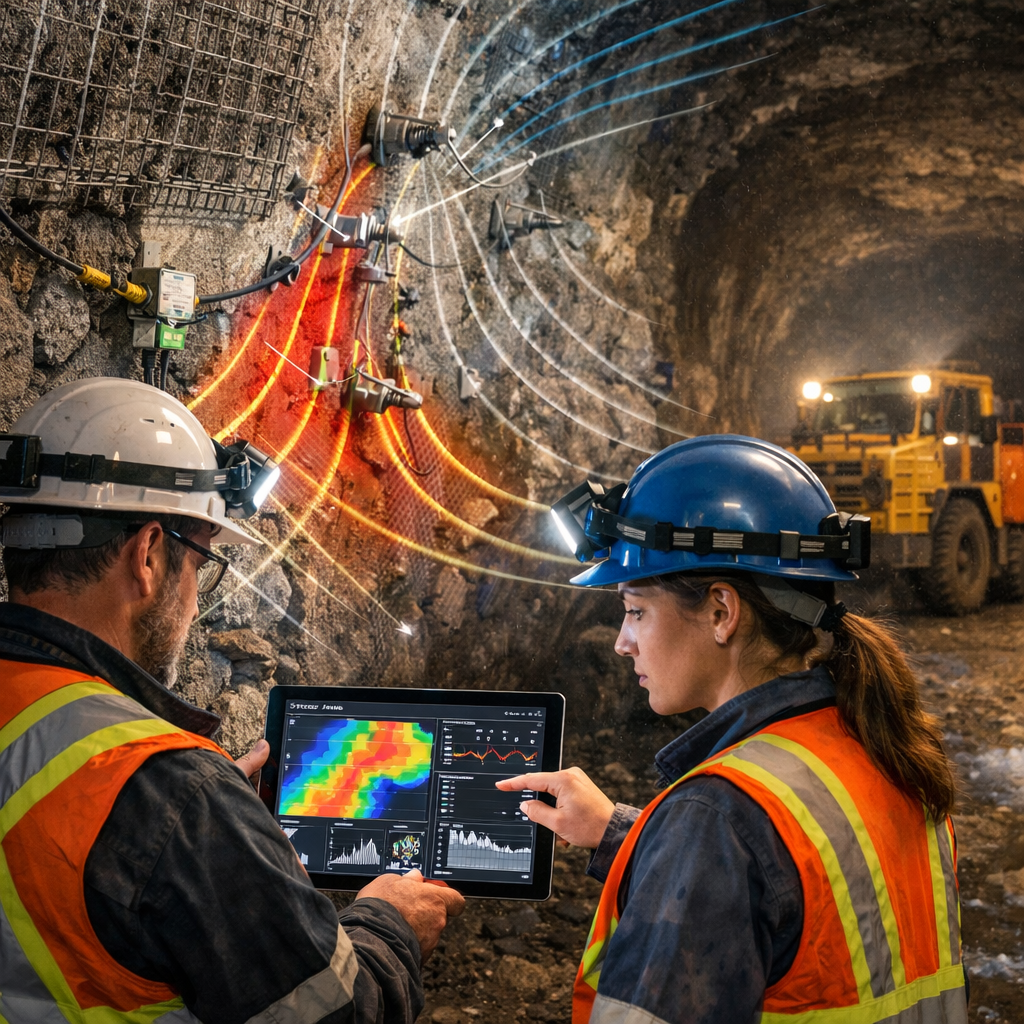
Historically, ground control relied on traditional geotechnical surveys. Today, the integration of remote sensing and real-time numerical modeling allows for precise rock mass characterization (Isaksson et al., 2025). As mining depths increase, the risks of catastrophic failures, such as rockbursts and seismic events, become more acute. Modern rock mechanics addresses these hazards through advanced seismic monitoring and geomechanical risk models that proactively identify potential ground collapses before they occur (Zhu et al., 2025). Furthermore, innovative ground support systems are now adaptively tailored to specific rock mass conditions, significantly enhancing the safety of underground personnel (Isaksson et al., 2025).
Beyond safety, rock mechanics is a primary driver of operational efficiency. For instance, the mechanical pre-weakening of rock masses can optimize blasting patterns, leading to better fragmentation and reduced energy consumption during crushing and milling processes (Aben et al., 2023). The “digital revolution” has further empowered the field through the use of robotic systems and machine learning algorithms for automated core logging, which provides engineers with high-fidelity data for decision-making (Zhu et al., 2025).
By combining fundamental theories with emerging technologies, rock mechanics provides the technical foundation necessary for the industry to push deeper into the Earth’s crust. It remains the silent guardian of the modern mine, ensuring that as operations become more complex, they remain both productive and safe for the next generation of mining.
References
Aben, E. Kh., Malanchuk, Z. R., Fedotenko, V. S., & Orynbaev, B. A. (2023). Improving efficiency of rock breaking using pre-weakening of rock mass. Eurasian Mining, (2), 62–65. https://doi.org/10.17580/em.2023.02.13
Isaksson, J., Karlsson, M., & Dijkstra, J. (2025). Quantifying the response of piled structures from displacements induced by pile installation in soft clay. Canadian Geotechnical Journal, 62, 1–16. https://doi.org/10.1139/cgj-2024-0387
Zhu, C., Huang, M., Cai, Q., Zuo, Y., Tang, S., & Yin, Q. (2025). Complex Rock Mechanics Problems and Risk Prevention Solutions. Applied Sciences, 15(2). https://doi.org/10.3390/app15020755