
Sign In


Forgot Password?

Don't have account, Sign Up Here

Forgot Password

Lost your password? Please enter your email address. You will receive a link and will create a new password via email.


Have an account? Sign In Now

Sorry, you do not have permission to Add a Post, You must login to Add a Post.


Forgot Password?

Need An Account, Sign Up Here

Sorry, you do not have permission to add Article.


Forgot Password?

Need An Account, Sign Up Here

Please briefly explain why you feel this Post should be reported.

Please briefly explain why you feel this Comment should be reported.

Please briefly explain why you feel this user should be reported.

Mining Doc Logo Mining Doc Logo Mining Doc Logo
Sign InSign Up

Mining Doc

Mining Doc Navigation

  • Home
    • About
    • Contact us
  • Mining articles
  • Online Courses
Search
Sign up

Mobile menu

Close
join for free
  • Home
  • Online courses
  • Case study
  • Mining Community
  • Solutions listing
    • Lase Solutions
    • O-PitBlast Solutions
    • Continuous Mining
    • Longwall mining
    • Geosight Scanners
    • LoopX AI
    • Terafil solutions
    • Blasting solutions
    • Geotechnical
    • Submersible Pumps
    • Mine rescue system
    • Ore sorting
    • Whittle Consulting Solutions
  • Add Blog
  • Feed
  • User Profile
  • Posts
    • New Posts
    • Trending Posts
    • Must read Posts
    • Hot Posts
  • Polls
  • Badges
  • Home
    • About
    • Contact us
  • Mining articles
  • Online Courses

Mining Doc Latest Posts

Mining Doc
  • 0
  • 0
Mining DocEnlightened
Added: June 24, 20262026-06-24T07:15:30-04:00 2026-06-24T07:15:30-04:00In: Mining Engineering

What are the engineering criteria for selecting longhole stoping versus cut-and-fill as the primary mining method in a narrow, steeply dipping vein?

  • 0
  • 0

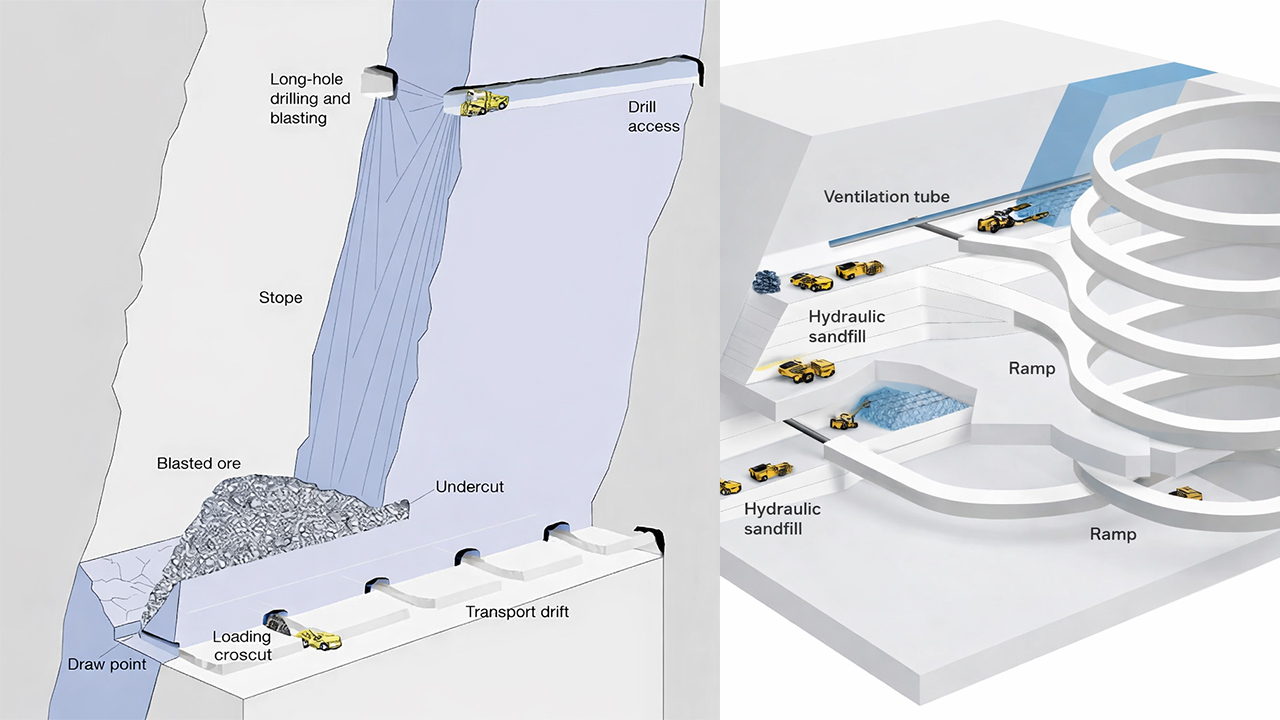
Underground metalliferous mining involves extraction of minerals from a relatively thin, inclined orebody (also known as veins), ranging from 0.5 to 3.0 meters wide and with a dip more than 50 degrees (Hustrulid & Bullock, 2001). Two main techniques that have been developed for extraction include longhole stoping (LHS) and cut-and-fill (CAF) mining. The former involves a bulk technique where huge quantities of ore are blasted and excavated at lower drawpoints, whereas the latter is a cyclic, selective technique involving mining of ore in horizontal layers with backfill immediately after ore removal.

The geometry of the veins determines whether these techniques are practical or not. In order for LHS technique to work, the dips of the veins have to be above 55 degrees such that broken ore moves down through gravity (Villaescusa, 2014). This technique also needs a constant strike, and therefore, geometrical anomalies in veins, such as pinch and swell, make it impossible because of fixed blastholes. On the other hand, CAF technique is very flexible since miners can adapt to changes in the geometry of the veins by adjusting the boundaries of the extraction face during breasting.

Geotechnical factors significantly affect the selection of the mining method. LHS leaves large unsupported spans of the hanging wall and footwall during extraction. In case of a weak host rock, stress release around these open stopes can lead to sloughing and wall failures (Guggari, Mohanto, & Deb, 2023). CAF is required for low wall rock competency. The introduction of engineered backfill creates active confinement of the host rock and limits wall closure while reducing the hydraulic radius of the exposed rock mass.

Narrow veins often contain high grades of precious metals, which makes the management of dilution crucial for the economic feasibility of the mining project. LHS is less selective; blasting results in the creation of a stoping span that exceeds the actual size of the vein and includes waste rock in it (Stewart, Trueman, & Lyman, 2001). Although a modern decoupled blasting technique can alleviate the problem, LHS cannot avoid the inclusion of internal waste rock. CAF method allows for precise mapping of the face before blasting, ore extraction and preserving high-grade material.

Factors of productivity and equipment capacity determine the tradeoff between these two methods. LHS uses heavy machinery such as longhole drill rig and load haul dump machines in order to attain high production rate. It has low operating costs per unit but entails high cost of development. CAF is a less productive method that is constrained by the long drilling, mucking and backfilling cycle time. CAF is relatively labor intensive, hence having higher operating cost which is balanced by the high value of the un-diluted ore.

In conclusion, the decision-making process takes into account engineering facts in order to meet the economic objectives. LHS is recommended when orebody is continuous, steep and competent in which the productivity becomes an advantage even if it means accepting some amount of dilution. CAF is a must-have in situations where rock mass is weak or orebody is very erratic. In either case, the safety of personnel is the top priority. Engineering keeps developing ways of eliminating personnel from unsupported space; hence, the trend in the industry is the use of remote-controlled machinery in longhole mining and efficient backfill system in cut and fill mining.

References

Guggari, V. B., Mohanto, S., & Deb, D. (2023). Stability analysis of crown pillar under the zone of relaxation around sub-level open stopes using numerical modelling. Geomatics, Natural Hazards and Risk, 14(1). 

Hustrulid, W. A., & Bullock, R. L. (2001). Underground Mining Methods: Engineering Fundamentals and International Case Studies. Society for Mining, Metallurgy, and Exploration.

Soto-Juscamayta, L. M., Perales-Rivas, R. Y., Berrocal-Argumedo, K., Flores-Nuñez, J. F., Jorge-Berrocal, R. R., Quispe-Arones, L. F., Berrocal-Argumedo, G., & Sulca-Ñaupas, G. S. (2025). Optimizing blasting in narrow veins: Using DECKs to reduce dilution and improve recovery in underground mining. Mathematical Modelling of Engineering Problems, 12(10), 3119-3125.

Stewart, P., Trueman, R., & Lyman, G. (2001). Development of benchmark stoping widths for longhole narrow-vein stoping. Mining Technology, 110(3), 168-175.

Villaescusa, E. (2014). Geotechnical Design for Sublevel Open Stoping. CRC Press.
What are the engineering criteria for selecting longhole stoping versus cut-and-fill as the primary mining method in a narrow, steeply dipping vein?
0
  • 0 0 Comments
  • 718 Views
  • 718 Reactions
  • 0 Followers
  • 0
    • Report
  • Share
    Share
    • Share on Facebook
    • Share on Twitter
    • Share on LinkedIn
    • Share on WhatsApp

Related Posts

  • What's the practical method for determining in-situ stress orientation before designing a deep underground excavation?
  • What's the practical difference in outcomes between electronic detonators and pyrotechnic delays for largescale bench blasting?
  • What's the correct approach to selecting explosive type (ANFO vs. emulsion vs. heavy ANFO) for wet blast holes?

You must login to add an Comment.


Forgot Password?

Need An Account, Sign Up Here
aalan

Sidebar

Sponsored Ads

aalan
  • Recent
  • How to Calculate Aggregate Production from a Stone Crushing Plant?
    • On: September 24, 2026

    How to Calculate Aggregate Production from a Stone Crushing Plant?

  • What does current research show about autonomous drilling rig performance in adverse ground conditions?
    • On: September 24, 2026

    What does current research show about autonomous drilling rig performance ...

  • Stone Crusher Machine in Chile for Mine Road Construction: Producing Aggregate from Local Rock
    • On: September 23, 2026

    Stone Crusher Machine in Chile for Mine Road Construction: Producing ...

  • Mining Job Costing: How ERP Helps Control Project Costs from Budget to Execution
    • On: September 23, 2026

    Mining Job Costing: How ERP Helps Control Project Costs from ...

  • Legal Validity of OTR Tire Supply Contracts: How Technical Appendices Protect the Interests of Mining Enterprises
    • On: September 21, 2026

    Legal Validity of OTR Tire Supply Contracts: How Technical Appendices ...

  • Mobile Crusher for Sale Philippines for Producing Road Base and Construction Aggregates
    • On: September 18, 2026

    Mobile Crusher for Sale Philippines for Producing Road Base and ...

  • Customs Clearance and Logistics Practices for Imported Crusher to Chile
    • On: September 18, 2026

    Customs Clearance and Logistics Practices for Imported Crusher to Chile

Go to Home page to view more

Top Members

Olena Skyba

Olena Skyba

  • 150 Posts
  • 2 Comments
Pundit
Marcial

Marcial

  • 91 Posts
  • 0 Comments
Enlightened
Jean Marais (Sanodea Group)

Jean Marais (Sanodea Group)

  • 26 Posts
  • 0 Comments
Beginner
Trending on Mining Doc

Trending Communities

Fixed Plant General Information Geology Mining Case Studies Mining Doc Documentary Mining Engineering Mining Events Mining Finance and Economy Mining Human Resources Mining Industry Research Mining Operations Mining Software Solutions Mining Sustainability Mining Technology Solutions Mobile Plant Equipment

Explore

  • Home
  • Online courses
  • Case study
  • Mining Community
  • Solutions listing
    • Lase Solutions
    • O-PitBlast Solutions
    • Continuous Mining
    • Longwall mining
    • Geosight Scanners
    • LoopX AI
    • Terafil solutions
    • Blasting solutions
    • Geotechnical
    • Submersible Pumps
    • Mine rescue system
    • Ore sorting
    • Whittle Consulting Solutions
  • Add Blog
  • Feed
  • User Profile
  • Posts
    • New Posts
    • Trending Posts
    • Must read Posts
    • Hot Posts
  • Polls
  • Badges

Footer

Mining Doc

Join our community and connect with other people in the Mining industry for knowledge sharing.

Legal Stuff

  • Privacy Policy
  • Terms of Service

Help

  • Support
  • FAQs
  • How to add new content and how to promote a content
  • Compliance and guidelines
  • Subscribe to Mining Doc

Follow

© 2026 Mining Doc. All Rights Reserved
