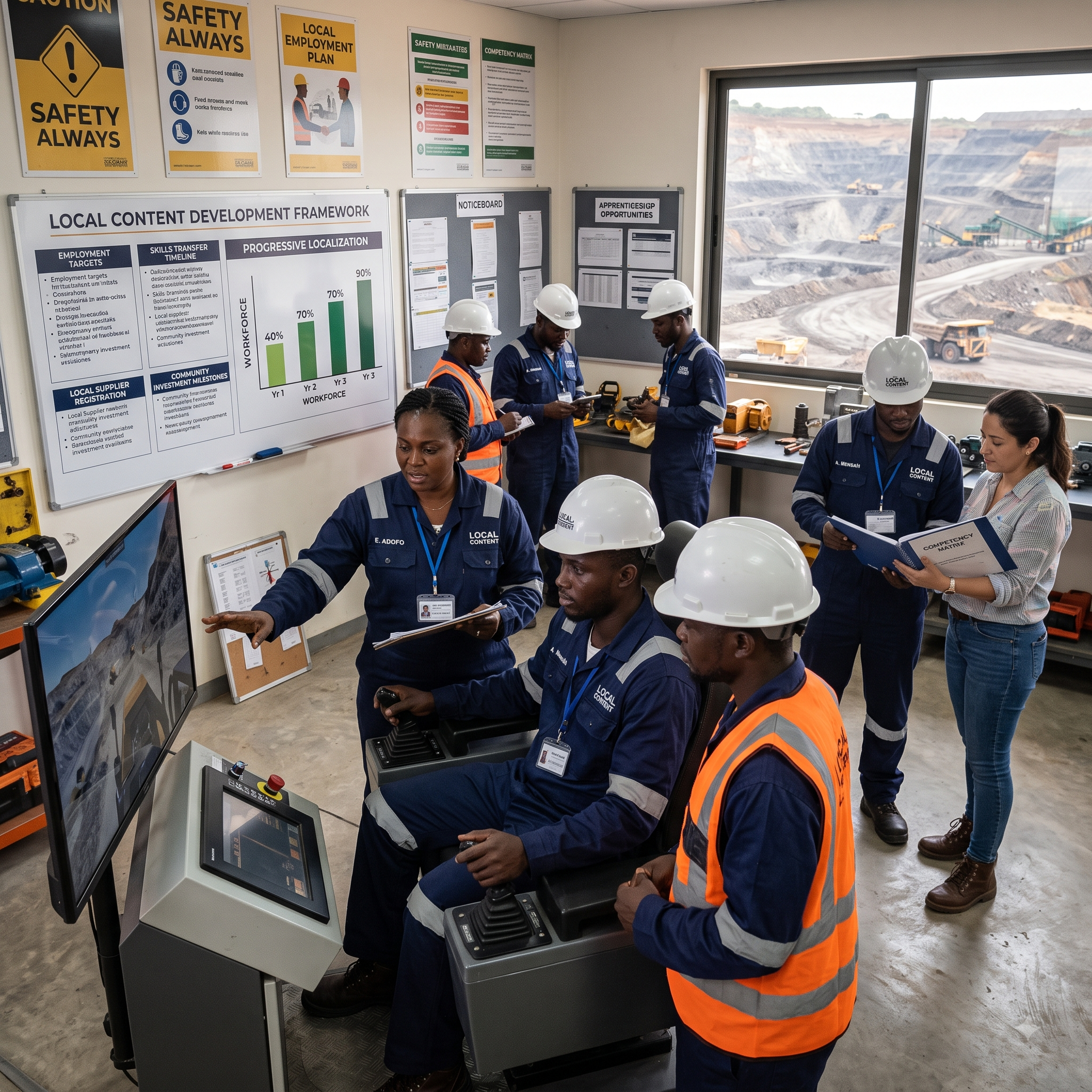
Market entry in any new environment, be it for any extractives, major infrastructure projects, or foreign direct investment, calls for MNCs to work their way through socio-economic environments which may not be so straightforward. The success of any market entry depends on two major interrelated concepts: local content policies and workforce development commitment. Local content is that aspect where there are requirements of regulations or contractual requirements for foreign companies to make use of the local labor and resources to boost the economy of the host environment. Workforce development commitment, on the other hand, is the process of skill development of indigenous manpower for the project.
Over time, host countries have leveraged LCPs to mitigate the resource curse by ensuring that foreign direct investments create value for the country. Host countries are not interested in creating enclave economies where the resource extraction only serves to enrich foreign companies. Therefore, host countries enact LCPs to help in developing petro-economies and promote general resource development within the host country (Ovadia, 2016). In the right implementation, the LCPs will allow MNCs not only to generate revenues but to also be part of the industrial and socioeconomic change process in the host country.
One of the key best practices when it comes to organizing commitments relates to strategic localization of certain job roles. It means that investors should go beyond simple quantitative requirements concerning the use of the local workforce by engaging in real knowledge exchange. The successful localization implies the identification of concrete positions that may potentially be taken by the local people after a realistic timeframe (Pegram et al., 2018). In order to accomplish it, a considerable effort is necessary including the development of educational initiatives tailored specifically to local people’s needs.
Additionally, the success of any program involving local content or workforce development relies significantly on the harmonization of business strategy within the overall political economy of the new environment. Local content is never just about economics; rather, it is firmly rooted in the politics involved in creating coalitions within host nations (Hansen et al., 2015). Any foreign company will have to openly work with state agencies and host populations in designing their commitments in line with national development programs. The importance of politics in the process will give corporations room to build politically resilient commitments.
Moreover, another important factor is overcoming the danger of policy superficiality through capacity development and cooperation with the industry. Indeed, too often, overly optimistic local content requirements become ineffective due to the inability of the local industry workforce to absorb them (Hansen et al., 2015). It is advisable that multinational companies do not work alone but form joint ventures, provide direct training for locals, and assist their local suppliers in the process of implementation. As such, investors turn burdens imposed by the policy into advantages that benefit their position in the market.
In the end, designing a local content and local human capital investment program in a new jurisdiction involves a fundamental change of paradigm from a purely compliance-driven approach to one driven by the principle of shared value creation. The best examples of such approaches involve holistic, adaptive models that are highly integrated within business strategy and national economic ambition (Ovadia, 2016). By focusing on skills transfer, political economy considerations, and capacity development efforts, multinational firms will be able to generate sustainable economic growth in their operating environments.
References
Hansen, M. W., Buur, L., Mette Kjær, A., & Therkildsen, O. (2015). The Economics and Politics of Local Content in African Extractives: Lessons from Tanzania, Uganda and Mozambique. Forum for Development Studies, 43(2), 201–228. https://doi.org/10.1080/08039410.2015.1089319
Ovadia, J. S. (2016). Local content policies and petro-development in Sub-Saharan Africa: A comparative analysis. Resources Policy, 49, 20–30. https://doi.org/10.1016/j.resourpol.2016.04.003
Pegram, J., Falcone, G., & Kolios, A. (2018). A Review of Job Role Localization in the Oil and Gas Industry. Energies, 11(10), 2779. https://doi.org/10.3390/en11102779