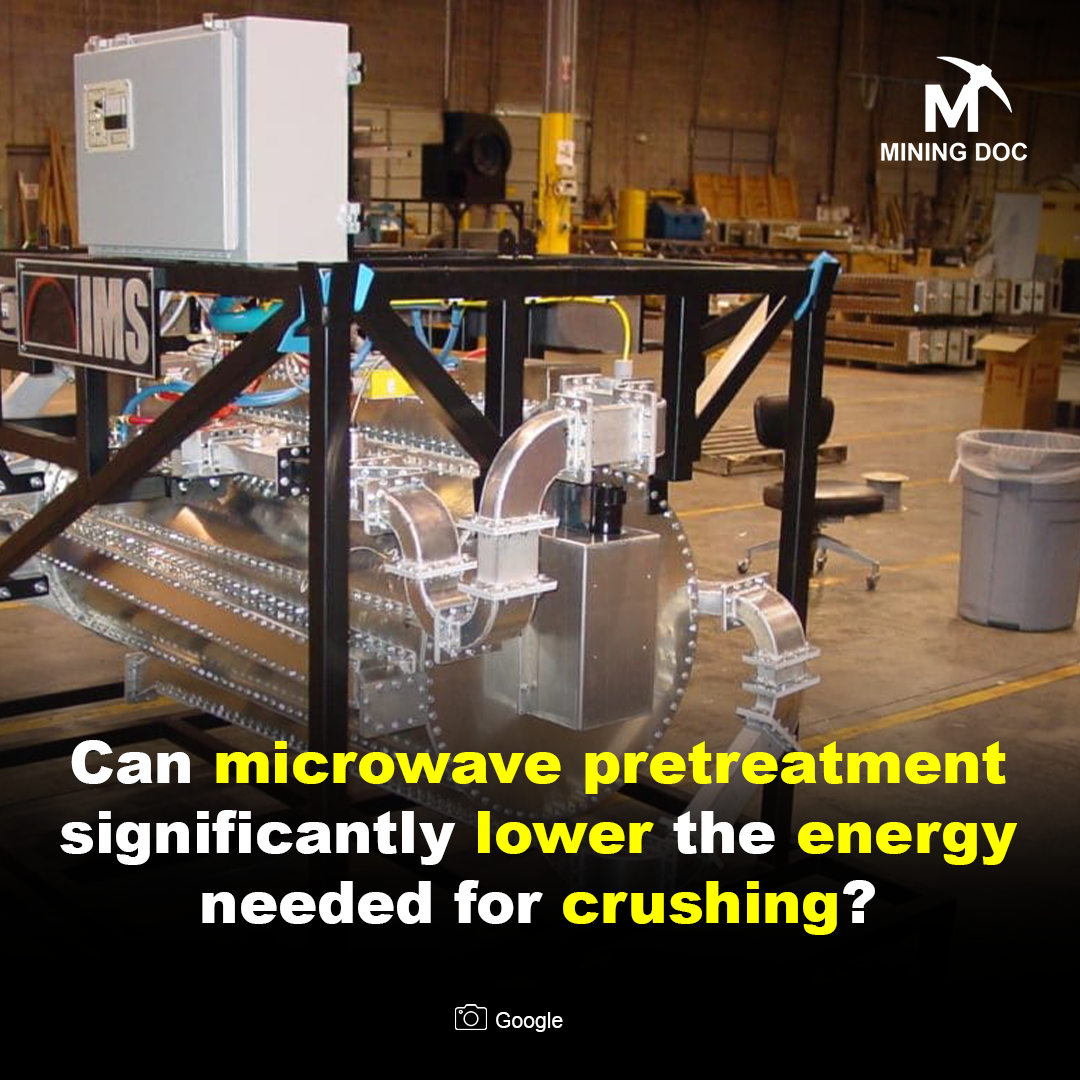
Comminution eats up an estimated 3–5% of global electricity and on many hard-rock sites, crushing and grinding alone can account for roughly half of total mine power draw. That single bottleneck has resisted decades of incremental engineering fixes.
As a matter of fact, when an ore is submitted to a microwave pretreatment process, the metal-bearing phases (copper sulphides, iron oxides) are dielectric, so they absorb microwave energy and heat rapidly whereas the surrounding gangue (quartz, silicates) is largely transparent to microwaves and stays cool. That temperature gap causes differential thermal expansion — the hot mineral grains expand while the cool gangue doesn’t, creating micro-scale thermal shock. As a result, micro-fractures are created along grain boundaries which weakens the rock’s structural weak points before a single crusher jaw or mill ball touches it.
Moreso, according to Kingman et al. the Bond Work Index reductions of 10–30% are commonly reported under controlled microwave exposure. Some ideal, high-mineral-contrast ore samples have shown competency reductions approaching 50–80% in small-scale batch testing. One of the secondary benefits reported in the literature is improved liberation at coarser grind sizes higher achievable throughput, and reduced media/liner wear from softer feed (Batchelor et al., 2016).
The recurrent question is net energy balance: does the electricity consumed by a high-power microwave applicator actually beat the mechanical energy it saves downstream in the crusher and ball mill? When researchers have scaled toward continuous, higher-throughput systems, the gains shrink considerably — some large-scale metallurgical testing has shown Bond Ball Mill Work Index reductions closer to single digits, a far cry from lab-scale headlines.
The technology is also still largely stuck between two development paths: continuous ultra-high-power, short-duration monomode applicators (promising, but not yet proven at full plant throughput) versus the batch-scale results that dominate the literature. Until monomode systems are demonstrated reliably at commercial tonnages, microwave pretreatment remains a “watch closely” technology rather than a drop-in retrofit.
If a continuous, full-scale microwave pretreatment system existed today, would the capex and power infrastructure be worth it for your ore body, or does SAG/HPGR still win on total cost of ownership?
References
-
Batchelor, A. R., Jones, D. A., Plint, S., & Kingman, S. W. (2016). Increasing the grind size for effective liberation and flotation of a porphyry copper ore by microwave treatment. Minerals Engineering, 94, 61–75. https://doi.org/10.1016/j.mineng.2016.05.011
-
Kingman, S. W., Jackson, K., Bradshaw, S. M., Rowson, N. A., & Greenwood, R. (2004). An investigation into the influence of microwave treatment on mineral ore comminution. Powder Technology, 146(3), 176–184. https://doi.org/10.1016/j.powtec.2004.08.006
-
Wills, B. A., & Finch, J. A. (2016). Wills’ mineral processing technology: An introduction to the practical aspects of ore treatment and mineral recovery (8th ed.). Butterworth-Heinemann.