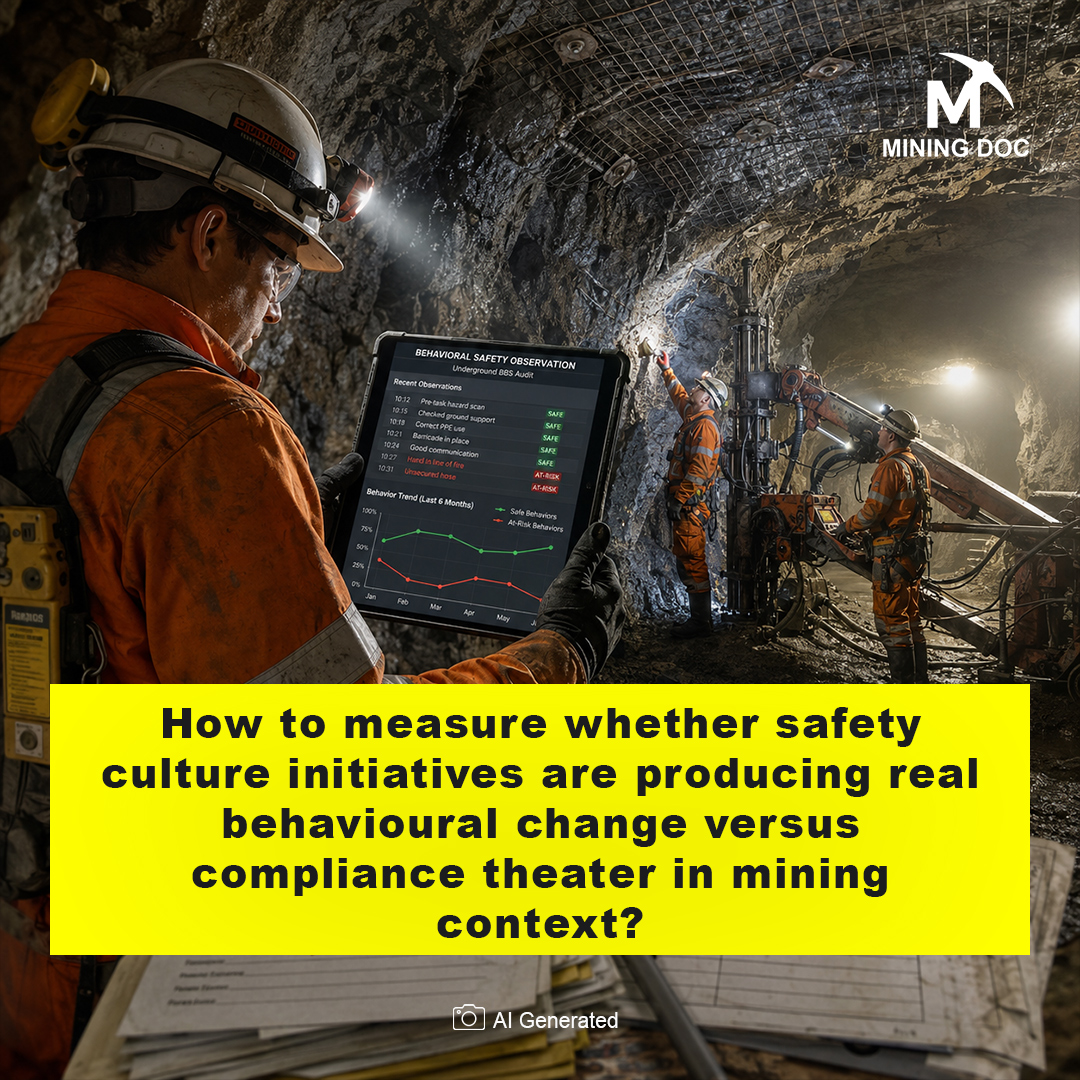
The mining sector is by nature one that involves significant risk, thus necessitating that safety remains topmost. However, the fact that safety programs can be introduced in this industry does not automatically equate to efficacy of safety measures. This means that it becomes important at the outset to understand three major terms. These include safety culture, compliance theater and behavior change. Safety culture is what pertains to the core values, beliefs, and practices associated with ensuring the safety of the organization. The concept of compliance theater is one where complex procedure may satisfy audits without guaranteeing any genuine safety for the employee.
In the mining industry, the overwhelming demand of meeting the rigorous regulations usually forces companies to engage in compliance theater. By depending entirely on lagging measures, including lower lost-time injuries, there is the danger that the inherent weaknesses may be completely hidden under the guise of compliance. For example, the miners can only use personal protection equipment in the presence of managers or complete risk assessments without using their cognition. The mere act of adherence gives an erroneous impression of security. Compliance is seen as an annoying process that should just be ticked off for fear of penalties.
If organizations want to see whether the safety activities undertaken by them are bringing about true behavioural change among them or not, then they should base the measurement process on leading and qualitative metrics. True change takes place when the employees start contributing actively in the process of finding out hazards and give useful suggestions to fellow workers concerning the safety hazards. The good measure in such a situation will be the number of near misses reported by the workers without any fear of reprisals.
The transition from externally imposed compliance to internalized behaviors takes place predominantly through front line leaders. According to research, front line leadership involvement and accountability are the main factors leading to genuine safety behaviors in mining contexts (Prinsloo & Hofmeyr, 2022). When front line leaders act safely and communicate openly without punishment, they create a culture of safety as part of their daily operational practices. Therefore, assessing how often and with what quality there is communication regarding safety between front line leaders and employees yields much more valid results than counting checklists done.
Furthermore, the organization needs to measure intrinsic motivation in order to distinguish between genuine behavior modification and mere compliance. Intrinsic safety behavior is highly dependent upon the miners’ intrinsic values associated with their work as well as upon their level of psychological empowerment. As long as safety programs empower employees instead of policing them, there is a much higher probability that they will behave in a safe way regardless of any changes in the safety climate (Chen et al., 2022).
As a summary, assessing the real impacts of safety culture improvement programs in the mining industry goes beyond conducting mere compliance audits. By assessing proactive risk reporting, accountability of supervisors on site, and employee empowerment, one is able to identify real behavior change versus compliance performance. A safety culture creates a situation where employees not only comply out of fear but also consciously apply safety measures to protect themselves from danger.
References
Chen, T., Hu, W., Liu, J., & Li, H. (2022). Effect of Work Values on Miners’ Safety Behavior: The Mediating Role of Psychological Empowerment and the Moderating Role of Safety Climate. Sustainability, 14, 9553. https://doi.org/10.3390/su14159553
Prinsloo, H., & Hofmeyr, K. B. (2022). Organisational culture, frontline supervisory engagement and accountability, as drivers of safety behaviour in a platinum mining organisation. SA Journal of Human Resource Management, 20. https://doi.org/10.4102/sajhrm.v20i0.1705