
Sign In


Forgot Password?

Don't have account, Sign Up Here

Forgot Password

Lost your password? Please enter your email address. You will receive a link and will create a new password via email.


Have an account? Sign In Now

Sorry, you do not have permission to Add a Post, You must login to Add a Post.


Forgot Password?

Need An Account, Sign Up Here

Sorry, you do not have permission to add Article.


Forgot Password?

Need An Account, Sign Up Here

Please briefly explain why you feel this Post should be reported.

Please briefly explain why you feel this Comment should be reported.

Please briefly explain why you feel this user should be reported.

Mining Doc Logo Mining Doc Logo Mining Doc Logo
Sign InSign Up

Mining Doc

Mining Doc Navigation

  • Home
    • About
    • Contact us
  • Mining articles
  • Online Courses
Search
Sign up

Mobile menu

Close
join for free
  • Home
  • Online courses
  • Case study
  • Mining Community
  • Solutions listing
    • Lase Solutions
    • O-PitBlast Solutions
    • Continuous Mining
    • Longwall mining
    • Geosight Scanners
    • LoopX AI
    • Terafil solutions
    • Blasting solutions
    • Geotechnical
    • Submersible Pumps
    • Mine rescue system
    • Ore sorting
    • Whittle Consulting Solutions
  • Add Blog
  • Feed
  • User Profile
  • Posts
    • New Posts
    • Trending Posts
    • Must read Posts
    • Hot Posts
  • Polls
  • Badges
  • Home
    • About
    • Contact us
  • Mining articles
  • Online Courses

Mining Doc Latest Posts

Mining Doc
  • 0
  • 0
Mining DocExplainer
Added: September 15, 20262026-09-15T05:22:48-04:00 2026-09-15T05:22:48-04:00In: Geology

What's the practical workflow for using portable XRF data in the field without compromising assay-grade decisions?

  • 0
  • 0

pXRF is defined as the type of analysis method which is non-destructive and applied to determine the chemical composition of materials in the field. In cases of mineral exploration and environmental analysis, pXRF allows for rapid and cost-effective analysis compared to traditional laboratory analyses and provides geologists with the opportunity to make real-time operational decisions. However, one of the major obstacles to overcome is creating high-quality data without damaging the quality of the assay grade decisions. A comprehensive and practical workflow is therefore required.

The first crucial stage of a successful pXRF workflow is a thorough selection and preparation of samples. Although pXRF analysis of unprepared rock cores can be performed, heterogeneous texture and moisture content may substantially influence the accuracy of element reading. Research proves that moisture leads to lower detection of total element concentration, which requires certain correction procedures (Kim et al., 2023). Field users should ideally perform analysis of dried, powdered, and homogenized samples since proper sample preparation and sufficient homogenization improve geochemical analysis accuracy (Zhou et al., 2023).

The next important step after sample preparation is the calibration of instruments. The use of only factory calibration may result in poor precision, which does not allow the investigation to be conducted properly. It is very important to establish matrix-matched secondary calibration with the help of Certified Reference Materials, which should be similar in geological matrix to the field site of interest (Ross et al., 2024). With the help of analyzing these materials, geologists can make an empirical correction of the data obtained with the help of pXRF.

Another important factor that influences field data is the measurement parameters. Usually, the duration of exposure is rather small; however, longer beam detection time increases the signal-to-noise ratio and makes it possible to obtain more precise data and detect trace elements (Zhou et al., 2023). In addition, when analyzing unprepared and rough samples, geologists can significantly increase sample precision by conducting measurements in several spots on the sample (Bourke & Ross, 2015).

Any field workflow must include Quality Assurance and Quality Control (QA/QC) protocols. A well-designed QA/QC plan should be embedded in routine practice and involve regular monitoring of the instrumental drift and contamination. Specifically, one should measure blanks to detect cross-contamination, along with constant re-assessing of certified reference materials (CRMs) to prove the sustained accuracy of analyses (Ross et al., 2024). The consistent application of such quality control measures will help keep the level of confidence in the field data equal to that of laboratory standards (Barago et al., 2022).

To sum up, although pXRF analysis is not able to substitute laboratory methods completely, it is a highly efficient technology provided it is used properly. Following the proposed workflow and including the procedures of thorough sample preparation, matrix matching, optimizing scanning parameters, and QA/QC, one can trust the results of the analysis performed using pXRF.

References

Barago, N., Pavoni, E., Floreani, F., Crosera, M., Adami, G., Lenaz, D., Larese Filon, F., & Covelli, S. (2022). Portable X-ray Fluorescence (pXRF) as a Tool for Environmental Characterisation and Management of Mining Wastes: Benefits and Limits. Applied Sciences, 12, 12189. https://doi.org/10.3390/app122312189

Bourke, A., & Ross, P.-S. (2015). Portable X-ray fluorescence measurements on exploration drill-cores: comparing performance on unprepared cores and powders for ‘whole-rock’ analysis. Geochemistry: Exploration, Environment, Analysis, 16, 147–157. https://doi.org/10.1144/geochem2014-326

Kim, E., Moon, Y., & Kim, J. (2023). Field Application of Portable XRF with Glass Bead Certified Reference Material(CRM) in Nickel Laterite Deposit. Journal of the Korean Society of Mineral and Energy Resources Engineers, 60, 99–111. https://doi.org/10.32390/ksmer.2023.60.2.099

Ross, P.-S., Beaudette, M., & Daoudene, Y. (2024). Portable XRF applied to regional bedrock mapping in Quebec, Canada. Journal of Geochemical Exploration, 258, 107397. https://doi.org/10.1016/j.gexplo.2024.107397

Zhou, S., Wang, J., Wang, W., & Liao, S. (2023). Evaluation of Portable X-ray Fluorescence Analysis and Its Applicability As a Tool in Geochemical Exploration. Minerals, 13, 166. https://doi.org/10.3390/min13020166
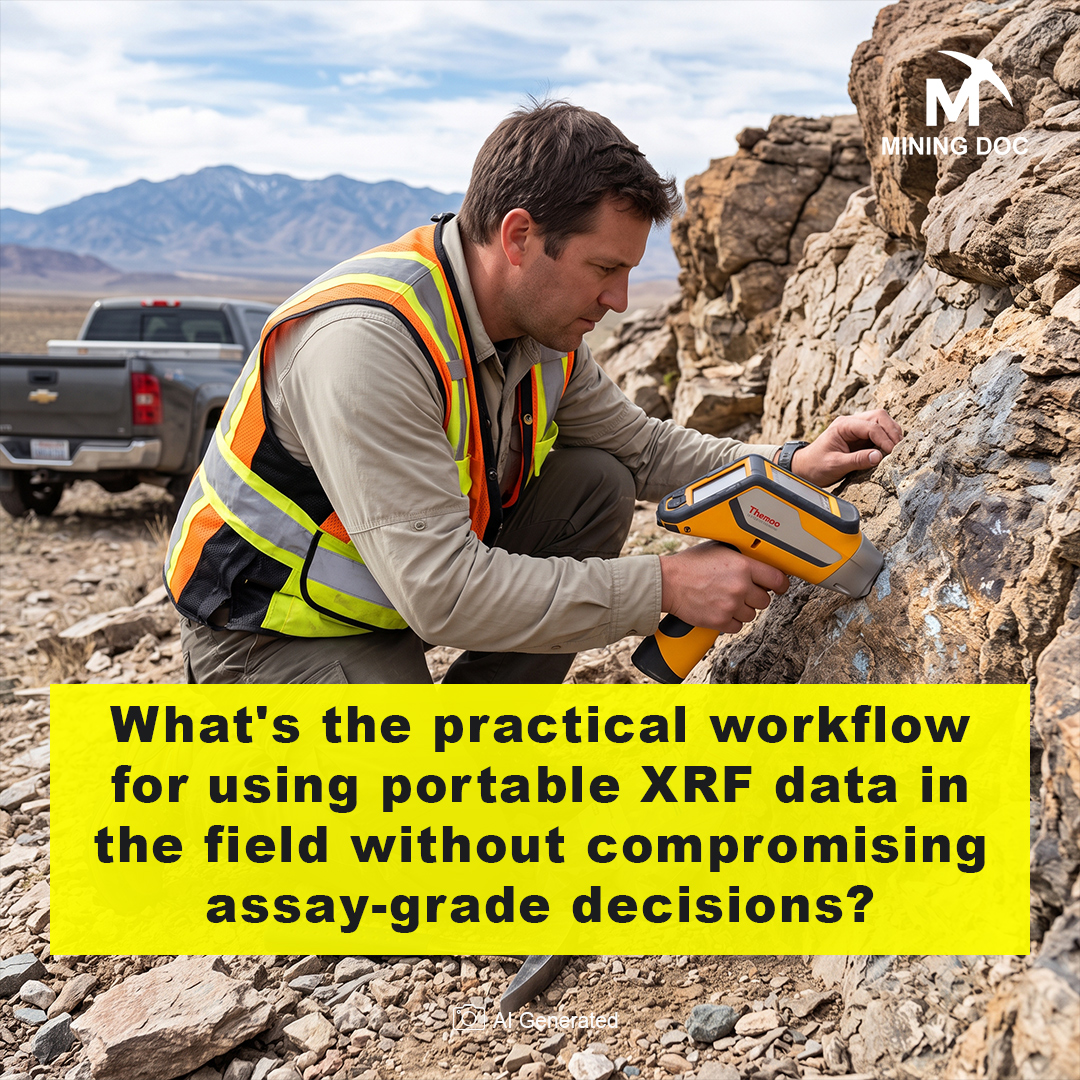

What's the practical workflow for using portable XRF data in the field without compromising assay-grade decisions?
0
  • 0 0 Comments
  • 31 Views
  • 30 Reactions
  • 0 Followers
  • 0
    • Report
  • Share
    Share
    • Share on Facebook
    • Share on Twitter
    • Share on LinkedIn
    • Share on WhatsApp

Related Posts

  • What's the correct method for logging RQD and core recovery to ensure defensible geotechnical domain models?
  • What geochemical pathfinder elements are most reliable for vectoring toward a porphyry copper center at depth?
  • How to distinguish between primary and remobilized structural controls when mapping a shear-hosted gold deposit?

You must login to add an Comment.


Forgot Password?

Need An Account, Sign Up Here
aalan

Sidebar

Sponsored Ads

aalan
  • Recent
  • Mining ERP: Bridging the Gap Between Planned and Actual Costs
    • On: September 14, 2026

    Mining ERP: Bridging the Gap Between Planned and Actual Costs

  • Ore Crushing Plant for Mountain Mines: Managing Access, Transport, and Production
    • On: September 12, 2026

    Ore Crushing Plant for Mountain Mines: Managing Access, Transport, and ...

  • How Does the Crushing Chamber Design of Aggregate Crushing Equipment Affect Output and Finished Product Quality?
    • On: September 12, 2026

    How Does the Crushing Chamber Design of Aggregate Crushing Equipment ...

  • How Can Mine Construction Teams Reduce Rework During Fast-Track Projects?
    • On: September 8, 2026

    How Can Mine Construction Teams Reduce Rework During Fast-Track Projects?

  • The Mine in Your Pocket: Why Mobile ERP Is Reshaping Mining Operations
    • On: September 8, 2026

    The Mine in Your Pocket: Why Mobile ERP Is Reshaping ...

  • How Concrete Is Used in Crusher and Screening Plant Foundations at Guatemalan Mines
    • On: September 4, 2026

    How Concrete Is Used in Crusher and Screening Plant Foundations ...

  • Portable Crusher Plant for Hard Rock Mines: How to Design the Crushing Circuit Before Grinding
    • On: September 3, 2026

    Portable Crusher Plant for Hard Rock Mines: How to Design ...

Go to Home page to view more

Top Members

Olena Skyba

Olena Skyba

  • 150 Posts
  • 2 Comments
Pundit
Marcial

Marcial

  • 91 Posts
  • 0 Comments
Enlightened
Jean Marais (Sanodea Group)

Jean Marais (Sanodea Group)

  • 26 Posts
  • 0 Comments
Beginner
Trending on Mining Doc

Trending Communities

Fixed Plant General Information Geology Mining Case Studies Mining Doc Documentary Mining Engineering Mining Events Mining Finance and Economy Mining Human Resources Mining Industry Research Mining Operations Mining Software Solutions Mining Sustainability Mining Technology Solutions Mobile Plant Equipment

Explore

  • Home
  • Online courses
  • Case study
  • Mining Community
  • Solutions listing
    • Lase Solutions
    • O-PitBlast Solutions
    • Continuous Mining
    • Longwall mining
    • Geosight Scanners
    • LoopX AI
    • Terafil solutions
    • Blasting solutions
    • Geotechnical
    • Submersible Pumps
    • Mine rescue system
    • Ore sorting
    • Whittle Consulting Solutions
  • Add Blog
  • Feed
  • User Profile
  • Posts
    • New Posts
    • Trending Posts
    • Must read Posts
    • Hot Posts
  • Polls
  • Badges

Footer

Mining Doc

Join our community and connect with other people in the Mining industry for knowledge sharing.

Legal Stuff

  • Privacy Policy
  • Terms of Service

Help

  • Support
  • FAQs
  • How to add new content and how to promote a content
  • Compliance and guidelines
  • Subscribe to Mining Doc

Follow

© 2026 Mining Doc. All Rights Reserved