
Sign In


Forgot Password?

Don't have account, Sign Up Here

Forgot Password

Lost your password? Please enter your email address. You will receive a link and will create a new password via email.


Have an account? Sign In Now

Sorry, you do not have permission to Add a Post, You must login to Add a Post.


Forgot Password?

Need An Account, Sign Up Here

Sorry, you do not have permission to add Article.


Forgot Password?

Need An Account, Sign Up Here

Please briefly explain why you feel this Post should be reported.

Please briefly explain why you feel this Comment should be reported.

Please briefly explain why you feel this user should be reported.

Mining Doc Logo Mining Doc Logo Mining Doc Logo
Sign InSign Up

Mining Doc

Mining Doc Navigation

  • Home
    • About
    • Contact us
  • Mining articles
  • Online Courses
Search
Sign up

Mobile menu

Close
join for free
  • Home
  • Online courses
  • Case study
  • Mining Community
  • Solutions listing
    • Lase Solutions
    • O-PitBlast Solutions
    • Continuous Mining
    • Longwall mining
    • Geosight Scanners
    • LoopX AI
    • Terafil solutions
    • Blasting solutions
    • Geotechnical
    • Submersible Pumps
    • Mine rescue system
    • Ore sorting
    • Whittle Consulting Solutions
  • Add Blog
  • Feed
  • User Profile
  • Posts
    • New Posts
    • Trending Posts
    • Must read Posts
    • Hot Posts
  • Polls
  • Badges
  • Home
    • About
    • Contact us
  • Mining articles
  • Online Courses

Mining Doc Latest Posts

Mining Doc
  • 0
  • 0
Mining DocEnlightened
Added: September 23, 20262026-09-23T05:18:20-04:00 2026-09-23T05:18:20-04:00In: Mining Engineering

What's the practical method for determining in-situ stress orientation before designing a deep underground excavation?

  • 0
  • 0

In situ stress refers to the natural state of stress that prevails in the Earth’s crust before any form of engineering intervention. Mining activity in underground workings changes the pre-existing state of stress due to removal of rock mass during the formation of shafts, stopes, haulages, and drifts. The removal of rock mass leads to stress concentration at the faces of underground openings. Excess of local stress over the strength of the rock mass leads to structural instability problems such as rockbursts, wall spalling, floor heaving, and roof collapse. Hence, the estimation of the three-dimensional in situ stress tensor is critical in controlling the ground, scheduling the excavation process, designing of support system, and mine safety.

The total stress underground includes six independent stress elements or three mutually perpendicular principal stresses. The magnitudes and orientations of these stress elements are influenced by natural factors like depth of overburden, tectonic stress, geology, and temperature gradient. Geotechnical engineers use direct testing techniques and indirect diagnostic logging techniques in boreholes to determine the pre-existing state of stress before undertaking any deep excavations.

The overcoring technique is the traditional technique to evaluate the three-dimensional stress field. Specifically, overcoring entails drilling a primary borehole, then drilling a pilot borehole at the bottom of the main borehole, installation of a strain gauge device (e.g., USBM deformation gauge or CSIRO Hollow Inclusion cell) in the borehole, and extension of the borehole such that total stress release is accomplished. The resulting circumferential strains or diametral displacement is evaluated using the principles of elasticity theory to derive the three-dimensional stress tensor. Although overcoring produces detailed information about the magnitude and direction of stresses, it requires physical access to the subsurface, is expensive, and makes measurements in small volumes of rocks.

Another technique is the hydraulic fracturing technique. This technique is widely used where there is no access to the underground environment. In this case, an isolated borehole interval is sealed using straddle packers, after which the pore pressure in the isolated borehole interval is increased until the rocks fracture. The breakdown pressure indicates the initiation of fracturing whereas the shut-in pressure equals the minimum horizontal stress. Hydraulic fracturing produces the average value of stress evaluation in large volumes of rock; however, the traditional test is confined to the two principal stresses in the horizontal plane.

The presence of natural discontinuities or zones with increased porosity complicates the implementation of traditional fracturing because of fluid loss. Technical innovations in this regard involve changing the pumping regime. The injection of fluids at high rates (up to 15 liters per minute) causes high-pressure gradients leading to tensile failure before the fluid is transferred into adjacent joints. On the other hand, pressurization of the formation with high-viscosity fluids reduces fluid losses in porous formations, like sandstone roofs of mines. According to field studies, stress magnitudes resulting from high viscosity fracturing match those obtained from overcoring.

The Hydraulic Tests on Pre-existing Fractures (HTPF) represents another approach, which helps to re-activate existing joint systems rather than create new ones. This involves the mathematical inversion of shut-in pressures in different fracture planes giving the stress field. Furthermore, there is a possibility to use probe microscopes, which do not rely on overcoring. In a plane stress state, the stressed borehole takes an elliptic shape. Probe microscopes measure the displacement and orientation of the ellipse major axis.

Image logging in boreholes is an indirect and fast method for assessing principal stresses in deep boreholes. Higher levels of stress result in compressive failure of the borehole walls, which lead to breakout failures in the borehole walls, parallel to the minimum horizontal stress, whereas drilling-induced tensile fractures (DIF) occur in the direction of maximum horizontal stress. Caliper logging, acoustic television, and resistivity are some of the methods used for identifying these phenomena and for stress analysis in the horizontal plane.

In-situ Stress Measurement is an essential element of rock mechanics in underground mining. Mining activities disturb the natural stress field, thereby creating zones of stress concentration that could be destabilizing to the structure. Overcoring provides a full 3D stress tensor at shallow to medium depths, while Hydraulic Fracturing (HF), Hydraulic Test and Pressure Fracturing (HTPF), and Borehole Breakout provide data on stress state at greater depth or highly anisotropic rock masses. The application of high viscosity fluid fracturing, probe microscopy and numerical back analysis techniques has overcome some technical limitations in measuring stress in poro-elastic and fractured rock media. A combination of these different methods allows mining engineers to build accurate stress databases, determine the orientation of stopes and provide adequate support systems to ensure sustainable ground control.
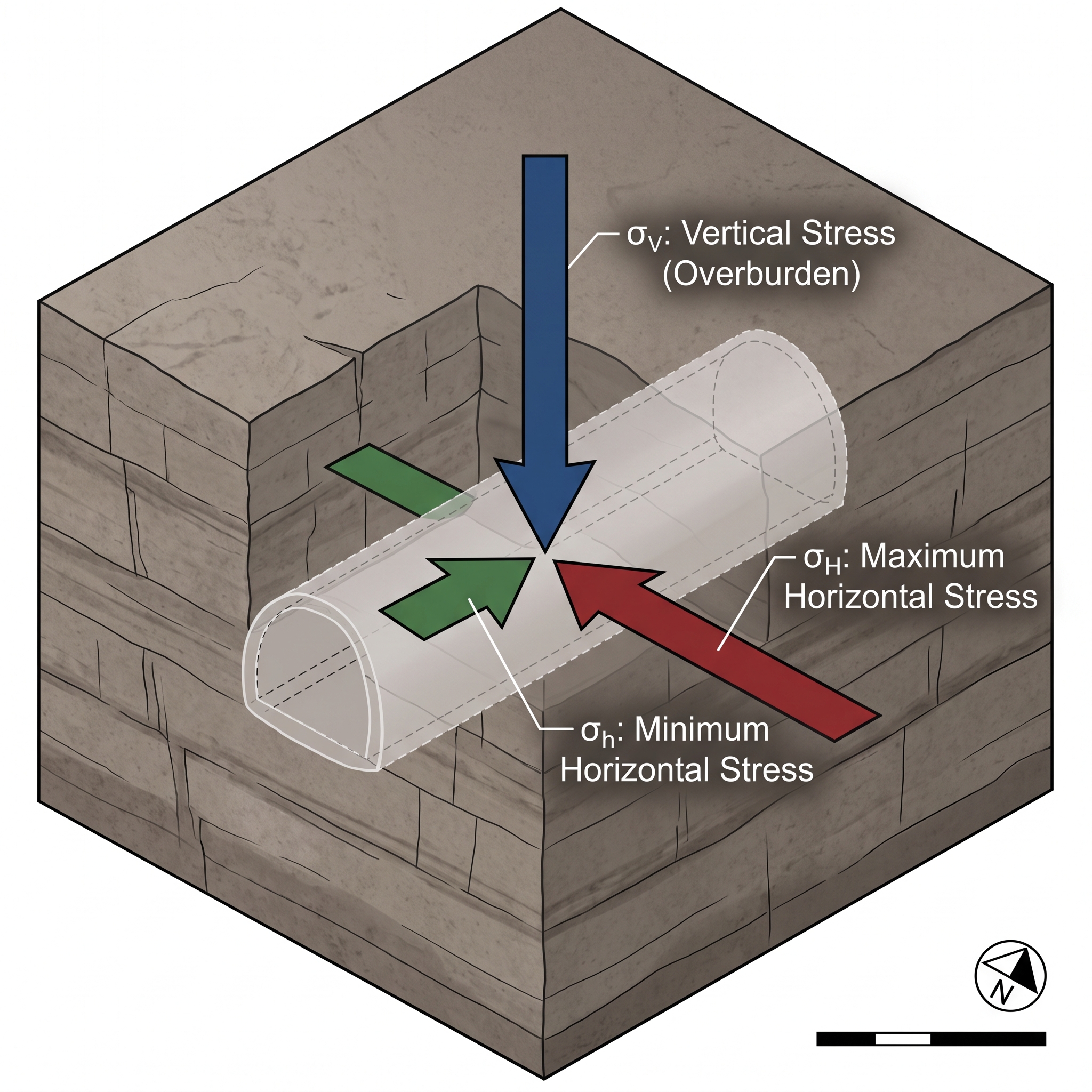

What's the practical method for determining in-situ stress orientation before designing a deep underground excavation?
0
  • 0 0 Comments
  • 53 Views
  • 47 Reactions
  • 0 Followers
  • 0
    • Report
  • Share
    Share
    • Share on Facebook
    • Share on Twitter
    • Share on LinkedIn
    • Share on WhatsApp

Related Posts

  • What's the practical difference in outcomes between electronic detonators and pyrotechnic delays for largescale bench blasting?
  • What's the correct approach to selecting explosive type (ANFO vs. emulsion vs. heavy ANFO) for wet blast holes?
  • What's the correct field procedure for diagnosing misfires before re-entering a blast area safely?

You must login to add an Comment.


Forgot Password?

Need An Account, Sign Up Here
aalan

Sidebar

Sponsored Ads

aalan
  • Recent
  • Stone Crusher Machine in Chile for Mine Road Construction: Producing Aggregate from Local Rock
    • On: September 23, 2026

    Stone Crusher Machine in Chile for Mine Road Construction: Producing ...

  • Mining Job Costing: How ERP Helps Control Project Costs from Budget to Execution
    • On: September 23, 2026

    Mining Job Costing: How ERP Helps Control Project Costs from ...

  • Legal Validity of OTR Tire Supply Contracts: How Technical Appendices Protect the Interests of Mining Enterprises
    • On: September 21, 2026

    Legal Validity of OTR Tire Supply Contracts: How Technical Appendices ...

  • Mobile Crusher for Sale Philippines for Producing Road Base and Construction Aggregates
    • On: September 18, 2026

    Mobile Crusher for Sale Philippines for Producing Road Base and ...

  • Customs Clearance and Logistics Practices for Imported Crusher to Chile
    • On: September 18, 2026

    Customs Clearance and Logistics Practices for Imported Crusher to Chile

  • Mining ERP: Bridging the Gap Between Planned and Actual Costs
    • On: September 14, 2026

    Mining ERP: Bridging the Gap Between Planned and Actual Costs

  • Ore Crushing Plant for Mountain Mines: Managing Access, Transport, and Production
    • On: September 12, 2026

    Ore Crushing Plant for Mountain Mines: Managing Access, Transport, and ...

Go to Home page to view more

Top Members

Olena Skyba

Olena Skyba

  • 150 Posts
  • 2 Comments
Pundit
Marcial

Marcial

  • 91 Posts
  • 0 Comments
Enlightened
Jean Marais (Sanodea Group)

Jean Marais (Sanodea Group)

  • 26 Posts
  • 0 Comments
Beginner
Trending on Mining Doc

Trending Communities

Fixed Plant General Information Geology Mining Case Studies Mining Doc Documentary Mining Engineering Mining Events Mining Finance and Economy Mining Human Resources Mining Industry Research Mining Operations Mining Software Solutions Mining Sustainability Mining Technology Solutions Mobile Plant Equipment

Explore

  • Home
  • Online courses
  • Case study
  • Mining Community
  • Solutions listing
    • Lase Solutions
    • O-PitBlast Solutions
    • Continuous Mining
    • Longwall mining
    • Geosight Scanners
    • LoopX AI
    • Terafil solutions
    • Blasting solutions
    • Geotechnical
    • Submersible Pumps
    • Mine rescue system
    • Ore sorting
    • Whittle Consulting Solutions
  • Add Blog
  • Feed
  • User Profile
  • Posts
    • New Posts
    • Trending Posts
    • Must read Posts
    • Hot Posts
  • Polls
  • Badges

Footer

Mining Doc

Join our community and connect with other people in the Mining industry for knowledge sharing.

Legal Stuff

  • Privacy Policy
  • Terms of Service

Help

  • Support
  • FAQs
  • How to add new content and how to promote a content
  • Compliance and guidelines
  • Subscribe to Mining Doc

Follow

© 2026 Mining Doc. All Rights Reserved