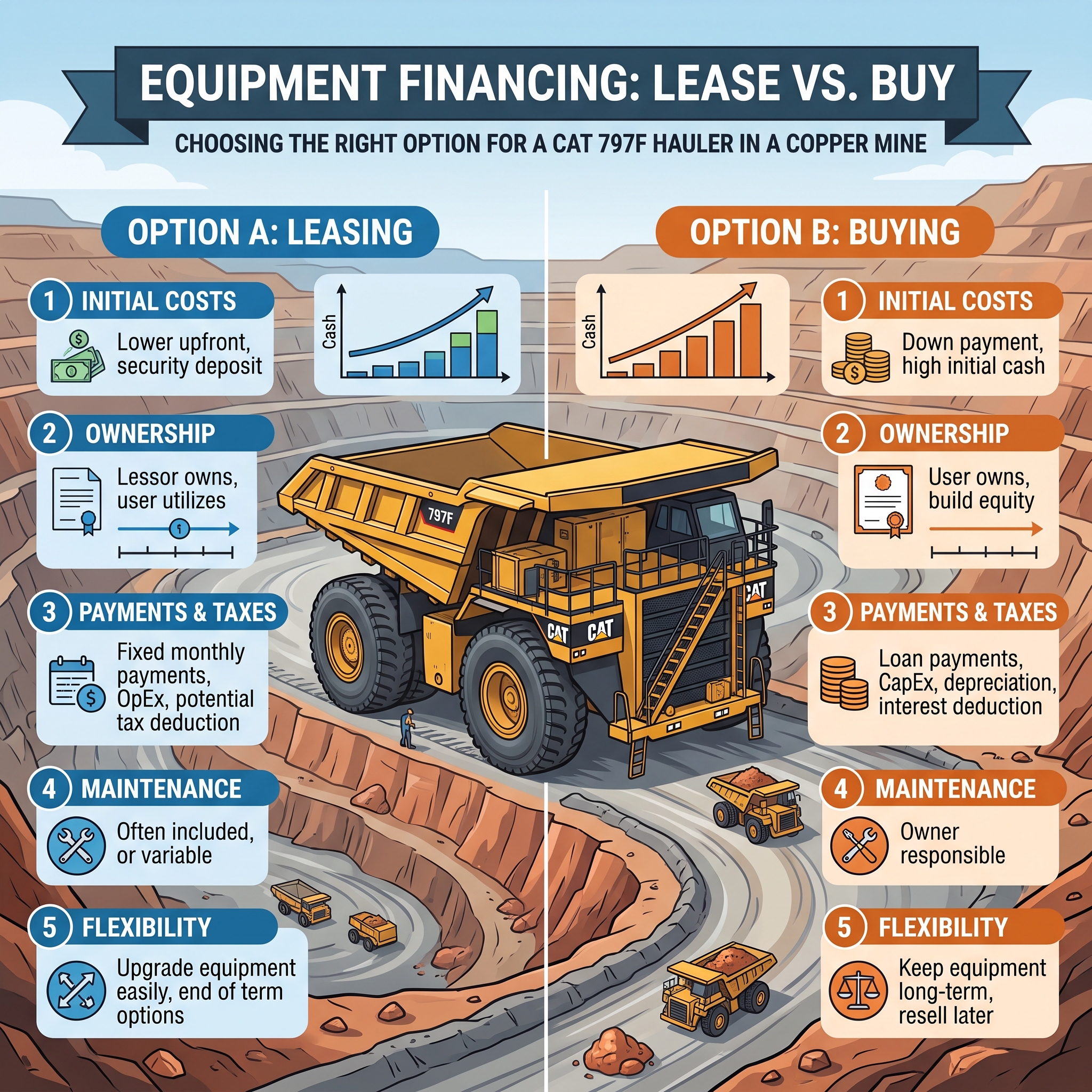
Heavy mining companies require heavy equipment and machinery to meet their production objectives and raw material movement needs. The challenge for fleet managers is how to decide whether to purchase the required equipment or lease them to expand or upgrade existing equipment. The decision has great impact on the company’s capital management strategy, maintenance process, technology cycle and corporate taxes. To choose the best way, the executives of the mining companies need to analyze the total cost of ownership during all life cycle phases and not focus only on upfront cost or lease payments.
Ownership provides the highest level of control since direct ownership allows the company to have complete oversight of fleet modifications, maintenance schedule, and procurement of parts. Unlimited use ensures that mining companies can use equipment for remote harsh shifts without facing mileage penalties or depreciation. However, purchasing the vehicles will require significant capital expenditures, limit credit capability, and expose the business to risks of residual value at disposal. Leasing will reduce the capital cost and ensure operating expenses predictability.
Closed-end leases transfer the risk of asset disposal to the leasing company, while open-end Terminal Rental Adjustment Clause (TRAC) agreements require the lessee to guarantee residual value. According to accounting principles including ASC 842 and IFRS 16, both operating and finance leases require capitalization of right-to-use asset and liability in the financial statement. Master lease includes several schedules for individual vehicles which serve as separate assets with different start dates and conditions of use.
The tax law plays an important role in determining the total net cost of acquiring commercial vehicles. The provisions of Section 179 and 100% bonus depreciation allow corporations to deduct the whole purchase price of commercial vehicles that are used for business activities, especially heavy equipment with the gross vehicle weight rating of more than 6,000 pounds. Tax benefits represent significant initial savings for companies. In addition to financing, the effective fleet plan must be supported by the replacement strategy based on the data.
Operators in the resource sector measure such indicators as repair cost per hour, average time between breakdowns, trends in fuel efficiency, and downtime. If the costs of repair work and downtime become higher than the remaining depreciation of equipment, replacement is required. Using telematics and other digital tracking solutions allows collecting information that is used for phased replacements of vehicles. Constant monitoring in the sourcing, financing, operation, and disposal phases increases the reliability of assets and reduces maintenance cost.
A good fleet management process would be able to combine the operational, financial, and taxation considerations in one coherent analysis framework. While direct buying will give you the most operational control and tax benefits by allowing for bonus depreciation, leasing keeps the cash flows flowing and reduces the risk of volatile residual values. Resource companies enjoy reduced total cost of ownership and increased equipment availability if their replacement cycles are determined based on the telematics information as opposed to purely timing-based cycles.