When 100 Alerts Appear, Which One Deserves Your Attention First?
A mining operation can have hundreds of connected assets—haul trucks,excavators, crushers, conveyors and support equipment—generating data continuously.
But more data does not automatically mean better maintenance.
The difficult question begins after the alert appears:
-
Which warning demands immediate attention?
-
Which condition can continue to be monitored?
-
Which asset could affect production?
-
What maintenance action is actually required?
-
Are the right technicians, parts and resources available?
Detection tells you that something is changing. Decision-making determines what happens next.
An Alert Is Not a Maintenance Decision
Not every alert demands the same response. AI can help maintenance teams identify what deserves attention first.
- Minor deviation → Continue monitoring
- Repeated abnormal pattern → Schedule an inspection
- Multiple linked anomalies → Prioritise maintenance
The objective is not to create more alerts.
It is to identify the alerts that could have greater operational impact and help teams decide what needs attention next.
From “Something is wrong” → to “This needs attention now.”
From Equipment Data to Maintenance Priority
The machine does not operate in isolation. Neither should its data.
A meaningful maintenance decision may require several signals to be considered together:
-
Equipment sensor readings
-
Historical maintenance records
-
Previous fault patterns
-
Equipment age and utilisation
-
Operating conditions
-
Production impact
-
Similar asset behaviour
-
Maintenance history and frequency
When these data points come together, the maintenance team gets more than an individual warning.
It gets context.
And context is what makes an alert actionable.
When Small Changes Start Telling a Bigger Story
A single abnormal reading may mean little. A pattern across multiple signals can mean much more.
Imagine a crusher where vibration begins increasing gradually.
On its own, the change may not appear significant.
But then other indicators begin moving:
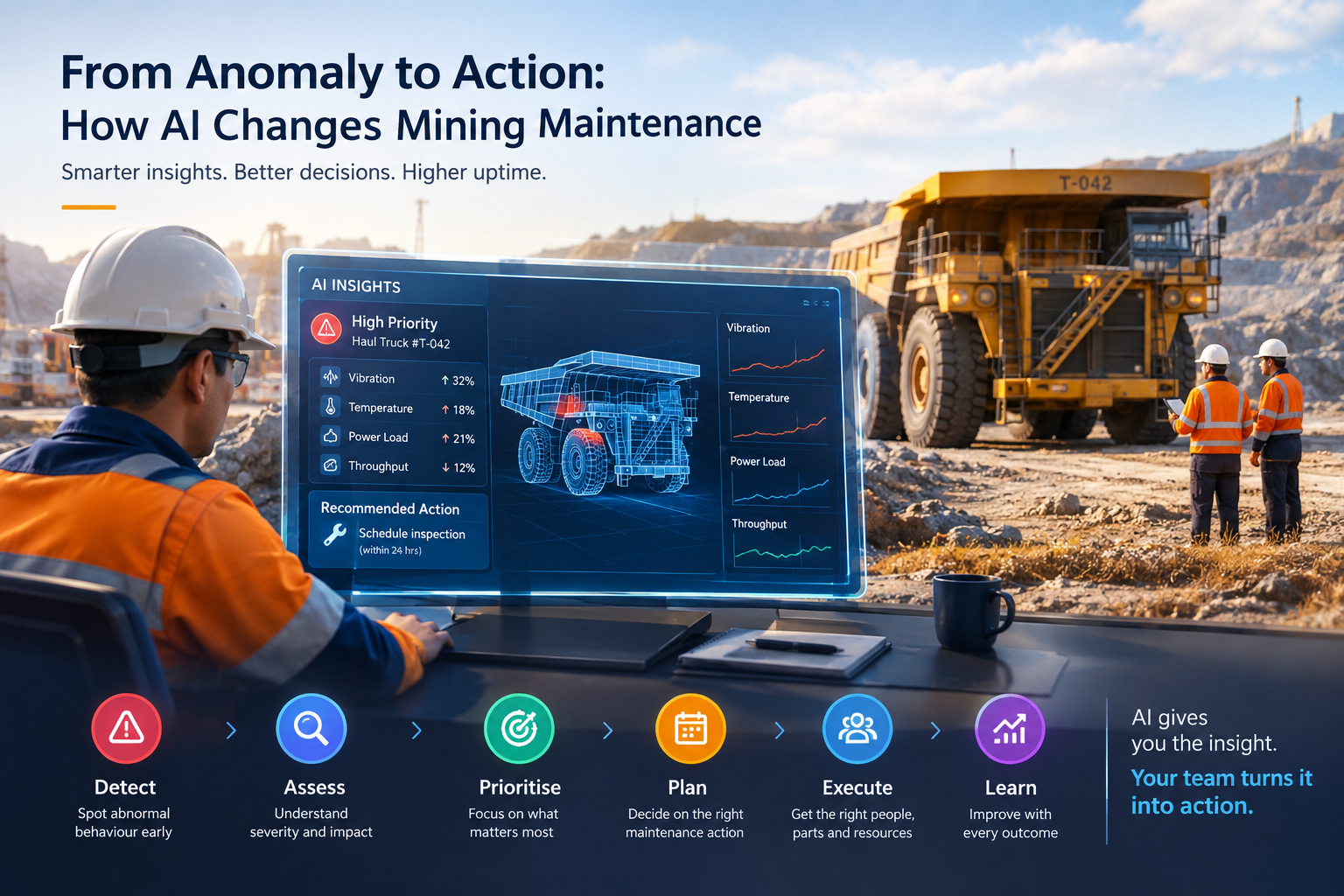
Vibration ↑ → Temperature ↑ → Power Consumption ↑ → Throughput ↓
The important signal is not necessarily one measurement.
It is the relationship between several changes over time.
AI-based analytics can help identify these developing patterns and bring potentially important conditions to the maintenance team’s attention earlier.
The objective is not to predict every failure with certainty.
It is to give the team better information before the problem becomes an operational disruption.
The Real Breakthrough: Turning Insight Into Action
A dashboard can show a problem. A connected system can help move the problem toward resolution.
For predictive maintenance to create operational value, the process needs to move beyond monitoring:
1. Sense : Capture equipment and operating conditions continuously.
2. Analyse : Compare current behaviour against expected and historical patterns.
3. Priortise : Identify conditions that require attention based on severity and operational relevance.
4. Plan : Determine the appropriate inspection, service or maintenance activity.
5. Execute : Coordinate technicians, spare parts, equipment availability and maintenance resources.
6. Learn : Capture the maintenance outcome and use it to improve future decisions.
This is where predictive maintenance becomes an operational workflow—not another dashboard.
The Maintenance Advantage Is Not Always “Zero Breakdowns”
Sometimes, the biggest gain is simply having more control over when maintenance happens.
A predictable maintenance requirement can create opportunities to:
-
Plan intervention around production schedules
-
Prepare critical spare parts in advance
-
Allocate technicians more effectively
-
Reduce emergency maintenance requirements
-
Coordinate equipment availability
-
Improve maintenance scheduling
-
Track recurring failure patterns
-
Strengthen maintenance planning with historical data
The objective shifts from responding to downtime to managing equipment condition.
AI Brings the Signal. Mining Expertise Brings the Decision.
Technology can identify patterns. The maintenance team provides the operational context.
A technician knows the machine.
They understand its workload, environment, operating behaviour and maintenance history.
AI contributes another layer of intelligence:
-
Continuous monitoring
-
Pattern recognition
-
Historical comparison
-
Anomaly detection
-
Maintenance prioritisation
-
Decision support
The strength comes from combining both.
Human expertise + machine intelligence = better-informed maintenance decisions.
What Changes When Maintenance Becomes Connected?
The biggest shift happens when equipment intelligence moves beyond the maintenance department.
Predictive maintenance becomes significantly more valuable when connected with:
-
Fleet Management — understand equipment availability and utilisation
-
Production — identify potential operational impact
-
Inventory — connect maintenance requirements with spare-part availability
-
ERP/EAM — link insights with maintenance planning and business processes
-
Management Dashboards — provide visibility into equipment health and operational priorities
Now, equipment data is no longer sitting inside a maintenance dashboard.
It becomes part of the larger mining decision-making ecosystem.
From “What Happened?” to “What Should We Do Next?”
Traditional maintenance data often answers:
“What happened to the equipment?”
Predictive analytics aims to move the conversation further:
“What is changing?”
And then:
“How important is it?”
And ultimately:
“What should we do about it?”
That is the real transition from equipment monitoring to equipment intelligence.
For mining companies, the future of predictive maintenance may not simply be about predicting failure.
It is about creating a connected chain:
Equipment → Data → AI Insight → Maintenance Priority → Action → Operational Learning
And when that chain connects with the wider mining operation, AI stops being just a source of alerts.
It becomes part of how the mine decides, plans and acts.
Because knowing that a machine is changing is useful. Knowing what to do next is where the real operational value begins.