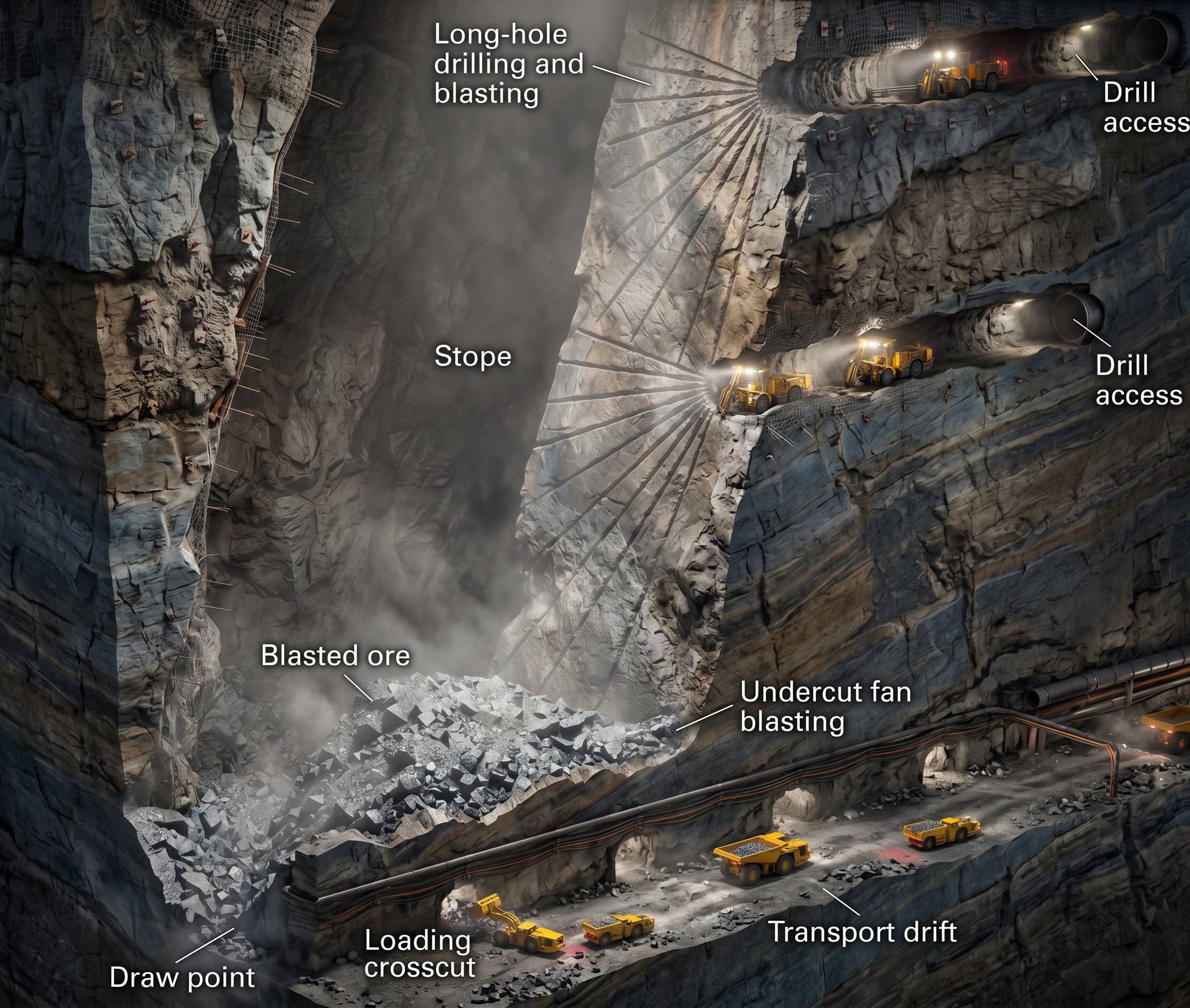
The sublevel open stoping technique is the main underground mining method adopted for the mining of ore deposits with steep dip, but unanticipated dilution of the ore is a great economic challenge in mining projects. The accidental blending of waste rock continuously reduces the ore grade raised from the underground, leading to greater costs in mucking, hauling, and processing operations, reducing the net present value of the mine assets. Empirical assumptions used conventionally do not help in stopping too much overbreak when mining in complicated geologic conditions. It calls for a comprehensive diagnosis process to determine the causes of such occurrences. Mine engineers should analyze three fundamental principles.
The process of void reconciliation involves taking three-dimensional CMS laser scanning of the voids to make a comparison between actual stopes and the original design of the stopes. The surveyors obtain quantitative data such as the Equivalent Linear Overbreak Slough (ELOS) and Ore Dilution Density (DD). These metrics help identify the location of the overbreak in the hangingwall, footwall, and crown. Such comprehensive void mapping allows distinguishing between the internal planned dilution and the external waste-rock detachment. Moreover, mucking and draw-control practices need to be audited. Load-haul-dump (LHD) machines may accidentally move waste rock due to poor visual identification of the ore and the host rock in open stope voids.
Deviation in blastholes is one of the major sources of overbreak that results from blasting operations. Site survey analysis shows that rig alignment and collar offset cause up to 64% of toe deviation, which is far above the impact of just downhole wander. Un-calibrated digital inclinometer and wear of rig equipment, among other aspects, contribute to rig alignment error at the collar level. In addition, blast design considerations need to be analyzed keenly. Powder factor that is too high, incorrect ring burden spacing, and delay sequencing of detonations cause a lot of vibration on the ground. Such vibrations lead to breaking apart of the rock walls, making hanging walls fall into the stope space.
Geotechnical assessment provides vital information regarding the quality of rock mass and mechanics of failure. Geological features such as graphitic fault zones, shear planes, and low GSI strength formations pose serious threats to the stability of the hanging wall. Development drifts that cause failure of continuous fault zones lead to stress relaxation and gravity induced wall sloughing. Ground support strength requires close audit. Cable bolt system fails either due to unsuitable water-cement ratio in grout or because of dilatation of the interface causing cable stripping instead of steel strand failure. Proper instrumentation like multi point extensometer and SMART cables can help in this regard.
The diagnostic system helps the mining company understand what is causing the high levels of stope dilution and then find the solution. The multi-disciplinary process of integrating the CMS spatial survey, audit of drill & blast operations, and back analysis of geomechanics transforms previous performance data into engineering measures that can be used to improve the situation. The use of digital rig alignment systems, optimized ring burdens, and ANN prediction helps reduce overbreak.