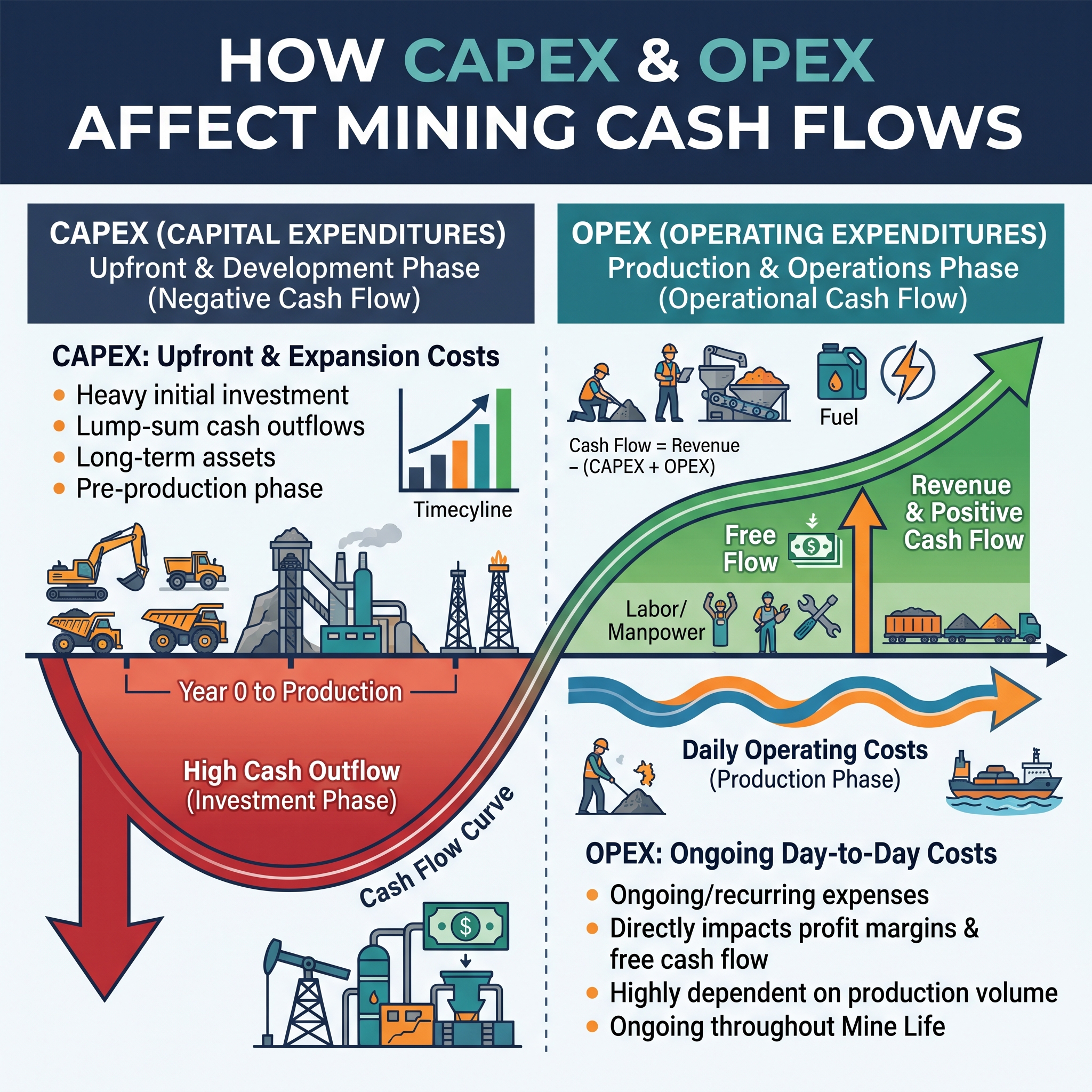
Capital investments in the resource sector require substantial financial commitment throughout the multi-year project lifecycle. Capital expenditures (CAPEX) represent major fixed-asset investments necessary to bring a mineral deposit into active commercial production. Daily operational expenses (OPEX) cover recurring running costs required for ongoing mineral extraction, ore treatment, and site management. Strategic balance between upfront capital commitments and ongoing operational expenses directly dictates net cash flows, Net Present Value (NPV), and organizational resilience against commodity price volatility.
Upfront capital outlays initiate greenfield project development through mineral rights acquisition, site preparation, shaft construction, and processing plant erection. On corporate financial statements, CAPEX appears as capital outlays under investing activities, creating heavy negative net cash flows during initial development phases. Initial capital outlays occur in the early years of a project when time value discount factors are minimal. Consequently, upfront capital efficiency heavily governs Net Present Value calculations and project payback horizons. Additional sustaining capital is required across the operational mine life for fleet renewals, underground development, and tailings storage facility expansions. Execution delays and capital expenditure overruns represent primary drivers of Value at Risk in mining project evaluations.
Operational expenses (OPEX) represent continuous cash outflows required for daily mineral production throughout the mine lifecycle. Extraction expenses comprise production drilling, blasting, loading, hauling, and mine worker wages. Mineral processing activities cover crushing, grinding, and chemical beneficiation alongside general administrative overhead and site power supply. Low unit operating costs widen operating profit margins, providing a crucial financial buffer during severe commodity price downturns. Operational performance is tracked through key industry metrics such as cost per tonne, cash operating cost per unit output, and All-In Sustaining Costs (AISC). Resource operations actively control OPEX through equipment automation, artificial intelligence monitoring, renewable power integration, and predictive maintenance programs.
Resource sector companies navigate constant strategic trade-offs between initial capital outlays and long-term operating costs. Upfront capital investments in automated, energy-efficient processing equipment reduce recurring unit operating expenses over the entire mine life. Strategic capital infusions must occur at planned operational transitions, such as converting from open-pit to underground extraction, to prevent costly production interruptions. Financial models analyze capital outlays and operating streams together using Discounted Cash Flow methodology, Net Present Value, and Internal Rate of Return (IRR). Early capital expenditures carry greater mathematical weight in discounted cash flow modeling than distant operational costs, making upfront capital control vital for securing project debt and equity financing.
Capital expenditures establish the initial productive capability of a mine, whereas operating expenditures dictate daily commercial survival and profit margin stability. Comprehensive project evaluation requires probabilistic risk management and All-In Sustaining Cost metrics rather than simple deterministic forecasts. Strategic alignment between strict capital discipline and continuous operational cost optimization maximizes discounted cash flows and delivers long-term economic value across volatile commodity market cycles.