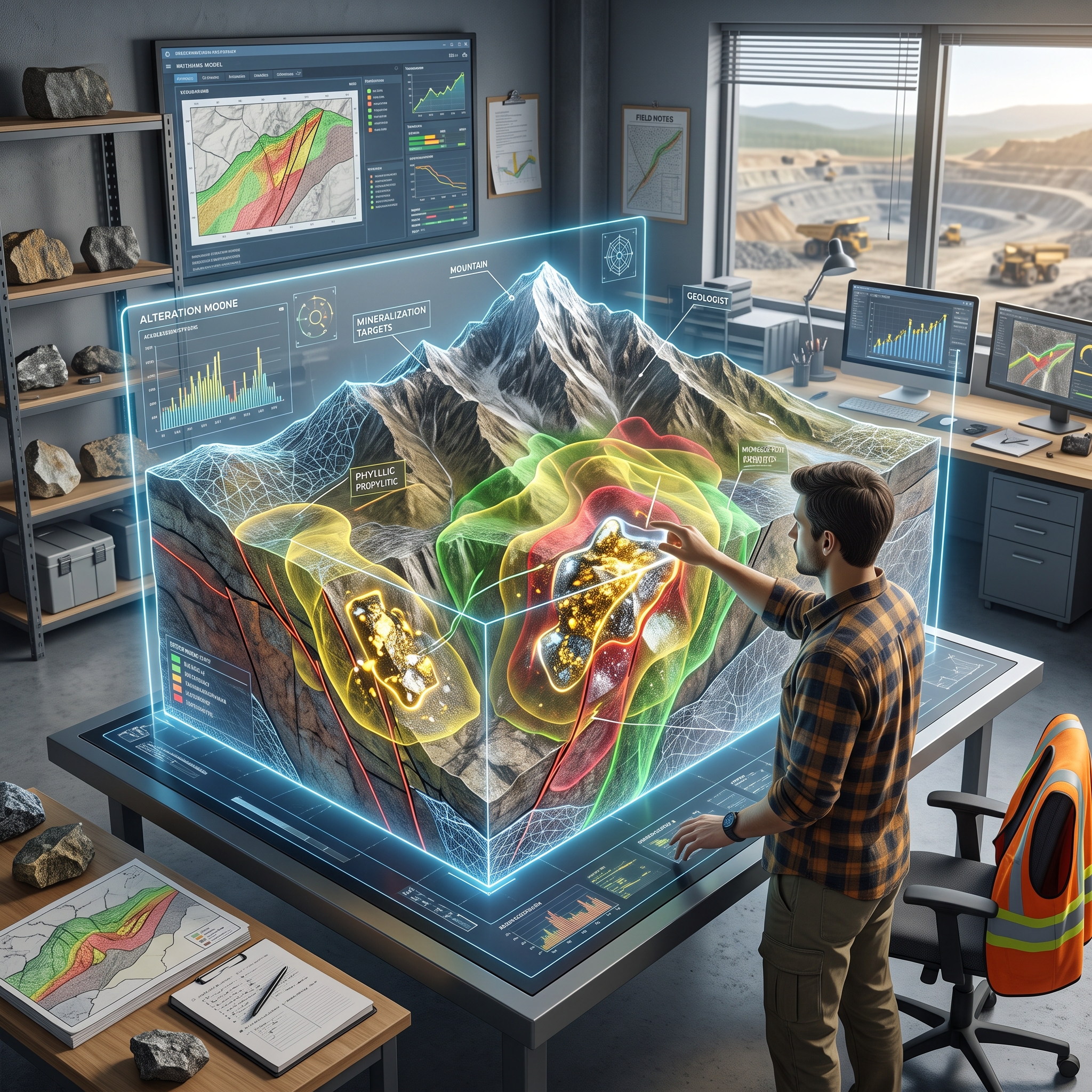


Modern mineral exploration increasingly targets deep-seated or concealed orebodies obscured by thick overburden and post-mineralization cover. Deep overburden and complex multi-phase deformation frequently obscure high-grade mineralization at depth. Conventional two-dimensional surface mapping often fails to detect blind mineralization in structurally complex settings. Three-dimensional alteration modelling provides a quantitative, spatial framework that converts mineralogical, geochemical, and spectral data into actionable vectors toward ore. Hydrothermal fluid-rock interaction mapping in three dimensions enables explorationists to delineate deposit halos, refine structural controls, and optimize drill targeting with greater precision and reduced capital risk.
Hydrothermal fluids produce broad alteration halos that extend far beyond narrow economic mineralization. Short-Wavelength Infrared (SWIR) spectroscopy and Hyperspectral Imaging (HSI) detect subtle mineralogical changes, such as white mica absorption shifts around 2200 nm. Spatial interpolation of these spectral parameters creates volumetric isosurfaces that vector directly toward fluid conduits. At the Mt Wright gold deposit in Queensland, 3D modelling of SWIR data mapped a subtle sericite chemistry gradient and a kaolinite-illite halo around the central breccia pipe, placing non-intersecting boreholes in proper spatial context (Lisowiec et al.). Short wavelength white mica (<2201 nm) dominates the upper breccia pipe at Mt Wright, whereas longer wavelengths occur at depth. Similarly, the Ocelot porphyry project in Arizona combined HSI with drill core logs to model alunite and topaz alteration shells along key structures (Scher et al., 2024).
Faults and shear zones act as primary pathways for hydrothermal fluids, making the integration of 3D structural models with alteration envelopes essential for target generation. Advanced frameworks combine these multi-source datasets within regular voxel grids using artificial intelligence. In the Siahcheshmeh intrusion-related gold system in Iran, a 3D Deep Autoencoder (DAE) integrated silicification halos with transpressive fault intersections (Bahroudi and Farahani, 2026). Monte Carlo Dropout quantified aleatoric and epistemic uncertainties across the model. High-prospectivity, low-uncertainty Tier-1 targets occupied only 24% of the volume yet captured 68% of mineralized borehole intercepts. The exclusion of high-uncertainty voxels increased predictive accuracy to 98.6%. Likewise, 3D lithofault and alteration models at the Tongshan copper deposit successfully identified high-potential targets beneath major fault structures (Wang et al.).
High-resolution 3D alteration models resolve complex boundaries between economic ore and barren wallrock, reducing resource estimation errors and ore dilution. At the Janja copper-gold deposit in Iran, dynamic anisotropic variogram modelling of alteration and lithology improved ore-waste separation across a 482-million-tonne resource (Farokhi Nasab et al., 2025). This approach separates sulfide from oxide domains and establishes clear cutoff boundaries for copper and gold grades. Furthermore, unsupervised machine learning groups complex multi-mineral assemblages into geometallurgical domains. At the Caspiche porphyry deposit in Chile, 3D domaining of HSI data mapped coexisting biotite, amphibole, and clay groupings to evaluate mineral processing characteristics prior to mining (Scher et al., 2024). These volumetric models bridge exploration targeting with downstream metallurgical performance.
Three-dimensional alteration modelling transforms complex geochemical and spectral datasets into actionable exploration vectors. The coupling of hydrothermal mineral zonation with structural architecture, machine learning, and uncertainty quantification allows geologists to pinpoint concealed targets, refine orebody geometries, and minimize drilling risk. Future exploration relies on continuous spectral updates and risk-calibrated 3D models to unlock deep mineral potential. This integrated spatial methodology maximizes discovery efficiency, enhances resource confidence, and supports sustainable mine development in increasingly challenging geological environments.
References
Bahroudi, A., & Farahani, A. (2026). 3D Ore prospectivity modeling Using Deep Autoencoder (DAE) with Uncertainty Quantification: A Case Study from Northwestern Iran. Journal of Mining and Environment.
Farokhi Nasab, K., Imamalipour, A., & Hossein-Morshedy, A. (2025). High-resolution 3D modeling for enhanced mineral resource estimation through improved ore-waste separation: a case study of the Janja Cu-Au deposit. Research Square preprint.
Lisowiec, N., Halley, S. H., & Ryan, L. Using Deposit-scale Alteration and Geochemical Signatures to Explore for Analogue Deposits: a Case Study From the Mt Wright Gold Project, Queensland. Carpentaria Gold / Resolute Mining Ltd. / Mineral Mapping Pty. Ltd.
Scher, S., Gorecki, A., Burkett, S., & Carmichael, T. (2024). Integrating hyperspectral imaging datasets in 3D alteration and geometallurgical domaining models with case studies. International Association of Applied Geochemistry (IAGS 2024).
Wang, G., Wang, L., Cui, G., Tan, C., & Jin, S. 3D integrated geological modeling to mineral exploration in Tongshan copper deposit, Heilongjiang Province, China. China University of Geosciences.
Zhang, Y., et al. (2024). Three-dimensional modeling and geostatistical structural analysis for ore deposit prospecting trend and wisdom mining: a case study in the Jiaoxibei gold field, China. Frontiers in Earth Science, 12, 1217016.