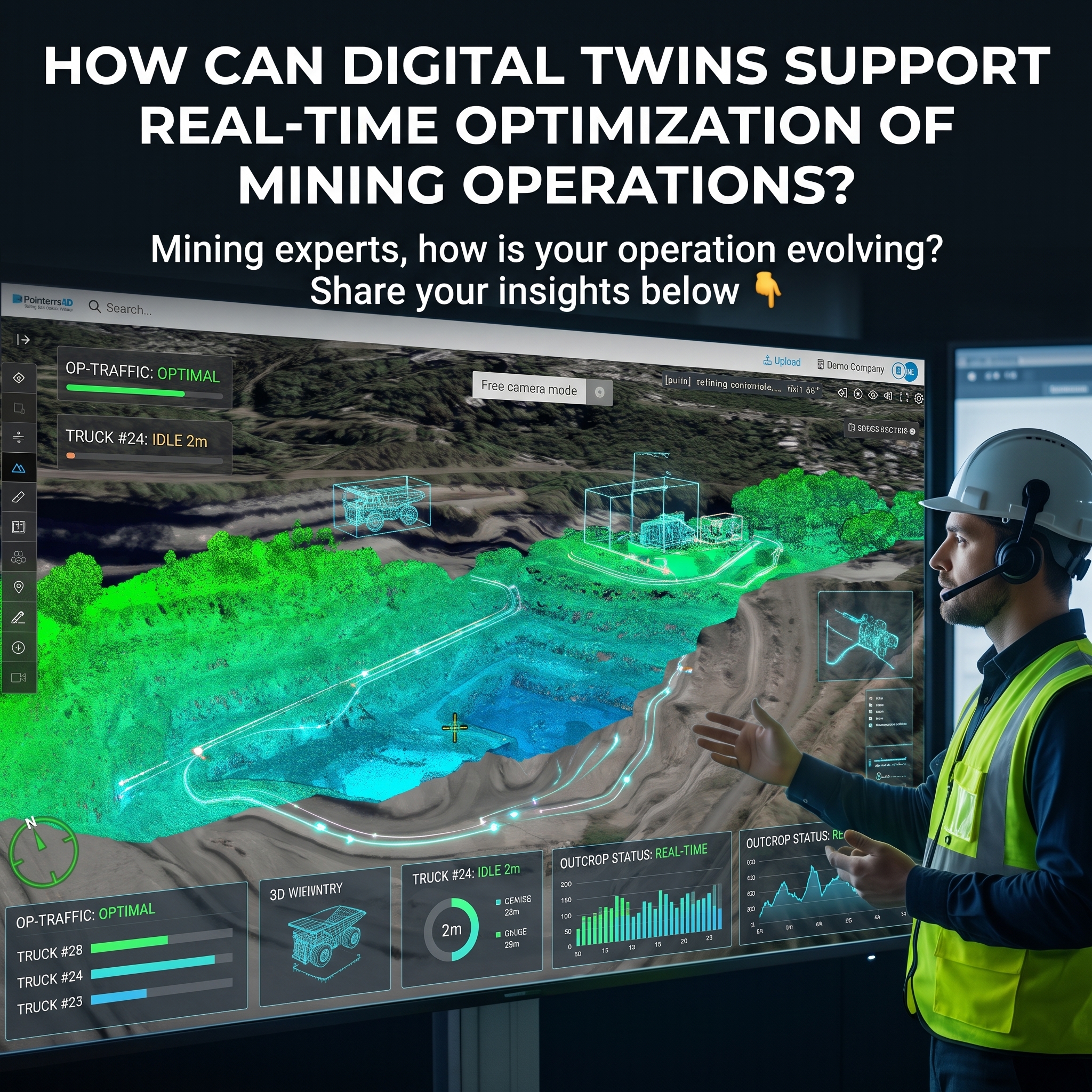
Global mining operations face relentless pressures from declining ore grades, extreme feed variability, and harsh environmental operating conditions. Modern processing facilities collect millions of operational data points across programmable logic controllers and supervision networks. However, these systems often remain siloed and reactive, forcing personnel to make delayed manual adjustments during shift changes. A modern industrial digital twin overcomes these operational boundaries by establishing bidirectional synchronization between physical assets and virtual computational models. Telemetry streams from Internet of Things sensors continuously feed physics-based simulations and machine learning algorithms. Consequently, this architecture creates a closed-loop framework that drives real-time optimization across process control, predictive asset maintenance, and environmental risk mitigation.
Conventional regulatory controllers respond to feed disturbances only after upsets propagate through the plant circuit. A digital twin replaces this reactive posture with predictive, two-way control loops that anticipate process bottlenecks. Comminution circuits, such as semi-autogenous grinding mills, benefit from hybrid architectures that combine state-space formulations, fuzzy expert systems, and recurrent neural networks. Automatic disturbance detection algorithms monitor prediction residuals in bearing pressure and motor power. When liners wear down or ore hardness abruptly changes, the framework triggers targeted model retraining without overfitting to sensor noise. Metallurgists can also conduct virtual scenario evaluations, adjusting reagent dosage or autoclave setpoints in simulation before applying physical changes to operational equipment.
Mobile fleets and heavy processing machinery endure severe mechanical stress that causes premature component failure. Continuous prognostics and health management frameworks track sensor telemetry to forecast remaining useful life across dumpers, crushers, and conveyor belts. Engine vibrations evaluated against international mechanical standards alert maintenance teams to mechanical wear long before catastrophic breakdowns occur. Multivariate operational patterns reveal whether equipment runs in a stable optimum or an overload inefficiency state. Remote operations with limited network connectivity deploy these predictive algorithms on industrial edge devices. Local execution delivers sub-second inference speeds, preserves operational continuity during communication dropouts, and isolates critical control networks against cyber threats.
Traditional mining operations maintain rigid boundaries between extraction, haulage, and metallurgical processing. A holistic digital twin dismantles these silos by connecting blast fragmentation analytics directly to conveyor feed rates and mill throughput. Dynamic stockpile tracking reduces unnecessary power consumption across grinding and flotation circuits. Furthermore, digital twins extend beyond production assets to secure critical containment infrastructure such as tailings storage facilities. Geotechnical sensor arrays, including tiltmeters, piezometers, and satellite positioning receivers, continuously monitor embankment stability. Automated forecasting models detect sub-millimeter surface displacements and pore pressure anomalies, providing operations with reliable early warnings against structural failures.
Industrial digital twins represent far more than passive three-dimensional renderings or static supervisory dashboards. They function as dynamic, self-calibrating ecosystems that combine live telemetry, advanced machine learning, and closed-loop control. Mines that implement these virtual systems achieve measurable reductions in maintenance expenditure, lower power consumption, and improved equipment availability. Successful adoption depends on robust data governance and modular edge computing rather than standalone software purchases. Mineral enterprises that embrace unified digital twins establish safer, more resilient, and highly competitive operations.