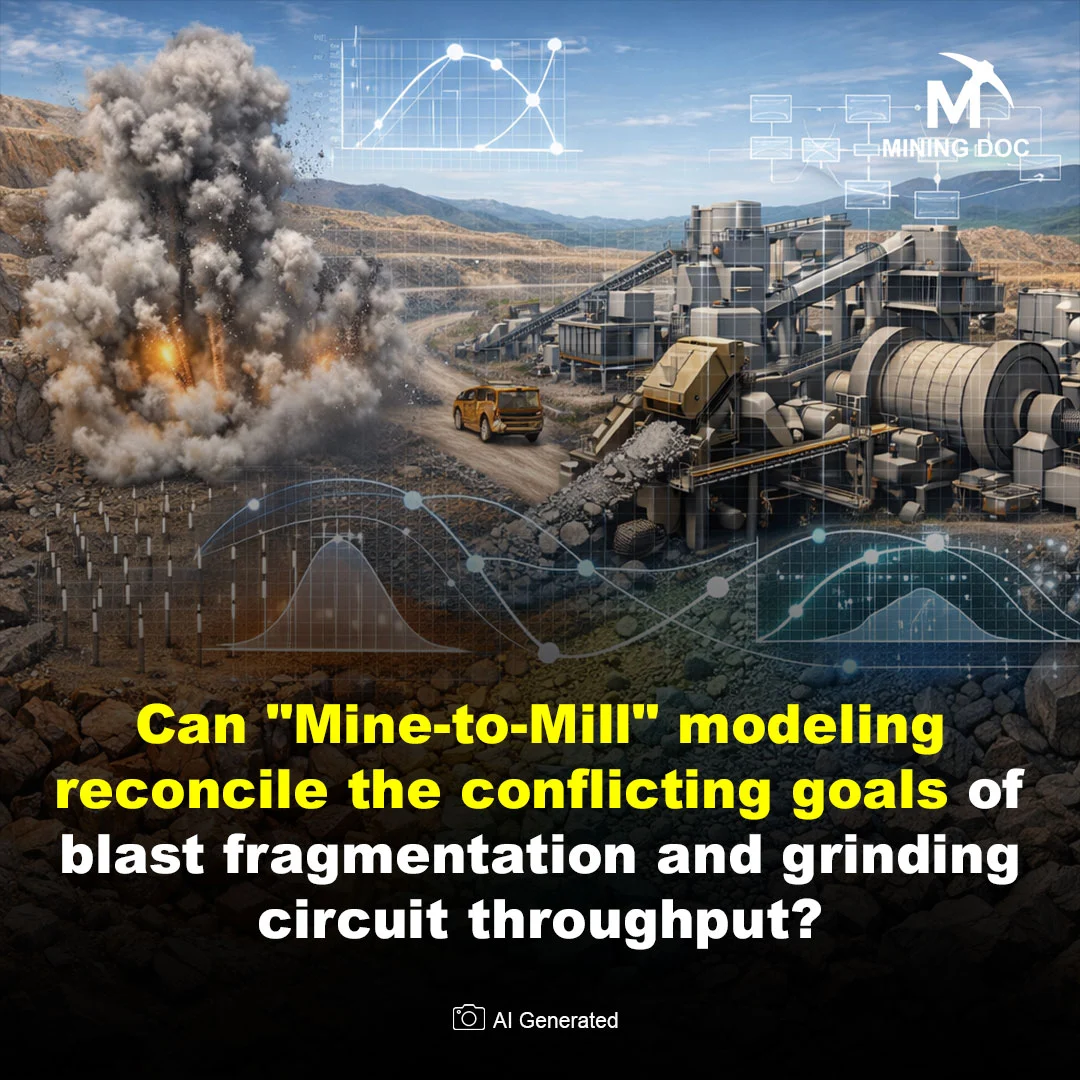
In traditional mining, the mine department seeks to minimize drilling and blasting (D&B) costs, which often results in coarser fragmentation [1]. Conversely, the mill seeks the finest possible feed to maximize throughput [2]. M2M modeling reconciles these by demonstrating that a strategic increase in D&B costs typically yields a massive, disproportionate return in milling efficiency.
The core reconciliation mechanism
M2M modeling uses mathematical simulations (like JKSimBlast for blasting and JKSimMet for grinding) to find the “global optimum” where the total cost per ton is minimized.
- The conflict: lowering D&B costs leads to larger rocks (coarse feed) and fewer “fines” (particles <12mm). This forces the SAG/AG mills to work harder, consuming more energy and slowing down throughput.
- The solution: M2M models prove that by increasing the Powder Factor (the amount of explosive per ton of rock), the mine can generate more “intrinsic fines. [3]“ These fines bypass or quickly pass through the primary grinding stages, effectively “unloading” the mill and allowing it to process significantly more tonnage per hour [4].
How M2M reconciles the two stages
The modeling process follows a structured workflow to align these departments:
| Feature | Traditional Approach | Mine-to-Mill Approach |
| D&B Goal | Minimize cost per meter drilled. | Optimize fragmentation for mill feed. |
| Mill Strategy | React to whatever the mine delivers. | Predict throughput based on incoming ore. |
| Primary KPI | Departmental cost silos. | Overall Net Present Value (NPV). |
| Measurement | Visual estimation of muckpiles. | Automated image analysis and “Electronic Twins.” |
Key benefits of the reconciliation
- Throughput gains: documented cases show that optimizing fragmentation can increase mill throughput by 10% to 30% without any new capital equipment [5].
- Energy efficiency: blasting is the most energy-efficient form of comminution. By doing more “breaking” in the pit with explosives, the mill reduces its specific energy consumption (kWh/t) [6].
- Micro-fracturing: M2M models account for “invisible” benefits; high-intensity blasting creates micro-cracks in the ore, which reduces the Bond Work Index (the energy required to grind the rock) in downstream circuits [7].
- Cost leverage: research indicates that for every $1 spent on additional blasting, the mill typically saves $7 to $10 in operating costs [8].
While the modeling is powerful, reconciliation often fails due to “Siloed Data.” Many mines have geological models, blast designs, and mill sensors in separate databases [9]. Modern M2M reconciliation uses Machine Learning (ML) and Digital Twins to bridge these gaps, allowing operators to see in real-time how a specific blast pattern in “Block A” will affect the SAG mill throughput 24 hours later [10].
Mine-to-Mill (M2M) modeling can effectively reconcile the conflicting goals of blast fragmentation and grinding circuit throughput by treating them as a single integrated value chain rather than two separate cost centers.
Reference
[1] “How does blast hole diameter influence fragmentation, powder factor, and downstream crushing efficiency? – Mining Doc.” Accessed: Jan. 20, 2026. [Online]. Available: https://www.miningdoc.tech/question/how-does-blast-hole-diameter-influence-fragmentation-powder-factor-and-downstream-crushing-efficiency/
[2] “Mine-to-Mill Optimization: Powering Efficiency Along the Value Chain – Digital Transformation beyond ERP | Automation | Softweb.” Accessed: Jan. 20, 2026. [Online]. Available: https://softweb.co.in/blog/mine-to-mill-optimization/
[3] P. Nobahar, C. Xu, and P. Dowd, “Cost-Integrated AI Meta-Models for Mine-to-Mill Optimisation: Linking Fragmentation, Throughput, and Operating Costs Across the Value Chain,” Minerals, vol. 16, no. 1, p. 73, Jan. 2026, doi: 10.3390/min16010073.
[4] “Mine-To-Mill Optimisation: Effect Of Feed Size On Mill Throughput | SRK Consulting.” Accessed: Jan. 20, 2026. [Online]. Available: https://www.srk.com/en/publications/mine-to-mill-optimisation-effect-of-feed-size-on-mill-throughput
[5] S. Expert, “Mine-to-Mill Optimization: Powering Efficiency Along the Value Chain,” Digital Transformation beyond ERP | Automation | Softweb. Accessed: Jan. 20, 2026. [Online]. Available: https://softweb.co.in/blog/mine-to-mill-optimization/
[6] H. Losaladjome Mboyo, B. Huo, F. K. Mulenga, P. Mabe Fogang, and J. Kalenga Kaunde Kasongo, “Assessing the Impact of Surface Blast Design Parameters on the Performance of a Comminution Circuit Processing a Copper-Bearing Ore,” Minerals, vol. 14, no. 12, p. 1226, Dec. 2024, doi: 10.3390/min14121226.
[7] E. Kinyua, Z. Jianhua, R. Kasomo, D. Mauti, and J. Mwangangi, “A review of the influence of blast fragmentation on downstream processing of metal ores,” Minerals Engineering, vol. 186, p. 107743, Aug. 2022, doi: 10.1016/j.mineng.2022.107743.
[8] S. Expert, “Mine-to-Mill Optimization: Powering Efficiency Along the Value Chain,” Digital Transformation beyond ERP | Automation | Softweb. Accessed: Jan. 20, 2026. [Online]. Available: https://softweb.co.in/blog/mine-to-mill-optimization/
[9] “Why Mines Struggle with Siloed Data Between Mine and Mill.” Accessed: Jan. 20, 2026. [Online]. Available: https://ntwist.com/blog/mine-to-mill-siloed-data
[10] P. Nobahar, C. Xu, and P. Dowd, “Cost-Integrated AI Meta-Models for Mine-to-Mill Optimisation: Linking Fragmentation, Throughput, and Operating Costs Across the Value Chain,” Minerals, vol. 16, no. 1, p. 73, Jan. 2026, doi: 10.3390/min16010073.