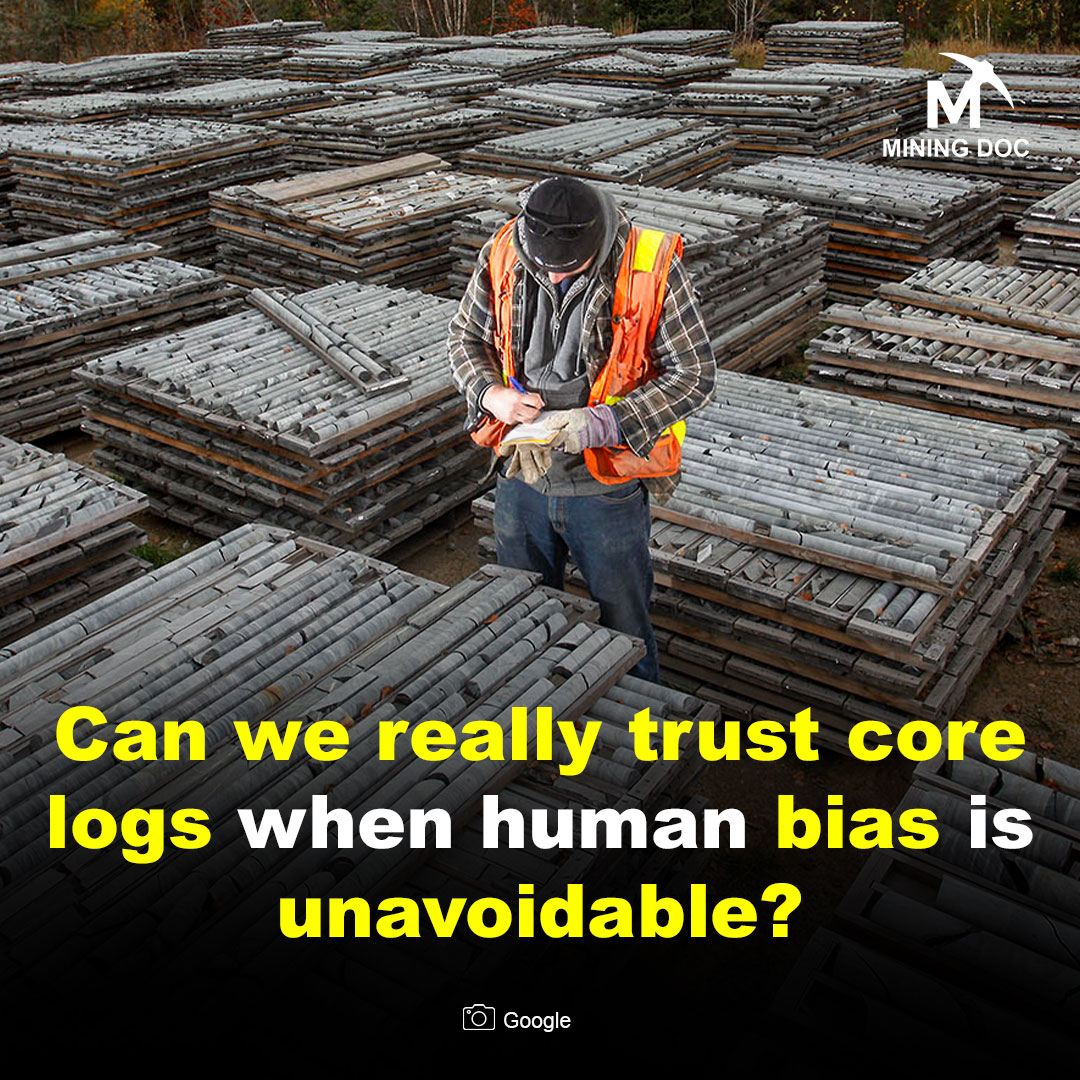
For over a century, geological core logging has been a fundamental practice in fields ranging from hydrocarbon exploration to climate science and mineral resource assessment. These meticulously described columns of subsurface rock are primary data, forming the basis for billion-dollar decisions and our understanding of Earth’s history. Yet, at the heart of this objective science lies a profoundly subjective element: the human logger. The critical question, therefore, is not if bias exists, but how its pervasive influence compromises data integrity and whether modern methodologies can mitigate it.
The inescapable nature of cognitive bias
Human bias in core logging is not a matter of negligence, but of cognitive architecture. Loggers interpret visual, textural, and structural features based on their training, experience, and even the subconscious expectations set by the geological model of the area. A study by Lynch et al. (2023) demonstrated that when presented with the same sedimentary core interval, experienced geologists showed significant variation in identifying and classifying heterolithic (mixed sand and mud) facies, with interpretations often aligning with their prior depositional environment hypotheses. This “confirmation bias” — the tendency to favor information that confirms pre-existing beliefs — can subtly shape descriptions, from grain size estimates to the prominence given to certain features.
Furthermore, Martino and Steel (2022) highlighted the impact of “anchoring bias” in quantitative estimates, such as porosity or vein density. An initial measurement or a colleague’s comment can unconsciously serve as an anchor, skewing subsequent measurements towards that value. This is particularly problematic in resource estimation, where small systematic errors can compound into large financial miscalculations.
The compound effect of subjective descriptive systems
Many traditional logging schemes rely on qualitative, descriptor-based classifications (e.g., “moderately sorted,” “friable,” “dark greenish gray”). As Harper et al. (2021) argue, these terms are inherently ambiguous and lack consistent thresholds between observers. Their research in mineralized core logging found that two geologists might agree on the presence of alteration, but their descriptions of its intensity and boundary could differ by over 30% of the interval length. This subjectivity directly translates into uncertainty in 3D geological models built from these logs, as the interpolated boundaries between rock types become fuzzy.
Pathways towards mitigation and quantifiable trust
Acknowledging these biases has spurred a multi-pronged approach to enhance objectivity and trust in core data.
- Digital and automated logging:the rise of high-resolution hyperspectral imaging, micro-CT scanning, and automated mineralogical tools (e.g., MLA, QEMSCAN) provides quantifiable, repeatable physical and geochemical datasets. Jones et al. (2024) showed that automated vein detection and mineral classification in drill core scans reduced the inter-observer variability in commodity-grade estimation by more than 60% compared to traditional manual logging. These digital twins of the core create a permanent, objective record that can be re-interrogated indefinitely.
- Structured and calibrated protocols:the industry is moving towards more structured and calibrated human logging. This includes the use of detailed, image-based standards for comparison, regular “logger calibration” sessions to align teams, and discrete interval selection for specific measurements rather than continuous description (Martino & Steel, 2022). Quantifying color with spectral tools instead of Munsell charts is another example of replacing a subjective scale with a physical measurement.
- Metadata and transparency:trust is also bolstered by comprehensive metadata. Documenting the logger’s identity, experience level, the specific protocol used, and the conditions of the logging (e.g., core quality, lighting) allows downstream users to contextualize the data’s reliability (Harper et al., 2021). Embracing this transparency about potential bias is a hallmark of robust scientific practice.
Conclusion
We cannot wholly eliminate the human element from core logging, nor should we—expert pattern recognition and holistic interpretation remain invaluable. However, blind trust in traditional logs is untenable given the evidence of unavoidable cognitive bias. The future of trustworthy subsurface data lies in a hybrid approach: leveraging quantitative digital tools to provide an objective baseline, while using rigorously trained human expertise to interpret complex features and geological context. By explicitly recognizing bias as a quantifiable uncertainty, rather than an unspoken flaw, the geosciences can produce core data that is not only trusted but whose degree of reliability is finally understood.
References
Harper, S., L. F. Pereira, & J. A. Turner. (2021). Quantifying observer bias in geological drill core logging: Implications for resource modelling. Ore Geology Reviews, 138, Part 1, 104389. https://doi.org/10.1016/j.oregeorev.2021.104389
Jones, R. R., K. J. W. McCaffrey, & M. L. Smith. (2024). Reducing subjectivity in mineral deposit characterization: A comparative study of automated versus manual drill core logging. Economic Geology, 119(2), 351–367. https://doi.org/10.5382/econgeo.2024.1202
Lynch, E. A., C. A.-L. Jackson, & M. D. Simmons. (2023). Cognitive bias in facies interpretation of sedimentary cores: An experimental study. Sedimentology, 70(5), 1587–1606. https://doi.org/10.1111/sed.13095
Martino, R., & R. Steel. (2022). Human factors in geological data acquisition: Mitigating anchoring and confirmation biases in reservoir characterization. AAPG Bulletin, 106(8), 1509–1526. https://doi.org/10.1306/12132120123