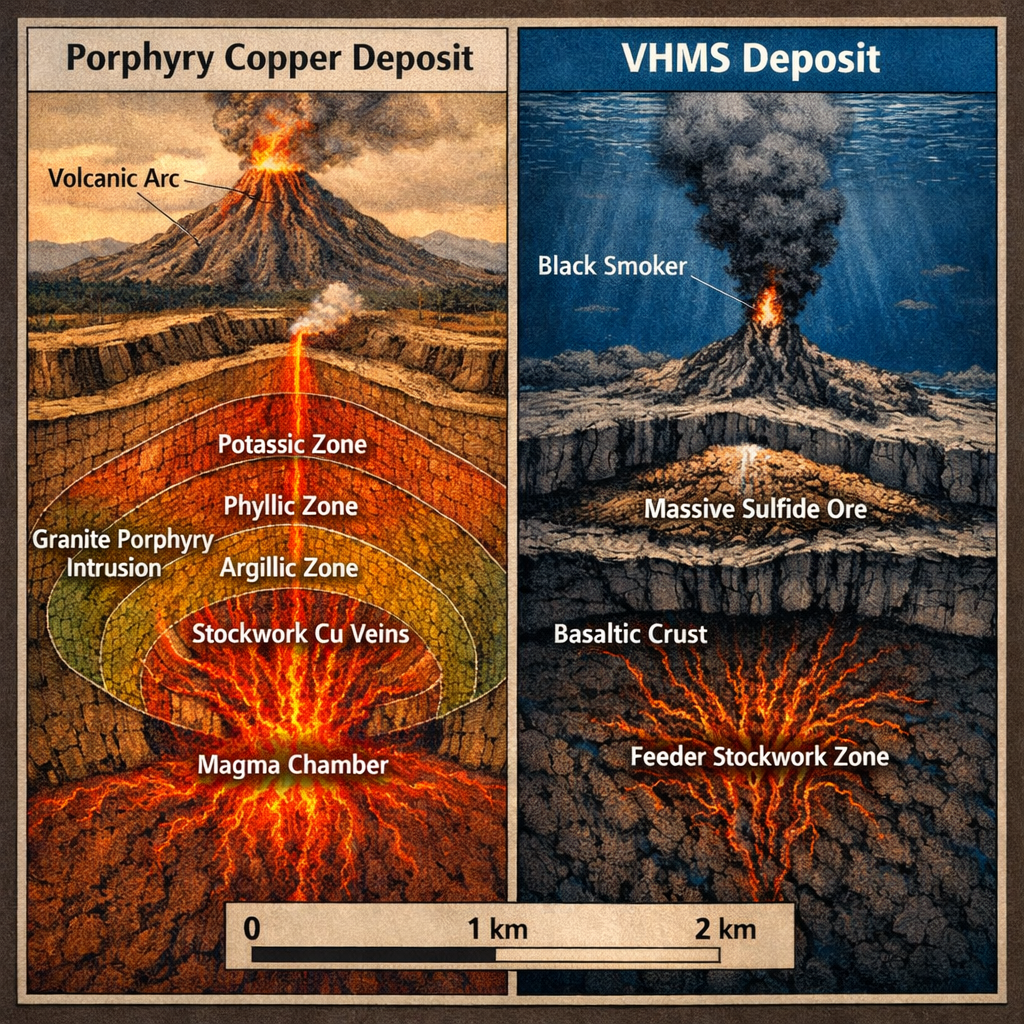
Porphyry copper and Volcanic-Hosted Massive Sulphide (VHMS) deposits represent two of the world’s most significant sources of base metals, yet they originate through distinct geological processes (Henley & Berger, 2000). While both are products of hydrothermal systems in magmatic arcs, their formation differs fundamentally in terms of tectonic environment, fluid sources, and depositional mechanisms.
Porphyry copper deposits typically form at convergent plate boundaries, particularly in continental or island arcs above subduction zones (Sillitoe, 2010). They are genetically linked to large-volume, intermediate-to-felsic porphyritic intrusions emplaced at relatively shallow depths of 2 to 5 km (Yang et al., 2023).
In contrast, VHMS deposits generally form in extensional tectonic settings, such as mid-ocean ridges or back-arc basins (Huston et al., 2010). Unlike the intrusive nature of porphyry systems, VHMS deposits are syngenetic, forming on or just below the seafloor in association with submarine volcanism (Almodóvar et al., 2019).
The primary distinction lies in the origin of the mineralizing fluids. Porphyry deposits are dominated by magmatic-hydrothermal fluids (Sillitoe, 2010). As large magma chambers cool, they release pressurized, metal-rich aqueous fluids that cause hydraulic fracturing, or “cracking,” of the surrounding rock (Henley & Berger, 2000).
VHMS systems are primarily driven by the convection of seawater (Huston et al., 2010). Seawater penetrates the ocean floor, is heated by underlying magmatic heat sources, and leaches metals from the volcanic and sedimentary host rocks. While some VHMS systems include a magmatic-hydrothermal contribution, the bulk of the fluid remains modified seawater (Huston et al., 2010; Almodóvar et al. 2019).
Porphyry deposits are characterized by disseminated and stockwork mineralization (veinlets) distributed over large volumes of rock (Sillitoe, 2010). They exhibit distinct concentric alteration zones, typically moving from a central potassic core to outer propylitic and phyllic zones (Yang et al., 2023).
VHMS deposits, however, form stratiform lenses of “massive” sulfide (over 60% sulfide content) directly on the seafloor or within porous sediments (Almodóvar et al., 2019). They are often identified by a vertical transition from a high-grade “stringer zone” (feeder pipes) to the overlying massive sulfide lens.
References
Almodóvar, G. R., Yesares, L., Sáez, R., Toscano, M., González, F., & Pons, J. M. (2019). Massive sulfide ores in the Iberian Pyrite Belt: Mineralogical and textural evolution. Minerals, 9(11), 653. https://doi.org/10.3390/min9110653
Henley, R. W., & Berger, B. R. (2000). Self-ordering and complexity in epizonal mineral deposits. Annual Review of Earth and Planetary Sciences, 28(1), 669–719. https://doi.org/10.1146/annurev.earth.28.1.669
Huston, D. L., Relvas, J. M. R. S., Gemmell, J. B., & Drieberg, S. (2010). The role of granites in volcanic-hosted massive sulphide ore-forming systems: An assessment of magmatic–hydrothermal contributions. Mineralium Deposita, 46(5), 473–507. https://doi.org/10.1007/s00126-010-0322-7
Sillitoe, R. H. (2010). Porphyry copper systems. Economic Geology, 105(1), 3–41.
Yang, F., Romer, R. L., Glodny, J., & Li, W. (2023). Magma and fluid sources in an intracontinental porphyry system: A case study of the Relin Mo–W(–Cu) deposit, southern Yidun terrane, SW China. Ore Geology Reviews, 163, 105761. https://doi.org/10.1016/j.oregeorev.2023.105761